If you need a quick decision: choose Fisherman’s Wharf or North Beach for easy tourist access and family-focused attractions; choose the Marina or Cow Hollow for quieter streets and parks; choose Union Square for convenience and transit links. That answer depends on whether you value short walks to kid-focused attractions, lower daily transit friction, or room configurations that fit three or four people. This guide lays out which neighborhood best matches your family’s priorities, explains how each area affects daily routing and how to think about room types and booking terms. Read the practical shortlists first to pick an area, then use the deeper sections to test tradeoffs against your trip rhythm and sleeping needs.

Check live stays in the areas that fit
Use your dates and party size to compare current rooms after you narrow the neighborhood fit.
Neighborhood fit: pick by daily priorities
Think of a neighborhood as a daily operating base. Fisherman’s Wharf and North Beach put you a short walk from kid-oriented stops—Aquarium of the Bay, Pier 39 sea lions, and frequent waterfront views—so you’ll save time on lower-energy days. The Marina and Cow Hollow place you near Crissy Field, spacious grass, and safe places for scooters and strollers, which is great if your family prefers relaxed afternoons and playground time. Union Square and the Tenderloin edge toward centrality: they shorten the distance to downtown restaurants, cable car lines, and large hotel lobbies that handle luggage and late check-ins well, which can be a big help with small children.
Match the neighborhood to how you plan to spend most days. If your itinerary centers on sightseeing loops that start and end on the waterfront, a Fisherman’s Wharf base reduces back-and-forth transit. If you want a mix of park time and neighborhood cafés with locals, the Marina or Cow Hollow give more residential calm. For families planning museum-heavy days or early train/airport connections, Union Square offers the most direct transit choices and a denser cluster of hotel services. Choosing by daily priorities keeps mornings and naps less stressful.
Choose an area-selection strategy
| Area approach | Best for | Tradeoff to check |
|---|---|---|
| Prioritize walkable tourist access (Fisherman’s Wharf/North Beach) | Families who want short walks to major attractions and minimal transit with kids | Can be crowded and more tourist-focused; quieter neighborhood character is reduced |
| Prioritize residential calm (Marina/Cow Hollow) | Families who prefer parks, open space, and quieter evenings close to waterfront strolls | Longer rides to downtown museums and some attractions; fewer large hotel chains |
| Prioritize transit convenience and central location (Union Square) | Families needing quick access to transit, shopping, and varied dining with lots of hotel services | Busier streets, less neighborhood feel, and potential for more noise and foot traffic |
| Prioritize apartment-style or rental stays | Larger families or those wanting kitchens, separate bedrooms, and laundry during multi-night stays | May be scattered across neighborhoods; service levels and check-in conditions vary widely |
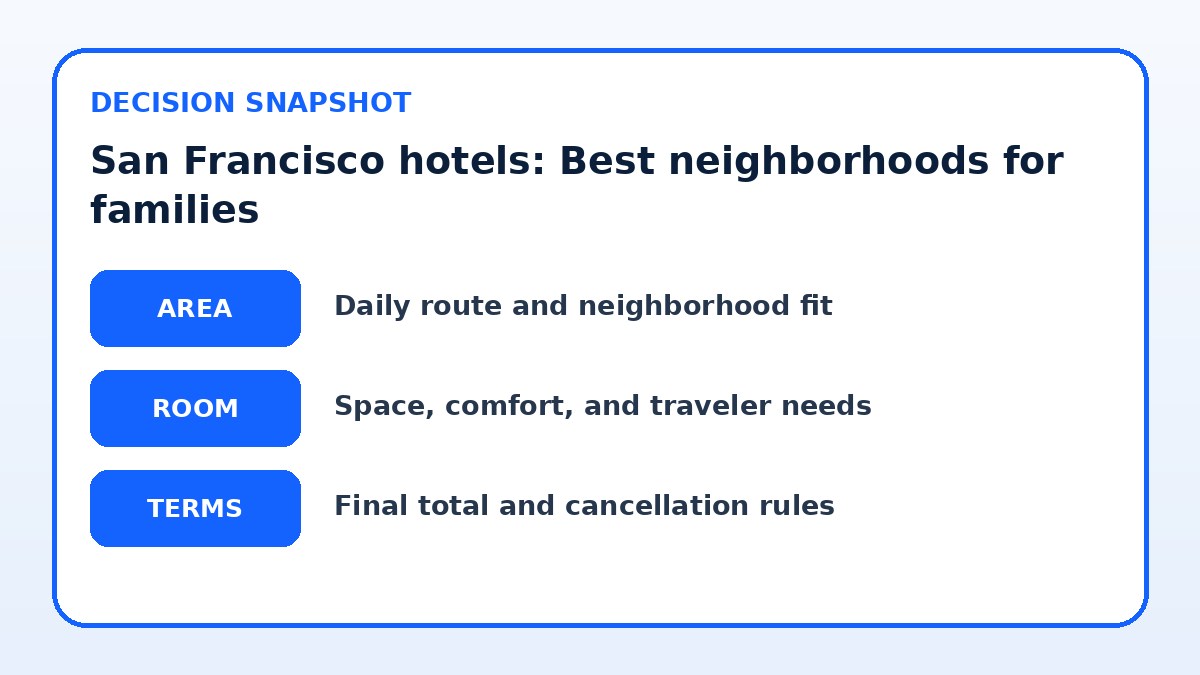
Daily-route friction: how each area affects moving around
San Francisco’s hills, traffic patterns, and transit stops produce different friction depending on where you stay. Fisherman’s Wharf and North Beach are flatter near the water and have a high concentration of sightseeing resources, which reduces walking time with kids but can feel crowded during popular hours. The Marina and Cow Hollow require more planning for trips to downtown museums or the Exploratorium; expect longer cab or transit rides rather than short walks. Union Square minimizes transfers for many downtown-bound trips and offers frequent transit links, though short walks in that area may include busy sidewalks and commercial traffic.
When comparing neighborhoods, map key daily legs: hotel to nearest breakfast spot, hotel to major attraction, and hotel to transit hub. If any of those legs include long uphill walks, plan for taxis or rideshares, which adds cost and time. Also check whether sidewalks and crossings are stroller-friendly; some waterfront promenades and park areas are easier to navigate than steep residential blocks. Balancing flat, walkable days against occasional longer transit journeys will make neighborhood selection much more practical for families with varied stamina.
Now compare like with like
Keep the same dates, guests, room needs, and cancellation preferences while you compare the final choices.
Room and party needs: choosing room types and services
Before you lock a neighborhood, decide what your party actually needs from the room. Young families often need a larger bathroom, space for a travel crib, and either a sofa bed or connecting rooms. Many hotels in Union Square and Fisherman’s Wharf have suites or family rooms marketed for groups; the Marina and Cow Hollow offer more apartment-style rentals and boutique hotels with living spaces. Confirm the hotel’s policy on cribs, extra beds, and maximum room occupancy—these policies vary widely and will determine whether a seemingly ideal neighborhood hotel can practically house your family.
Also consider in-hotel services that reduce daily friction: luggage storage for early arrivals or late departures, on-site breakfast options or kitchens, and laundry facilities for longer trips. If you value quiet evenings and early bedtimes, smaller boutique hotels in residential neighborhoods may be better than large central hotels that host tours and events. Whatever neighborhood you favor, check the provider’s final booking page for exact room dimensions, bed configurations, family extras, and any mandatory fees that apply to room amenities—these details are essential before your final purchase.

Hotel booking check before payment
- Map three daily routes from the hotel: to breakfast, to your top attraction, and to the nearest transit stop to estimate walk vs. transit time.
- Confirm exact room configuration and maximum occupancy on the hotel’s final booking page, including whether connecting rooms are guaranteed or by request.
- Read the hotel’s cancellation and deposit policy closely and screenshot or save the page showing the terms before you complete payment.
- Verify whether the hotel provides a crib, rollaway, or sofa bed and whether those items incur additional charges for children.
- Check luggage storage and early check-in/late check-out options if you have early arrivals or late departures scheduled.
- Compare multiple properties in your shortlisted neighborhood on a live booking site like Trip.com and then verify final terms with the hotel directly.
Final booking terms: what to check before you commit
When you’re ready to book, focus on terms that affect families: cancellation policy flexibility, whether breakfast is included or can be added for children, and charges for additional guests or rollaway beds. These conditions change often, so always verify them on the hotel’s live booking page or the vendor you choose to use. If you’re comparing multiple properties within a chosen neighborhood, line up the exact room types and read the small print on refunds, deposit amounts, and whether a credit card hold is applied on arrival. Those differences can outweigh a small nightly rate gap.
Also confirm logistics that matter on arrival day: airport-to-hotel transfer options, whether the hotel offers a shuttle or easy taxi access, and the hotel’s luggage-hold policy for early arrivals or late departures. For multi-room bookings, ask whether rooms will be adjacent or connecting—hotel descriptions sometimes list this as ‘available on request.’ Finally, if you use a travel platform like Trip.com to compare availability, treat it as one option to check live conditions and then verify final terms with the hotel before confirming.
Hotel Guide questions travelers ask
Which San Francisco neighborhood is easiest for toddlers and short stroller walks?
Fisherman’s Wharf and North Beach are generally easiest for toddlers because many attractions are clustered along flat waterfront promenades and piers. These areas reduce the need for hills and long transit hops, which makes mid-day naps and short outings easier. The Marina’s Crissy Field also offers wide, stroller-friendly paths and open grass for play, but it sits farther from downtown attractions. When choosing, check the walking surface and curb cuts near the hotel, and ask the hotel about stroller storage or nearby rental options if you plan multiple outings in a day.
Is Union Square a bad choice for families with young children?
Union Square is not a bad choice; it is a practical choice when families prioritize transit links, short taxi rides, and a wide selection of hotels that cater to group needs. The area is busier and more commercial than residential neighborhoods, which means sidewalks and streets can feel crowded and noisier in the evenings. If you want quick connections to trains, buses, or airport shuttles and plan for organized day trips, Union Square can reduce travel time. If you prefer quieter evenings and nearby parks, consider the Marina or Cow Hollow instead.
Should I book a suite, two connecting rooms, or an apartment for a family of four?
The right choice depends on ages and routines: suites or family rooms work well when you want everyone under one roof with some separation between sleeping and living areas, simplifying supervision. Two connecting rooms offer privacy for adults and children but confirm that connecting doors are guaranteed on booking. Apartment-style rentals provide kitchens and laundry, which are convenient for longer stays and picky eaters, but service levels and immediate support vary. Compare the final booking details—occupancy limits, extra-bed rules, and cleaning arrangements—before you commit.
Final decision note
Shortlist an area before you search inventory: decide whether flat, walkable access to attractions, residential calm, or transit convenience matters most for your family’s daily rhythm. Once you pick the neighborhood, use the checklist to verify room configuration, crib and extra-bed policies, cancellation terms, and luggage logistics on the hotel’s live page. If multiple hotels in your chosen neighborhood meet your needs, weigh quieter streets against proximity benefits and remember that a slightly longer transit leg may be worth lower daily friction at bedtime. Compare availability on a live site if you wish—then confirm final booking terms with the hotel directly to avoid surprises.
Continue planning
Check current options and final conditions
Use the provider page to confirm live availability, the final total, cancellation terms, and every condition that matters to your trip.
This evergreen planning guide was created with AI-assisted drafting and a structured quality review. It does not display live prices, schedules, availability, visa guidance, or provider rankings. Verify current details before booking. Some links are affiliate links; we may earn a commission at no additional cost to you.