If you need to go from Tokyo to Osaka on a single travel day, the practical answer is this: choose the mode that minimizes door-to-door friction for your schedule and luggage. For many first-time visitors that means a direct high-speed rail option if you value central terminals and minimal transfers, or an intercity coach if you need lower cost and don’t mind longer travel. Ferry combinations can be scenic but add transfers and timing complexity; flights exist but add airport transfers and security time that often outweigh savings. Start by comparing how each mode connects your accommodation and arrival point, how many times you will have to switch stations or luggage handlers, and what backup option you can reach within an hour. This article helps you make that choice, explains tradeoffs, and lays out the terminal, luggage, timing, and disruption checks you should do the day before and the morning of travel.
Choose the right mode for door-to-door practicality
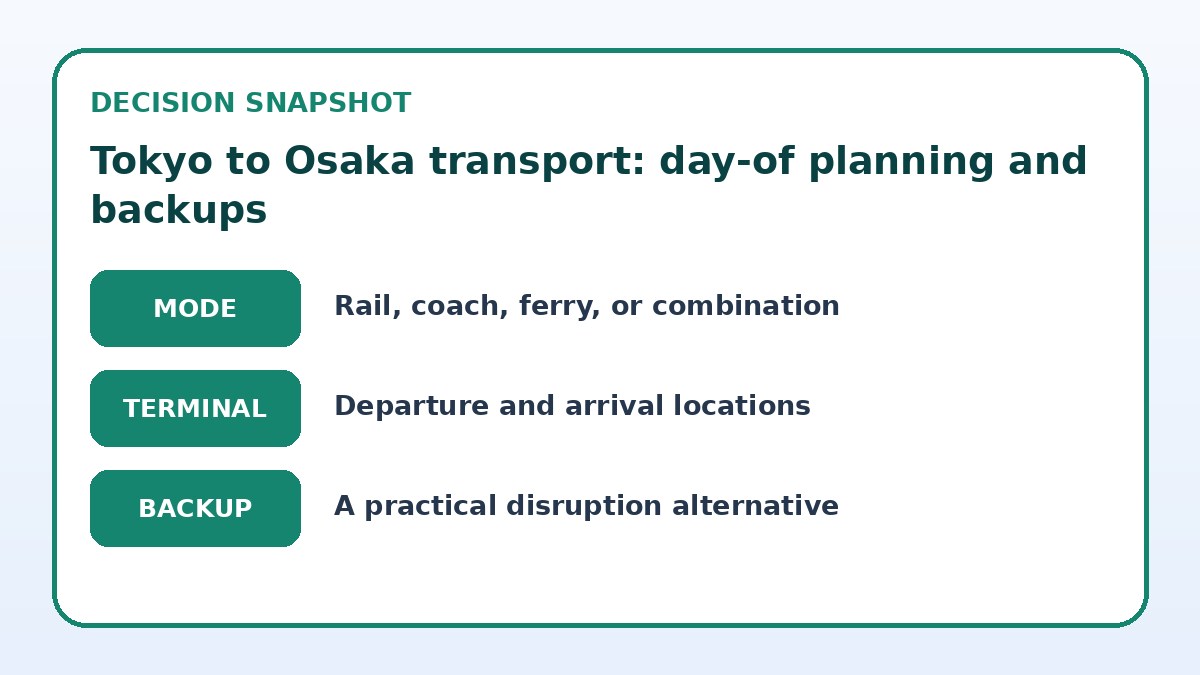
When deciding between rail, coach, ferry, plane, or a combination, think door-to-door rather than just the advertised journey time. Map the walking, subway or taxi legs from your Tokyo accommodation to potential departure terminals and from Osaka arrival points to your final address. A faster ride that starts or finishes far from where you actually need to be can cost you time and stress. Consider how each option drops you into central or peripheral stations: central terminals usually make onward transfers easy, while peripheral airports or bus terminals often require longer last-mile transfers.
Also compare luggage handling and transfers. A direct rail service that departs from a station a short subway ride away and delivers you to central Osaka is often the simplest single-ticket solution. Coaches may stop closer to budget hotels or near major bus hubs and can be cheaper if you are flexible on timing. Flights and ferries can work if your pickup or drop-off points are near air or sea terminals, but those add security or boarding steps and often bigger transfer windows. Lay out the entire chain of steps for each mode before you book.
Choose the end-to-end journey plan
| Journey approach | Best for | Friction to check |
|---|---|---|
| Prioritize fastest scheduled ride (usually high-speed rail or flight) | Travelers with tight intercity time needs and central drop-off requirements | May start or finish at terminals that add significant transfer time or require extra luggage handling |
| Prioritize lowest number of transfers (direct rail or direct coach) | Visitors who value simplicity and minimal station navigation | Could be slower than multi-leg options that use faster segments like flights or express trains |
| Prioritize cost and flexibility (coaches or flexible multi-operator tickets) | Budget-conscious travelers who can accept longer travel and variable departure times | Lower cost often means longer journey times and higher sensitivity to traffic or schedule gaps |
| Prioritize scenic or mixed routes (ferry+train or regional detours) | Travelers who want an experience en route and have relaxed schedules | Adds transfers and timing complexity, increasing the chance of delays affecting downstream plans |
Check live intercity options
Look beyond the ride itself and compare terminals, transfers, luggage, and arrival fit.
Terminal fit and transfer friction: map every step
Terminal fit means how well the departure and arrival points match your on-the-ground needs. For each candidate departure choose a station or terminal and list the transit legs required: walk, subway, taxi, or shuttle. Note whether elevators and escalators are available if you have heavy luggage or mobility concerns, and whether you’ll need to navigate multiple concourses. If walking between platforms requires leaving and re-entering paid areas, that increases complexity and may require extra ticketing steps.
Transfer friction is about time and effort at each handoff. Count the number of times you will move bags between vehicles or staircases. If you must change trains, check whether you need to cross platforms or exits; if your transfer includes a bus or ferry, allow extra time for boarding queues. Aim to eliminate at least one transfer if possible—sometimes choosing a slightly slower direct option reduces overall effort and uncertainty. Before booking, confirm the precise terminal names and platform areas on the provider’s final booking page or station maps.
Timing flexibility: when to depart and how much buffer to allow
Plan departure and arrival windows, not specific minutes. Identify a range of departures that meet your schedule and pick one with a comfortable buffer for delays on the approach to the terminal. If you are traveling on a tight schedule—connecting to a tour, check-in deadline, or evening reservation—choose an earlier departure and build in a cushion for crowding or slow station movement. Consider peak commuting hours in Tokyo and periodic crowd surges; these can make short transfers take much longer than advertised.
Also build flexibility into your day by picking services that run frequently or have several departures near your preferred time. If you must travel on a fixed departure, keep a backup option that departs at a different time or from a different terminal. When comparing options, verify frequency and earliest/latest departures on the operator’s final booking page before paying. Trip.com can be used to check current availability and connection options, but verify terminal details with the transport provider.
Compare the practical alternatives
Use the final page to confirm what is actually offered on your dates and save a workable fallback.
Intercity travel checklist
- Map walking, subway, or taxi legs from your accommodation to the chosen departure terminal and from the arrival point in Osaka to your final address.
- Measure and test-carry your luggage through stairs or station concourses; switch to smaller bags or arrange forwarding if transfers are awkward.
- Save screenshots of your booking, terminal maps, platform numbers, and an alternative departure on your phone for offline use.
- Check multiple departure times and pick one with at least a 30–60 minute buffer for unexpected delays en route to the terminal.
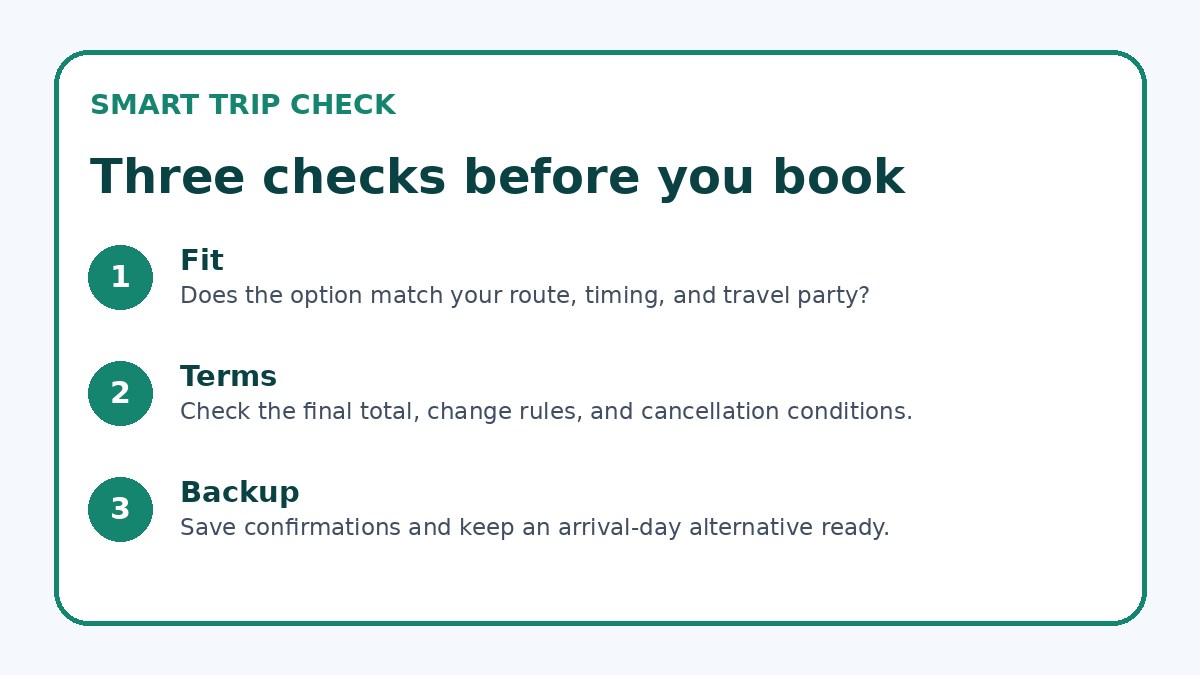
- Confirm rebooking or refund rules on the provider’s final booking page so you know your options if changes are needed.
- Prepare an essentials carry-on with documents, chargers, medications, and an outfit change in case checked luggage is delayed.
Disruption backup and simple contingency planning
Create a short, clear backup plan you can execute if your primary service is delayed or canceled. Choose one realistic alternative within roughly an hour’s travel—another train from the same station, a coach from a nearby terminal, or an earlier high-frequency regional service. Keep alternative departure times and terminal names saved on your phone, and screenshot or print confirmation pages and route maps in case mobile service is unreliable. If you rely on reserved seats, check the provider’s rebooking rules on their final booking page before travel.
Prepare a fail-safe for luggage: if your plan depends on carrying heavy bags through multiple transfers, consider a luggage-forwarding service or switch to smaller, manageable bags. Keep essential items—medication, chargers, a change of clothes—in a carry-on so a lost or delayed suitcase won’t derail your day. Finally, register any onward rendezvous or hotel check-ins with expected arrival windows so hosts know your plan if disruptions occur.
Rail & Intercity Transport questions travelers ask
How do I decide between the train and a coach for Tokyo to Osaka transport?
Start by mapping where each option departs and arrives relative to your lodgings. If a train departs from a station easily reached by subway and arrives at central Osaka stations, it usually reduces transfers and walking. Coaches may be cheaper but often stop at bus terminals that require extra local transit. Compare the number of transfers, expected walking with luggage, and how each option fits your arrival time at your Osaka destination. Verify terminal details and frequency on booking pages before you finalize.
What should I pack and prepare for the travel day to reduce stress?
Pack a compact carry-on with essentials: travel documents, a phone charger, medication, a small change of clothes, and snacks. Wear shoes that are comfortable for walking through stations and up stairs. Attach a clear, legible luggage tag and consider a luggage strap for easy handling. Prepare cash and an IC card or local transit payment method to speed transfers. If you expect to use elevators or accessible pathways, check station layouts and allocate extra time for boarding and disembarking.
If my booked departure is canceled, what simple backups should I plan?
Have one or two alternate departures saved that you can reach quickly from your location, and note the terminal names for each. If seats are reserved, learn the provider’s rebooking rules on their final booking page and carry evidence of purchase. Keep contact details for your accommodation or local host so they can adjust arrival expectations. If public transport options are time-sensitive, identify a nearby coach terminal or a later train that runs frequently and can absorb delayed passengers.
Final decision note
Planning Tokyo to Osaka transport as a first-time visitor is mainly about minimizing friction between door and door, not chasing the fastest headline travel time. Choose the option that keeps transfers low, fits your luggage needs, and drops you close to where you need to be in Osaka. Build timing buffers, map every leg of the day, and prepare one reachable backup departure so a delay won’t cascade into missed plans. Before you book, verify terminal names, transfer details, and rebooking rules on the provider’s final booking page; you can also check current availability and routing on Trip.com as a starting point. With a clear door-to-door plan and a simple contingency, your travel day will run more smoothly and leave you free to enjoy Osaka.
Continue planning
Check current options and final conditions
Use the provider page to confirm live availability, the final total, cancellation terms, and every condition that matters to your trip.
This evergreen planning guide was created with AI-assisted drafting and a structured quality review. It does not display live prices, schedules, availability, visa guidance, or provider rankings. Verify current details before booking. Some links are affiliate links; we may earn a commission at no additional cost to you.