If you’re arriving in New York City with extra luggage—bulky sports gear, shipping boxes, or oversized suitcases—deciding whether to rent a car comes down to convenience versus cost and city friction. Driving can be a practical choice if you need door-to-door transport, flexibility for outer-borough pickup, or a base for day trips upstate. But fuel policies, mileage allowances, and return rules can add substantial cost and complexity if you don’t check them before you book. This guide gives you the practical answer up front: rent a car only if the time saved, luggage needs, or onward route clearly outweigh parking hassles, tolls, and local driving restrictions. Otherwise choose a non-driving option and plan luggage logistics carefully. Below you’ll find how to weigh route value, read insurance and fuel wording, spot pickup/return friction, and a ready fallback so extra baggage doesn’t derail your plan.

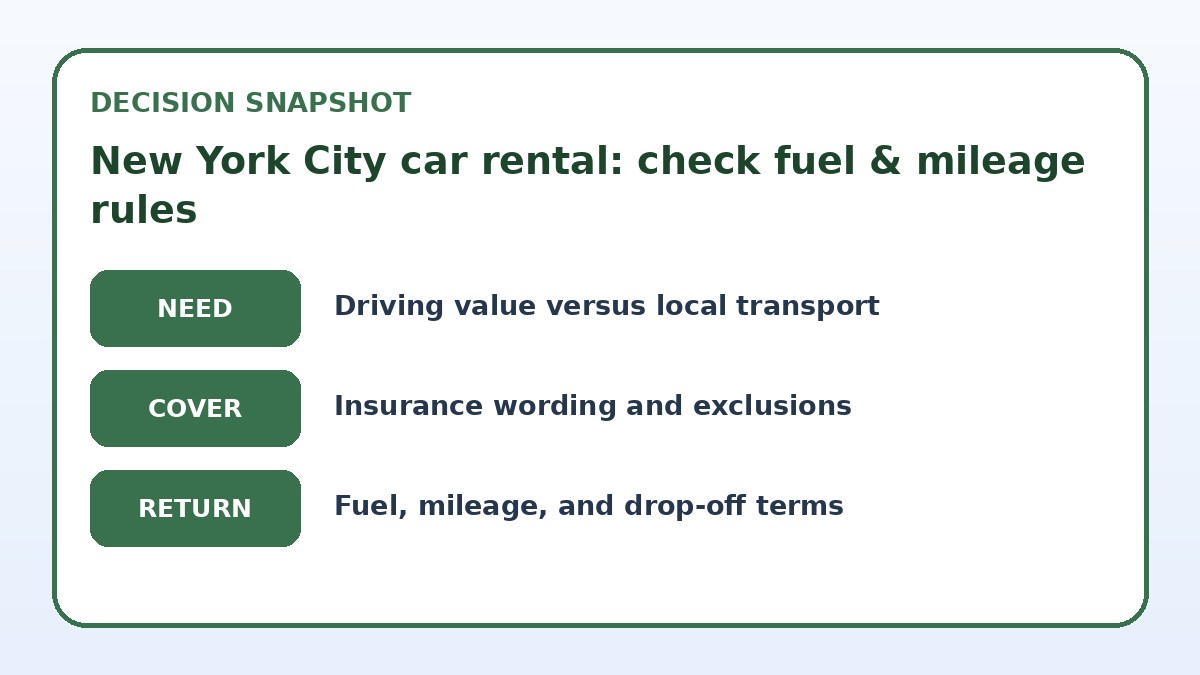
Decide whether driving improves your New York City plan
Start by mapping the core of your itinerary: will most of your time be inside Manhattan or spread across boroughs and beyond? If your schedule includes multiple points with heavy luggage—unloading at an Airbnb then heading out for a day trip to the Hudson Valley or New Jersey—having a car can save multiple rideshare charges and simplify moving bulky items. Compare that convenience to the friction of parking garages, narrowed streets, and rush-hour congestion. If you’re staying in a Midtown or Lower Manhattan hotel, the effort of curbside unloading plus garage fees often outweighs the door-to-door benefit.
Also weigh the route value of any planned day trips. A car is far more valuable if it replaces two or more long, complicated public-transit legs or if you must reach destinations not well served by trains (e.g., remote parks, some suburbs). For short intra-Manhattan hops, transit plus occasional rideshare is usually faster and cheaper. List your stops and estimate door-to-door times with and without a rental—this practical comparison should be the primary driver in your decision.
Decide whether driving earns its place
| Mobility strategy | Best for | Cost or friction to check |
|---|---|---|
| Rent a car for full trip | Travelers needing heavy, frequent luggage moves and flexible day trips beyond NYC | Higher parking, toll, and fuel risk; complex insurance and return logistics |
| Rent only for day trips | Visitors based in the city wanting a car for specific outings outside the metro area | Extra pickup/return steps and possible one-way fees; luggage transfer to pickup location needed |
| Rideshare/van services on demand | Short city transfers with bulky items and no overnight car need | Cost accumulates with multiple rides; availability varies and large-van supply can be limited |
| Public transit plus luggage storage | City-only itineraries where cost and parking are primary concerns | More handling of bags and potential convenience loss when moving between stations and storage sites |
Check live rental choices only after the route test
Use the exact driver, dates, pickup point, and return plan to compare current conditions.
Read fuel and mileage rules carefully before booking
Fuel policies vary: some companies expect you to return the vehicle with a full tank, others sell a pre-paid fuel option, and some charge a refueling fee based on market rates. For travelers with extra luggage, pre-paid fuel might seem convenient, but it can cost more than local prices if you don’t use the tank. Conversely, returning with less than the promised fuel level can trigger expensive refuel service charges. Always note whether the rental uses a full-to-full or full-to-empty policy and whether electronic fuel receipts are accepted at return.
Mileage allowances matter if you plan to travel outside the city. Unlimited miles are common for local rentals but not guaranteed for specialty vehicles or certain cross-border trips. If there’s a per-day cap, calculate expected miles for pickups, transfers, and day trips; excess miles are billed per mile and can add up quickly. On the provider’s final booking page, verify the fuel policy wording, the per-mile charge for overages, and how the company measures return mileage (odometer vs. GPS).

Compare the full rental conditions
Confirm insurance wording, exclusions, deposit, fuel, mileage, and return terms on the final page.
Check insurance wording and pickup/return friction
Insurance terminology can be confusing. Basic rates often exclude collision damage waivers (CDW), super CDW, or supplemental liability insurance. If you have a credit card that offers rental coverage, confirm the card’s country and vehicle restrictions and whether it covers loss-of-use, administrative fees, and deductibles. For drivers with extra luggage, also confirm whether the policy covers items left in the vehicle and whether personal effects insurance is included or needs a separate policy.
Pickup and return logistics in New York City can create hidden costs: airport pickups may use off-site lots with shuttle transfers, and returns during peak hours can mean long queues. Find out if the rental location has curbside handoff, whether luggage carts are available, and what the after-hours drop-off process is. For one-way rentals, check whether drop-off locations charge one-way fees. On the provider’s final page, verify hours, exact pickup address, shuttle details, and any after-hours key-drop procedures.
Car rental terms to verify
- Confirm the rental fuel policy (full-to-full, pre-paid, or billed at return) and estimate refill cost based on tank size and expected usage.
- Verify mileage allowance and per-mile overage fees if your plan includes day trips beyond the metro area.
- Check insurance inclusions and exclusions, then confirm any credit-card coverage limits and required documentation for claims.
- Ask the rental provider about pickup and drop-off hours, shuttle needs, luggage cart availability, and after-hours key drop procedures.
- Compare garage and curbside parking options at your accommodation and estimate daily parking fees and congestion charges.
- If not driving, pre-book a large-capacity rideshare, transfer service, or short-term luggage storage and confirm baggage size/weight rules.
Plan a non-driving fallback and luggage strategies
If driving is more friction than benefit, have a fallback that handles extra luggage smoothly. Pre-book an airport-to-hotel transfer that accommodates oversized bags, reserve a large-capacity rideshare or van for the heaviest legs, or use short-term luggage storage at a terminal or a nearby facility. For city-to-city legs, consider express coach or Amtrak with checked baggage options; these can be simpler than fighting Manhattan parking.
Also think in layers: ship items ahead, consolidate bags into fewer hard-shell cases, or split bulky items among travelers to stay within ride or train baggage limits. If you find a rental tempting as backup, consider booking a free-cancellation option but confirm the provider’s cancellation window and fuel/mileage wording before finalizing. You can also compare availability and booking conditions on Trip.com as one place to view current options, but always read the provider’s final booking terms.
Car Rental & Road Trip questions travelers ask
Can I buy the rental company’s pre-paid fuel and save time when returning the car?
Pre-paid fuel can save you time at return because you won’t need to stop and refuel, but it’s not always the cheapest option. Providers price this convenience above local pump rates to cover administrative costs. If you drive less than a full tank or can refill near the drop-off at normal prices, returning full often costs less. On the provider’s booking page, check the pre-paid fuel wording, whether refunds are given for unused fuel, and how the company calculates refuel charges when you return with less than the promised level.
How do mileage caps work and when should I expect extra charges?
Mileage caps set a daily or total limit on included miles; exceeding that limit incurs a per-mile charge shown in the rental terms. Caps are common on specialty vehicles or specific promotional rates. To avoid surprises, estimate miles for airport transfer, hotel moves, and any day trips, then compare that total to the allowance. If you expect to exceed it, look for an unlimited-mileage option or pre-purchase additional miles and confirm the provider’s method for measuring mileage on their final page before booking.
Will my credit card cover rental insurance and lost luggage?
Many premium credit cards offer secondary or primary rental coverage, but each policy has limits and exclusions—often excluding certain vehicle types, non-domestic rentals, or loss-of-use charges. Credit cards typically do not cover personal effects left in the car; that requires personal property or travel insurance. Before relying on card coverage, read the card’s rental insurance certificate, check if it applies in New York State, and ask the rental company what documentation they require for claims. Confirm these details on both the card issuer’s site and the rental provider’s booking page.
Final decision note
For travelers with extra luggage, a New York City car rental can be a real convenience—but only when the saved time and flexibility outweigh city costs and administrative friction. Start by listing your exact stops, luggage needs, and any off-city legs; then compare door-to-door times and tally parking, tolls, fuel, and likely over-mileage charges. Read insurance and fuel wording thoroughly on the provider’s final booking page and verify pickup/return logistics so you aren’t caught by after-hours procedures or shuttle transfers. If driving isn’t clearly better, pick a non-driving plan that handles oversized bags—pre-booked transfers, large-capacity rideshares, or short-term storage—to keep your trip moving smoothly without the hidden costs of a city rental.
Continue planning
Check current options and final conditions
Use the provider page to confirm live availability, the final total, cancellation terms, and every condition that matters to your trip.
This evergreen planning guide was created with AI-assisted drafting and a structured quality review. It does not display live prices, schedules, availability, visa guidance, or provider rankings. Verify current details before booking. Some links are affiliate links; we may earn a commission at no additional cost to you.