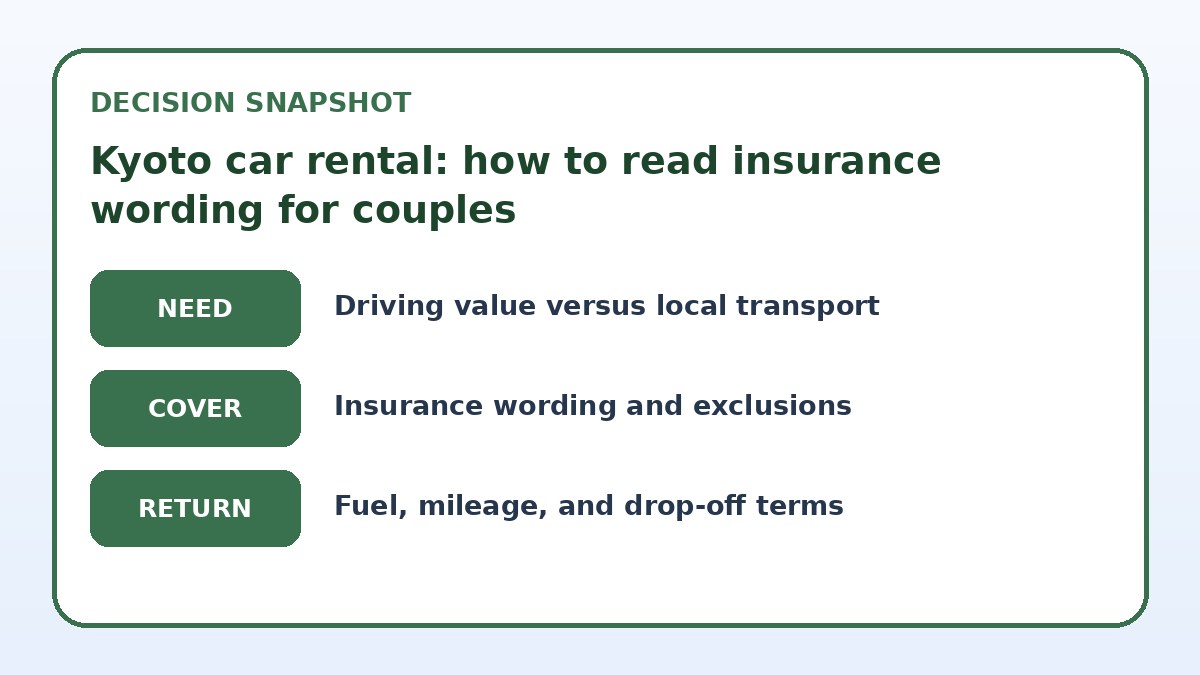
Practical answer first: for most couples visiting central Kyoto, driving rarely improves the core sightseeing plan; rely on public transit and taxis. Consider renting a car if you and your partner plan day trips to rural destinations—like northern Kyoto prefecture temples, Amanohashidate, or small coastal towns—where transit is infrequent or connections are long. If you do rent, the wording in insurance and supplemental coverages directly affects your liability, peace of mind, and whether you can legally drive on narrow rural roads or take the car across prefectural borders. Read the policy text for collision, third-party liability, personal accident, and roadside assistance, and compare deductibles, exclusions, and named-driver rules. Below you’ll find how to judge route value, decode common insurance phrasing, handle pickup/return friction with your partner in mind, and a fallback plan if driving looks like more trouble than it’s worth.
Route value: when a car adds real advantages
A car matters when your couple’s itinerary includes places that are time- or connection-poor by rail or bus. Think sparse rural temples, mountain roads, small coastal towns, and multi-stop day routes that require many transfers. Driving can compress travel between points, let you start earlier or stay later, and open lesser-served attractions where a 30–60 minute bus cadence would waste an entire day. Also consider luggage: moving between ryokan or family-run inns with limited public-transit access can be far easier with private transport.
Balance those advantages against parking and local access. Central Kyoto’s historic districts are compact and pedestrian-friendly, and parking is limited and sometimes costly; using a car for downtown sightseeing often causes more friction than benefit. For couples who value photography stops, spontaneous detours, or traveling with bulky gear (bikes, picnic supplies), a rental becomes more appealing. If your planned day routes consistently show more than one long connection or a combined travel time saving of an hour or more over public transit, the car’s flexibility is likely worth the added insurance review and fees.
Decide whether driving earns its place
| Mobility strategy | Best for | Cost or friction to check |
|---|---|---|
| Rent a car with full supplemental waiver | Couples doing multiple rural day trips with heavy luggage or flexible timing | Higher cost and more pickup/return paperwork; check exact waiver wording and exclusions |
| Standard rental with basic insurance | Couples on a tight budget who limit driving to well-maintained roads | Lower upfront cost but higher deductible and possible exclusions for tires or undercarriage |
| Public transit plus taxis/private transfers | Couples focused on central Kyoto and a handful of remote stops without driving stress | Less flexibility for spontaneous detours and dependent on timetables; potentially higher last-mile cost |
| Hybrid: short-term rental or day hire for single excursions | Couples who want one rural day trip without a full multi-day rental | Need to coordinate pickup times and likely pay extra for mid-day insurance or mileage packages |
Check live rental choices only after the route test
Use the exact driver, dates, pickup point, and return plan to compare current conditions.
Insurance wording: the phrases you must decode
Start by identifying the core coverages the rental lists: Collision Damage Waiver (CDW) or Loss Damage Waiver (LDW), third-party liability, personal accident insurance, and roadside assistance. Don’t stop at the headings—read the definitions and the exclusions. Pay attention to the deductible (excess) and whether supplemental waivers reduce it. Key phrases to flag include “named drivers only,” “off-road or unpaved road exclusion,” “mountain road limitation,” and “tort liability exclusions.” These can determine whether damage from narrow rural lanes, stone walls, or gravel outlines is covered.
Also check how the policy handles single-car accidents, theft with forced entry, and glass or tire damage—some waivers exclude tires, windshields, or undercarriage claims unless you buy extra cover. Notice wording about “cross-border” or “prefectural” restrictions if you plan to leave Kyoto Prefecture, and whether roadside assistance response times or towing limits are specified. If jargon or ambiguity remains, copy the exact clauses and ask the provider for plain-language confirmation before you finalize the booking. On the provider’s final booking page verify these exact terms and any quoted excess amounts.
Compare the full rental conditions
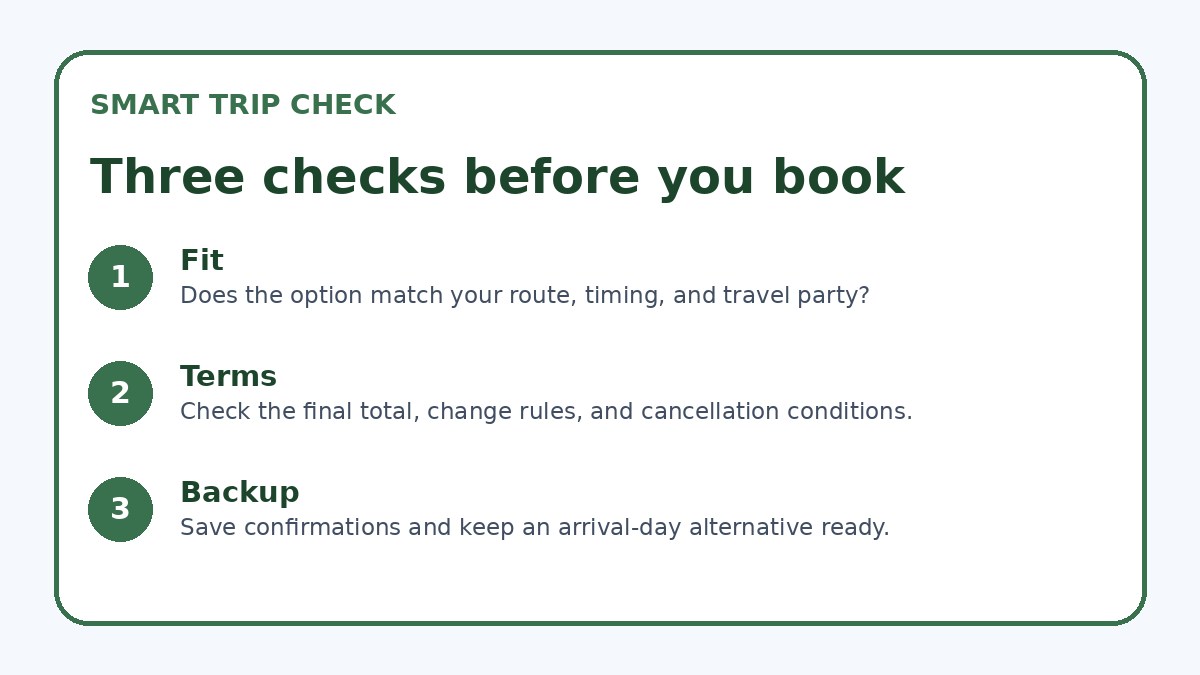
Confirm insurance wording, exclusions, deposit, fuel, mileage, and return terms on the final page.
Pickup and return friction: what couples should decide in advance
Pickup and return are where most disputes and unexpected costs happen. Couples should agree beforehand who will perform the inspection, where to photograph the car, and how to document fuel and mileage. Rental agreements often include clauses like “pre-rental inspection to be completed by renter” or “fuel charge for missing fuel.” These create friction unless you set a simple shared routine: take time-stamped photos of every angle, note existing scratches on the inspection form, and confirm the agreed fuel level in writing or via the provider’s app.
Plan the logistics around airport or station counters too: some contracts list separate fees or different insurance options for off-hour pickups and returns. If one partner will handle returns while the other flies out earlier or stays longer, confirm how final inspection and settlement work—some providers allow immediate electronic check-out with photos, others require a staff inspection. Always verify on the provider’s booking page whether drop-off at different locations is permitted and how any after-hours drop-box process affects claims or documented damage.
Car rental terms to verify
- Collect screenshots or PDF copies of the exact insurance clauses (deductible, named-driver rules, exclusions) shown on the booking page.
- Agree who inspects the car and take time-stamped photos of all sides, the dashboard, and any pre-existing damage before driving away.
- Confirm whether your international driving permit, domestic license translation, or passport must be presented and recorded at pickup.
- Ask the provider to explain any “off-road,” “unsealed roads,” or “mountain roads” exclusions in plain language and note the response.
- Verify fuel and mileage policies, after-hours drop-off procedures, and how final inspection is documented on the provider’s page.
- Plan a rail-plus-taxi backup for each driving day and pre-book transfers for the most remote or time-sensitive segments.
Non-driving fallback: how couples keep plans flexible without a car
If insurance exclusions, high deductibles, or narrow-road risks make renting unattractive, couples can still see much of Kyoto and surrounding areas using trains, buses, and targeted taxis. Rail covers central Kyoto, Arashiyama, Fushimi Inari, and regional hubs; for farther-out rural spots, identify local bus timetables and arrange a single private transfer or taxi for the final mile. Splitting transportation—train to a town, then a booked taxi for the rural segment—is often cheaper and simpler than a full-day rental once insurance and parking hassles are included.
Prepare a flexible itinerary with prioritized day trips so you can swap a planned driving excursion for a well-timed rail-plus-taxi alternative if weather or wording in the rental policy looks risky. Use online timetables and station maps to check how many transfers a public-transit option requires and pre-book taxis for late finishes or remote drop-offs. Trip.com can be used to compare current availability for cars and transfers, but always verify insurance and cancellation terms on the actual provider’s page before you commit.
Car Rental & Road Trip questions travelers ask
If a contract mentions a deductible, how does that affect our out-of-pocket costs after an accident?
A deductible (or excess) is the amount you and your partner would pay before any waiver or insurer covers the remaining damage. If the booking page shows a deductible of X, you could be responsible for that full amount after a claim. Supplemental waivers sometimes reduce or eliminate the deductible; confirm whether the waiver applies to tires, windscreen, underbody, and single-vehicle incidents. On the provider’s final page, verify the exact deductible amount, how it is charged (blocked hold or billed after the claim), and whether a purchase on arrival or prepayment reduces it.
What does “named drivers only” mean and why does it matter for couples sharing driving duties?
“Named drivers only” means the rental contract covers only those individuals explicitly listed on the agreement. If one partner drives but isn’t named, the insurer may refuse a claim, leaving the couple fully liable for damage. Always list both partners if both plan to drive, and confirm whether there is a fee or documentation requirement to add a second driver. On the booking page, check who is accepted as an additional driver (age limits, license types) and whether adding them changes insurance terms or costs.
Are there common exclusions related to narrow rural roads or undercarriage damage we should watch for?
Yes. Many rental agreements exclude damage from unpaved roads, steep mountain routes, or narrow lanes common in rural Japan; they may also exclude undercarriage and tire damage unless you buy extra cover. These exclusions can be decisive for couples planning country drives because they shift significant risk back to renters. When you see language about 'unsealed roads' or 'off-road use,' request clarification and consider either buying an extended waiver that explicitly covers those scenarios or choosing a non-driving alternative for that day. Always verify the exact exclusion wording on the provider’s final booking page.
Final decision note
For couples visiting Kyoto, driving is a tool best used selectively: it unlocks remote and flexible day trips but introduces insurance wording and logistical friction you must understand before you sign. Read the fine print for deductibles, named-driver rules, and exclusions related to unpaved or mountain roads; verify how pickup and return inspections are handled and who covers what in a claim. If the contract’s exclusions or excesses feel risky, opt for rail plus taxis or a single-day rental for a specific excursion. Take photos, copy the exact clauses, and confirm ambiguous language with the provider on the booking page so you and your partner can enjoy Kyoto with control and minimal disputes.
Continue planning
Check current options and final conditions
Use the provider page to confirm live availability, the final total, cancellation terms, and every condition that matters to your trip.
This evergreen planning guide was created with AI-assisted drafting and a structured quality review. It does not display live prices, schedules, availability, visa guidance, or provider rankings. Verify current details before booking. Some links are affiliate links; we may earn a commission at no additional cost to you.