Short answer: for most Seoul business travelers, a rental car is necessary only when your schedule includes suburban client visits, early-morning trips to Incheon-area sites, or team logistics that public transport and taxis can’t handle. Central business districts—Gangnam, Yeouido, Jongno—are well served by subway lines, buses, and plentiful taxis; parking and traffic during weekdays can nullify time savings. This guide helps you decide by weighing route value (where you need to go), insurance and liability wording you must verify, pickup and drop-off friction at airports and downtown offices, and a realistic non-driving fallback. Read the checklist and comparison rows to match a mobility approach to your exact itinerary, then check provider pages for final booking details such as insurance wording, fuel policies, and return locations.

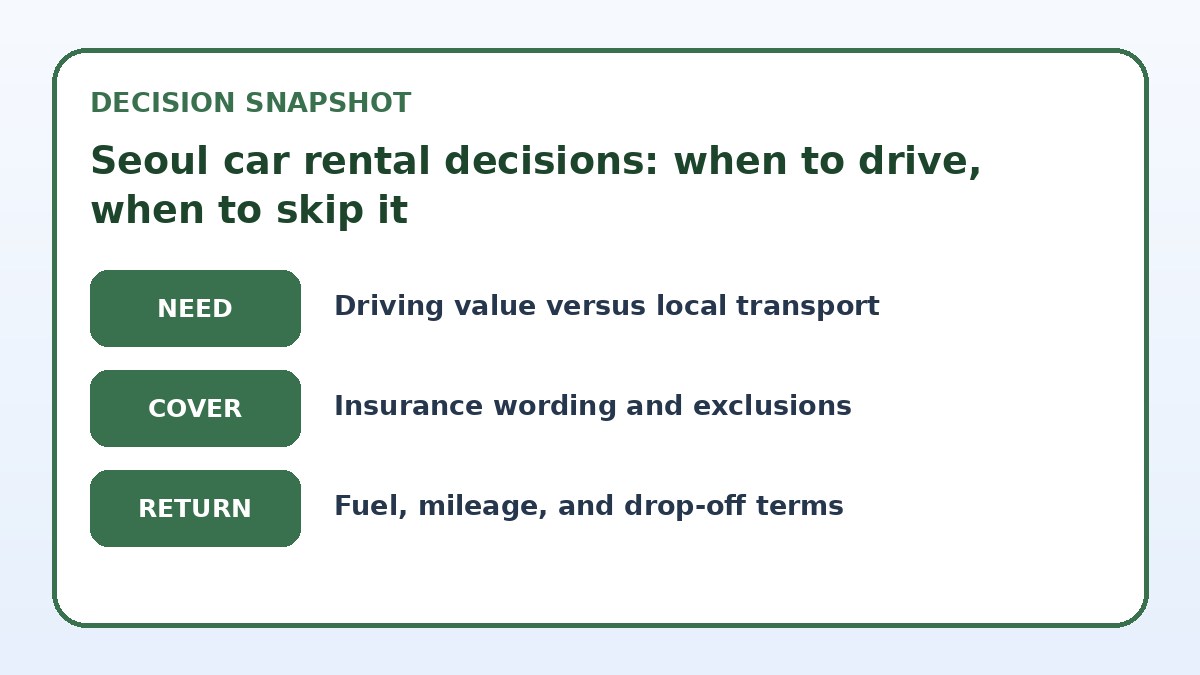
Route value: map the trips that justify a car
Start by plotting every appointment, hotel, and event on a map and timing each trip by public transport and taxi during your planned meeting hours. If your itinerary clusters in central Seoul—areas like Myeongdong, Gangnam, Jongno, and Yeouido—mass transit covers them efficiently. Driving can become a liability if surface streets are congested or if your schedule depends on short inner-city hops; travel time variance in traffic often makes taxis or the subway more predictable for single-person trips.
A car adds measurable value when you have multiple off-hours visits to outer districts (e.g., tech parks, factories, client offices in Gyeonggi-do), when moving bulky samples or equipment, or when your schedule requires early-morning or late-night travel where subway service is limited. Also consider hotel parking availability and meeting locations with secure parking; the administrative cost and time to find parking can erase any perceived flexibility a car provides.
Decide whether driving earns its place
| Mobility strategy | Best for | Cost or friction to check |
|---|---|---|
| Self-drive rental (compact/business car) | Travelers needing precise control over timing and multiple suburban stops. | Higher parking and congestion stress plus insurance questions you must resolve before booking. |
| Chauffeured rental or car with driver | Executives who want door-to-door scheduling without local driving or parking concerns. | Higher cost and less flexibility for last-minute personal errands; verify driver hours and overtime policies. |
| Public transport plus taxis | Single-person meetings inside central Seoul where predictability and cost-efficiency matter. | Not practical for bulky cargo, early starts before subway service, or multiple dispersed suburban visits. |
| Hybrid approach (rent only for specific days) | Trips with a mix of central and occasional suburban obligations where rental days are targeted. | Requires extra planning and coordination to pick up/drop off vehicles; possible additional fees for multiple rentals. |
Check live rental choices only after the route test
Use the exact driver, dates, pickup point, and return plan to compare current conditions.
Insurance wording: what to verify before signing
Insurance and coverage terms vary; never assume standard global policies apply. Verify the rental agreement for liability limits, collision damage waiver (CDW) terms, and whether the CDW includes theft protection and roadside assistance. Look specifically for exclusions—drivers under a certain age, passengers’ coverage, and damage to tires or undercarriage are common gaps. If your company policy reimburses rentals, confirm whether it requires the company’s insurer to be primary or if you must use corporate credit-card coverage.
If you plan to cross provincial borders or drive toward the DMZ-adjacent areas, check cross-border restrictions and regional exclusions. Also confirm what documentation the provider requires for claims (police reports, local language forms) and how claim disputes are handled. When in doubt, capture screenshots of contract pages and request written confirmation from the provider; the final booking page should show the exact insurance wording and optional coverages you intend to purchase.
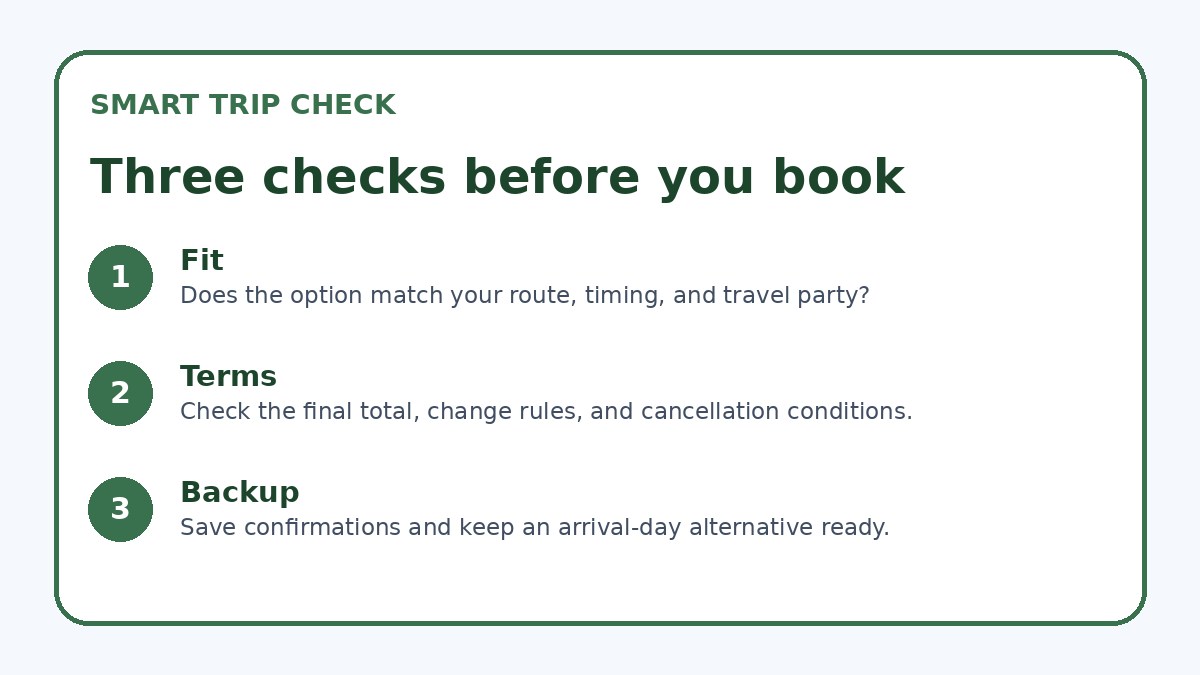
Compare the full rental conditions
Confirm insurance wording, exclusions, deposit, fuel, mileage, and return terms on the final page.
Pickup and return friction: airport vs. downtown options
Airport pickup at Incheon or Gimpo is convenient when you’re arriving on a long flight, have luggage, or need to depart immediately to a suburban meeting. However, airport counters often have queues, extra surcharges, and specific return lanes that add time. If your meetings begin several hours after arrival, consider taking a taxi or the express train to central Seoul, then picking up a city-located rental the next morning to avoid peak arrival friction and additional airport fees.
City pickup gives flexibility: you can choose smaller rental desks near your hotel and skip airport surcharges. But downtown pickup increases coordination—shuttle waits, office hours, and possible difficulties dropping the car late at night. Always verify exact pickup and return locations on the reservation page, opening hours, and whether there are after-hours return instructions and fees. Confirm fuel policy and whether returns to different locations are allowed and how fees are calculated.
Car rental terms to verify
- Map every meeting and hotel, then time each route using subway schedules and taxi estimates for your planned meeting hours.
- Ask the rental company for the exact insurance wording (CDW, LDW, liability limits, and exclusions) and save a screenshot of the terms.
- Confirm pickup and return locations, hours, after-hours return rules, and any airport surcharges on the provider’s booking page.
- Check hotel parking availability and costs, plus whether your meeting venues have guest parking or validated parking options.
- Compare the total time and cost of driving versus public transit plus taxis for each day of your itinerary before committing.
- If you carry equipment, line up courier or storage alternatives in Seoul in case you choose not to rent a vehicle.
Non-driving fallback: plan a complete alternative
Even if you plan to rent, create a non-driving fallback that covers the entire itinerary. Identify subway lines and closest stations to each meeting, average taxi times during your meeting windows, and whether private-hire app services operate reliably in your areas of interest. For early-morning airport transfers or late returns, note express bus and airport limousine options as well as trusted taxi contacts—this avoids last-minute surprises if a rental issue arises.
Also prepare for equipment moves: if you normally use a car for samples or displays, arrange courier pickup or temporary storage near meeting venues. For group logistics, compare the cost and coordination of multiple taxi rides versus a single vehicle hire with a driver. Document the fallback plan and share it with colleagues so changes can be made quickly if traffic, weather, or rental complications force you off the road.
Car Rental & Road Trip questions travelers ask
Will driving in Seoul save time compared with the subway for business meetings?
It depends on where your meetings are. In central business districts, the subway and taxis are often faster and more reliable because they avoid surface traffic variability and parking delays. Driving may save time for meetings in outer districts, early-morning airport transfers, or when you must move bulky materials. To decide, compare door-to-door transit times during your actual meeting windows, including time to find parking and walk to venues.
What insurance details should my company check before approving a rental?
Your company should confirm liability limits, collision damage waiver (CDW) inclusions and exclusions, theft protection, and whether company or credit-card insurance is primary. Verify age restrictions, coverage for additional drivers, and exclusions for tires, windshields, or undercarriage damage. Insist on written policy wording from the rental provider’s final booking page and note required documentation for claims such as local police reports or provider incident forms.
How do I reduce pickup and return friction when renting in Seoul?
Choose a pickup location that matches your arrival logistics: airport counters can be convenient but include surcharges and queues; downtown desks may be quicker if you arrive earlier and have light baggage. Confirm exact addresses, operating hours, and after-hours return procedures on the booking confirmation. Consider one-way rentals only if the provider publishes clear fees and locations; otherwise plan pick-up and drop-off at the same site to avoid unexpected charges.
Final decision note
For most business travelers whose meetings stay within Seoul’s central districts, public transit and taxis are the pragmatic choice: they save time, reduce variability, and avoid parking complexity. Choose a rental when you have clear suburban appointments, early or late schedule edges, large equipment, or group logistics that public transport cannot handle. Whatever you decide, verify the rental agreement’s insurance wording, pickup and return details, and any airport or one-way fees directly on the provider’s final booking page before you confirm. If you still feel unsure, plan a hybrid solution—use public transport for central days and rent only for the specific days you truly need a vehicle.
Continue planning
Check current options and final conditions
Use the provider page to confirm live availability, the final total, cancellation terms, and every condition that matters to your trip.
This evergreen planning guide was created with AI-assisted drafting and a structured quality review. It does not display live prices, schedules, availability, visa guidance, or provider rankings. Verify current details before booking. Some links are affiliate links; we may earn a commission at no additional cost to you.