If you’re traveling solo between Amsterdam and Berlin, the most practical choice usually comes down to how much you value door-to-door simplicity versus lower upfront cost. Trains offer fewer transfers and larger luggage allowances, coaches are usually cheaper but add transfer and comfort tradeoffs, and mixed options (train plus short coach or regional rail) can balance time and price. Start by mapping your exact pickup and drop-off points: central stations in both cities are often easiest for solo travelers carrying luggage or planning quick onward connections. Think about luggage handling, how flexible your schedule must be, and one realistic disruption backup in case of delays or cancellations. This article walks through terminal fit, luggage friction, timing flexibility, and solid backup choices so you can choose the option that gets you from door to door with the least hassle.
Terminal fit: where the journey actually starts and ends
Terminal fit is about more than comfort; it influences transfers, taxi rides, and how you plan arrival logistics. In both Amsterdam and Berlin, central rail stations are often the most convenient for solo travelers because they connect directly to city transit, taxi ranks, and many hotels. Compare station addresses with where you’ll actually start and finish: a peripheral coach terminal or a farther-out rail stop can add costly taxi rides or long tram transfers that negate any fare savings.
When comparing options, consider how easy it will be to walk between station platforms, buy a quick coffee, and handle luggage alone. If an option requires multiple platform changes, long shuttle buses, or a walk with no sheltered path, it increases friction for a solo traveler. Before you book, check station maps and platform transfer notes on the operator’s booking page and verify the precise terminal name used at both ends—two stations in one city can sometimes look similar on booking engines.
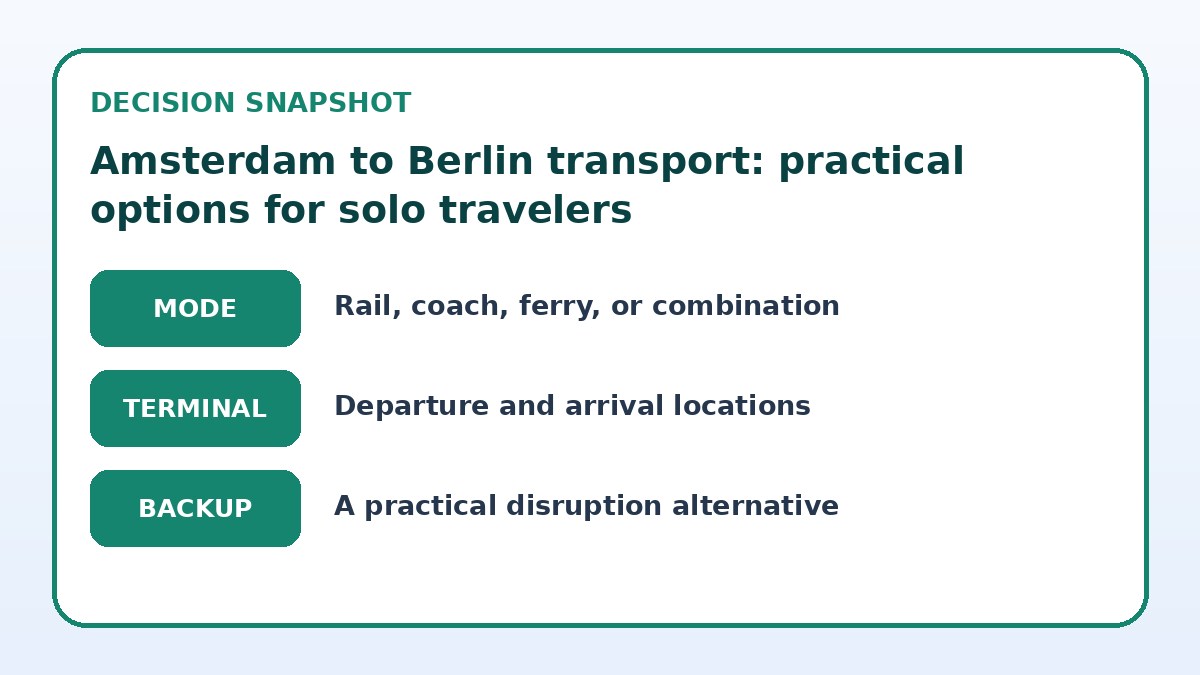
Choose the end-to-end journey plan
| Journey approach | Best for | Friction to check |
|---|---|---|
| Direct intercity train | Solo travelers who prioritize fewer transfers, station-to-station simplicity, and the ability to carry luggage onboard. | May be pricier upfront and run less frequently at certain times of day; check seat reservation and luggage rules before booking. |
| Long-distance coach | Travelers focused on minimizing fare cost and willing to accept peripheral terminals and longer journey durations. | Adds transfer and luggage-handling friction; coach terminals can be farther from central hotels or transit hubs. |
| Mixed route (rail + regional or short coach) | Anyone seeking a balance between price and convenience when direct services are limited or timings don’t match. | Requires careful timing to avoid missed connections and more luggage moves between segments. |
| Split-day approach (overnight stop en route) | Travelers who prefer lower daily travel stress and want to turn a long journey into two manageable segments. | Adds booking complexity and accommodation planning; overall travel time increases though daily effort decreases. |
Check live intercity options
Look beyond the ride itself and compare terminals, transfers, luggage, and arrival fit.
Luggage and transfer friction: what you’ll actually carry
Luggage rules and real-world handling can make a longer but simpler journey preferable. Trains usually allow larger bags and let you keep things nearby, reducing the number of times you lift them onto a rack. Coaches sometimes have limited or strictly sized bays and require labeled drop-off and pick-up; retrieving bags from a crowded stop is more stressful when you’re alone. Look for explicit luggage dimensions, whether assistance is offered at stations, and whether you must stow bags under seats or in a baggage hold.
Also assess transfer friction: will you be dragging a wheeled suitcase across cobbles, up stairs, or along long pedestrian paths? If changing between modes, factor in the time to collect and re-check bags. If your route requires a taxi or rideshare to reach a peripheral terminal, add that to your mental cost. Where possible, choose options with fewer transfers even if the travel time is a little longer—reduced handling often beats a nominal time saving for solo travelers.
Timing flexibility: schedules, buffers, and solo traveler pace
Solo travelers often value schedule certainty and reasonable buffers for bathroom breaks and last-minute essentials. High-speed or intercity trains typically run on predictable timetables and offer several departures per day, which helps if you need to adjust plans. Coaches might have fewer daily services and more variable travel times because of road conditions. If your itinerary includes a tight connection—another train, a hostel check-in window, or a guided tour—prioritize a route with multiple departure options so you can rebook onto a later run without major disruption.
Think about how you want to spend travel time: do you prefer a single continuous ride where you can relax, work, or nap, or are you prepared for transfers and shorter segments? Also check how early you’d need to arrive at terminals for ticket collection or seat allocation; some low-cost services recommend arriving well before departure. When deciding, aim for an itinerary that aligns with your pace rather than the theoretical fastest option that leaves little margin for delays.
Compare the practical alternatives
Use the final page to confirm what is actually offered on your dates and save a workable fallback.
Intercity travel checklist
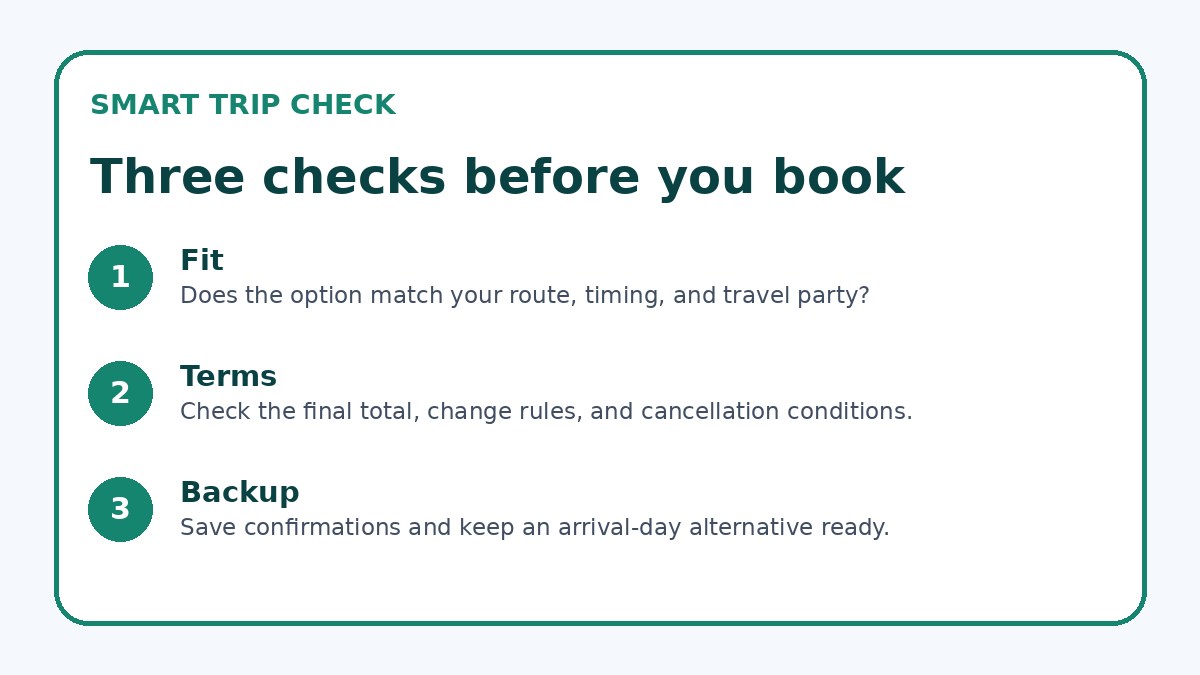
- Confirm the exact terminal names and addresses at both Amsterdam departure and Berlin arrival before you book.
- Compare door-to-door time by adding transfer, taxi, or transit times to the quoted travel duration.
- Check the operator’s luggage allowance and whether you must tag or stow bags in a hold.
- Identify at least one later departure you could reasonably switch to if your original service is delayed.
- Save screenshots of tickets and booking references offline, plus station maps for both endpoints.
- Verify change and refund policies on the operator’s final booking page before completing payment.
Disruption backup: realistic fallbacks you can enact alone
A practical disruption plan for solo travelers is concise and actionable: pick one or two realistic backups you can book or reach quickly. Identify later trains on the same operator, alternate routes via a different city (for example, routing through Hannover instead of a direct service), or a coach operator with frequent departures. Make a note in your phone of the next three departures and their booking links so you can switch without scrambling to find Wi‑Fi at the station.
Also prepare simple steps for on-the-ground disruption: where the local ticket office is, whether staff speak English, and the address of a nearby budget hotel if overnight is unavoidable. If you’ll consider a rideshare or taxi to a different terminal, estimate that expense ahead of time. You can check current availability and options on comparison sites—Trip.com is one place to compare live conditions—but always verify final terms, baggage rules, and change policies on the operator’s official booking page before spending money.
Rail & Intercity Transport questions travelers ask
Is taking the train between Amsterdam and Berlin the fastest practical option for a solo traveler?
Fastness depends on whether you mean door-to-door time or in-vehicle time. Trains often have shorter in-vehicle times on direct high-speed services and place you in central stations, which reduces extra transfer time for solo travelers. However, if a coach or mixed route drops you closer to your exact destination, that could make it faster door-to-door despite a longer ride. Compare the station addresses and calculate total travel time including transfers rather than relying solely on the listed journey duration.
How should I evaluate luggage risk when choosing between coach and train?
Assess both the formal rules and the practical handling. Trains generally let you keep bags near you and avoid repeated loading and unloading; coaches often require gated hold storage and handling by staff. For fragile or essential items, prefer options that minimize transfers. If you must use coach services, pack valuables and immediate-need items in a daypack kept with you, label checked luggage, and arrive early to oversee loading.
What’s a simple disruption backup for a solo traveler on this route?
Pick a single realistic alternative you can act on quickly: a later train on the same corridor, a different route via an intermediate hub, or a coach operator with multiple departures. Keep the backup’s booking page or app open on your phone, know the nearest ticket office location, and have a small buffer of funds available for rebooking or a rideshare if you need to move between terminals. This minimal plan reduces stress and lets you make fast decisions when delays happen.
Final decision note
For most solo travelers prioritizing door-to-door practicality, a direct intercity train is often the simplest choice because it minimizes transfers and luggage handling and usually deposits you in central locations. Coaches can save money but add friction and may arrive at peripheral terminals, while mixed routes can help when schedules or budgets need balancing. Before you book, map the terminals, add realistic transfer times to quoted journey durations, verify luggage rules on the operator’s final booking page, and pick a short, actionable disruption backup. If you want a quick comparison of live options, Trip.com is one place to view current availability—but always confirm critical details with the operator before you pay.
Continue planning
Check current options and final conditions
Use the provider page to confirm live availability, the final total, cancellation terms, and every condition that matters to your trip.
This evergreen planning guide was created with AI-assisted drafting and a structured quality review. It does not display live prices, schedules, availability, visa guidance, or provider rankings. Verify current details before booking. Some links are affiliate links; we may earn a commission at no additional cost to you.