If you’re traveling from Tokyo to Kyoto with extra luggage, make the decision first by prioritizing how much handling and how many transfers you want. For many, the simplest options are (1) shinkansen with baggage accommodation and luggage-forwarding service, (2) highway coach that accepts oversized items, or (3) a private transfer or combination of rail plus courier. The practical question isn’t just speed; it’s how every bag moves from door to door, how many times you’ll lift it, and how much schedule flexibility you need. This article explains how to weigh terminal fit, luggage friction during transfers, timing flexibility, and disruption backups so you can choose an end-to-end plan that actually works for your physical limits, itinerary, and comfort.
How to choose between rail, coach, courier, or a hybrid
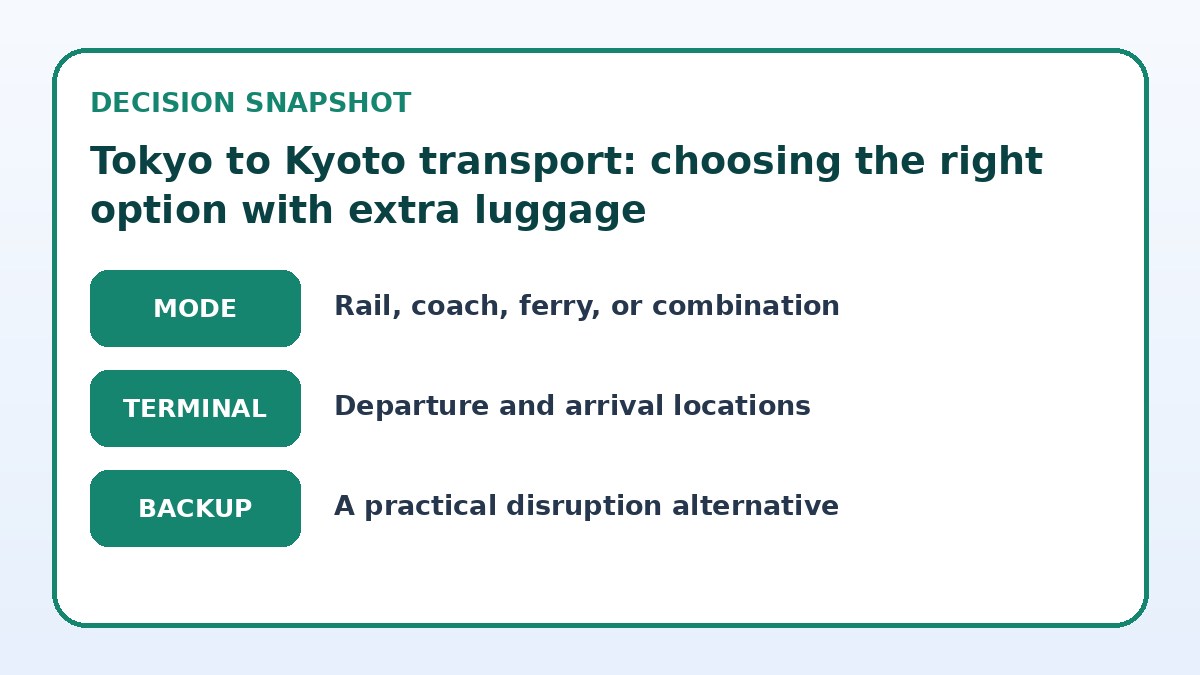
Start by listing what matters most: total door-to-door time, number of lifts and transfers, cost sensitivity, and how fixed your schedule is. High-speed rail usually offers the fastest point-to-point travel but can involve carrying bags across busy stations and between platforms. Coaches can reduce handling because many allow or load bulky items into underfloor compartments, but they typically take longer and may stop at less convenient terminals. Luggage-forwarding services (couriers) let you travel lighter on public transport and can deliver items to your hotel or a pickup point, but they add an extra step in booking and a time buffer for delivery.
A hybrid approach often gives the best balance: forward the heaviest items and take a faster train or coach for yourself with a small carry bag. If you choose rail and want to avoid platform hassle, verify which trains have dedicated large-bag spaces or allow advance seat reservations next to storage areas. If you plan to rely on a courier, check delivery windows and whether the recipient address accepts same-day or next-day deliveries; some services require hotel permission or a convenience store pickup. Decide based on how much you value personal mobility versus minimizing baggage effort.
Choose the end-to-end journey plan
| Journey approach | Best for | Friction to check |
|---|---|---|
| High-speed rail (shinkansen) with carry-on and seat reservation | Travelers prioritizing speed and a predictable arrival, willing to manage luggage in busy stations. | Requires carrying bags onto platforms and between exits; may be uncomfortable during peak times. |
| Highway coach with underfloor luggage storage | Those who want fewer lifts and direct curbside drop-offs, tolerating a longer journey time. | Longer travel time and potential for stops at less convenient locations; schedule frequency may be lower. |
| Luggage-forwarding courier combined with public transport | Travelers wanting minimal handling who can plan for next-day or timed delivery windows. | Adds service coordination and delivery lead time; you must carry only essentials on the ride. |
| Private door-to-door transfer (taxi or minivan) | Groups or travelers with many oversized items seeking the least handling and direct pickups. | Usually more expensive and may be constrained by vehicle size or city access rules. |
Check live intercity options
Look beyond the ride itself and compare terminals, transfers, luggage, and arrival fit.
Terminal fit and transfer friction: practical station-to-station realities
Not all terminals are equally easy to navigate with oversized luggage. Major Tokyo stations have multiple exits, long pedestrian corridors, and sometimes stairs or elevators that require extra time. Kyoto’s main stations are central but may involve walking through concourses to reach taxis or buses. Evaluate door-to-door routes: measure time and physical difficulty from your lodging to the departure terminal and from arrival terminal to your final destination. Consider whether a taxi or local delivery at either end will reduce the number of times you must lift or stow heavy bags.
When planning transfers, account for the worst-case walking route with luggage—switching platforms, crossing pedestrian bridges, or moving between nearby but separate stations can turn a short transfer into a stressful ordeal. Look for stations with step-free access, luggage trolleys, or porter services if mobility is a concern. If changing modes (for example, train to coach), confirm whether the arrival and departure points are adjacent or require a separate local transfer; that extra step often dictates whether you should forward luggage instead of hauling it yourself.
Timing flexibility and how it affects luggage choices
Your tolerance for schedule changes and arrival windows should shape the ticket and luggage plan. Fixed-departure options like reserved high-speed trains give predictable arrival times, which is advantageous if a courier delivery or hotel check-in requires a narrow window. Conversely, flexible tickets or frequent coach services let you wait for a more convenient departure if you experience delays, but they may complicate courier timing. If your schedule is tight—early check-in or evening plans—choose a plan that minimizes dependence on third-party delivery times.
If you opt to forward luggage, allow a buffer day for delivery and plan clothing or essentials in your carry-on. For reserved trains, check the seat reservation policies regarding large items and allow extra time to move through busy stations. For coaches, confirm departure frequency to avoid long waits; coaches that run infrequently increase the risk that a missed vehicle will cause long delays while you wait for the next scheduled service. The best choice balances your tolerance for waiting against the relief of traveling lighter.
Compare the practical alternatives
Use the final page to confirm what is actually offered on your dates and save a workable fallback.
Intercity travel checklist
- Measure your largest bag and check provider size limits or courier dimensional rules before booking.
- Confirm station access and step-free routes from your lodging to departure terminal and arrival station to final destination.
- Reserve seats or buy flexible tickets that allow rebooking in case of delays or missed connections.
- If using a luggage-forwarding service, verify pickup and delivery windows and the exact delivery address acceptance policy.
- Plan a small essentials carry-on with clothes and valuables to avoid dependence on immediate luggage delivery.
- Save contact details for your courier, coach operator, rail provider, and a local taxi company for quick contingency calls.
Disruption backups: practical contingency plans
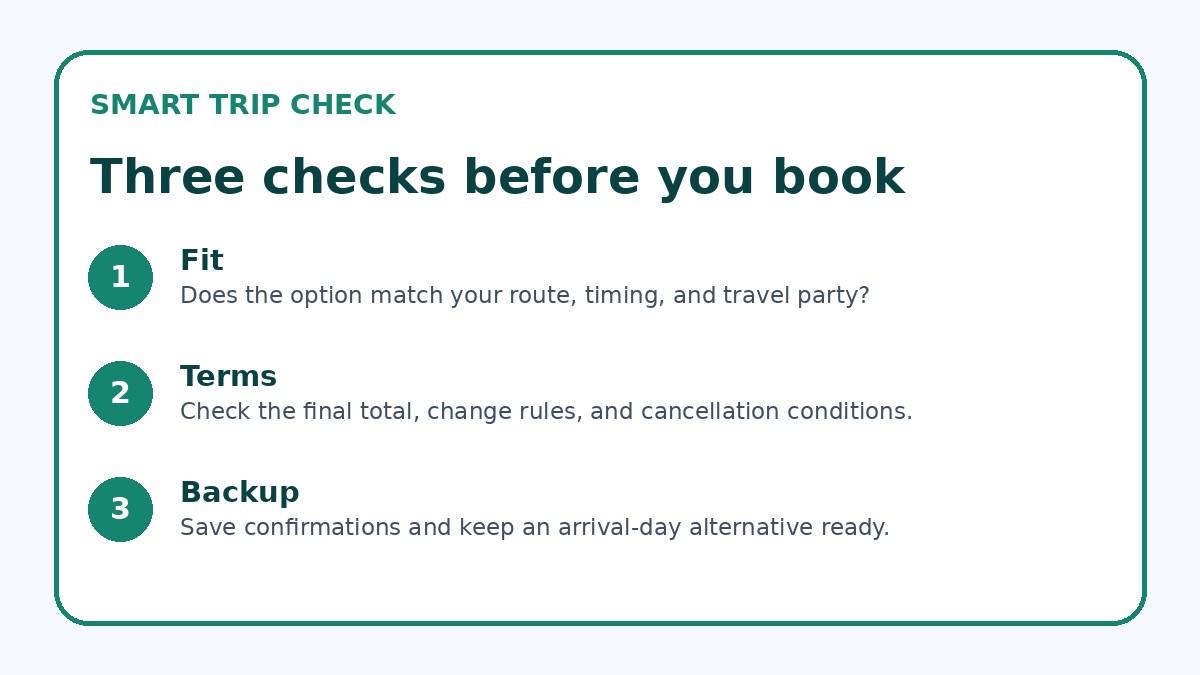
Always have a simple backup if your primary plan is disrupted. Good options include a pre-identified courier that will collect luggage from your location, a flexible or refundable train/coach ticket, or a local taxi company that can accommodate larger items. If traveling during busy periods, book a backup seat on a later train or note alternative coach routes. Keep digital copies of booking confirmations and the courier’s contact information so you can rearrange delivery or pickup without wasting time in a station queue.
Another practical step is to split responsibility: travel yourself on a booked train while a courier moves the heaviest suitcase. If the train is delayed, the courier may still complete delivery and meet you later, depending on the delivery window. When relying on coaches, check whether the operator will rebook passengers on the next available service in case of missed departures. Finally, identify a nearby luggage storage option at your arrival station or a trusted hotel that can temporarily hold items if timing goes off-plan.
Rail & Intercity Transport questions travelers ask
Can I take large suitcases on the shinkansen from Tokyo to Kyoto?
Shinkansen trains generally accommodate luggage, but carriage space and policies vary by service and season. Many travelers use reserved seats and position large bags in designated areas or in overhead racks, though very large suitcases may be awkward in crowded trains. Before booking, check the specific train’s baggage guidance and seat-reservation options; if carriage rules are unclear, consider forwarding oversized items to your Kyoto address or booking a seat near storage-friendly spots. Confirm details on the operator’s official booking pages or on comparison sites such as Trip.com.
Is it safer to forward luggage or bring it on a coach?
Forwarding luggage reduces the physical strain of handling heavy items and lowers the chance of losing time during transfers, but it introduces dependency on delivery timing and the courier’s processing. Coaches normally load large items into secure underfloor compartments, offering a hands-off experience during the ride; however, coach travel can be slower and involve multiple stops. Weigh the tradeoff between having direct control of your bag and the convenience of not carrying it yourself, then check service terms and delivery guarantees before deciding.
What if my luggage delivery or train is delayed—how should I proceed?
Have a contingency that suits your priority: a flexible ticket to change trains, a backup courier pickup time, or a nearby luggage storage option at the arrival station. If a train is delayed, notify your courier or recipient so delivery timing can be adjusted. If delivery is delayed, carry sufficient essentials in your hand luggage to cover a day. Keep all booking references and service contact numbers handy and, where possible, purchase options that allow same-day adjustments or rebooking to minimize disruption.
Final decision note
For Tokyo to Kyoto travel with extra luggage, the best plan balances the number of times you must handle bags, your schedule flexibility, and how much you value speed. High-speed rail suits travelers who prioritize arrival predictability but requires more hands-on handling in stations. Coaches and private transfers reduce lifts and curbside hassles but can add travel time or cost. Luggage-forwarding services remove heavy items from your immediate itinerary and pair well with a fast train or coach for personal travel. Prepare by measuring luggage, checking provider rules on official booking pages, and arranging a clear backup so your door-to-door journey stays practical and low-stress.
Continue planning
Check current options and final conditions
Use the provider page to confirm live availability, the final total, cancellation terms, and every condition that matters to your trip.
This evergreen planning guide was created with AI-assisted drafting and a structured quality review. It does not display live prices, schedules, availability, visa guidance, or provider rankings. Verify current details before booking. Some links are affiliate links; we may earn a commission at no additional cost to you.