On arrival in Taipei, the first-hour decision is simple: catch public transit if you want predictable cost and local immersion, or book a private transfer if you value direct door-to-door service and minimal walking with luggage. Which is right depends on the size of your party, how much luggage you have, whether your arrival is late or disrupted, and where in the city you’re staying. This guide gives the practical answer up front—choose public transport for solo or budget-minded travelers staying near metro stations; choose private transport for groups, heavy luggage, or tight schedules—then explains the tradeoffs and the exact checks to run while your flight and hotel details are open. Use the checklist to confirm pick-up points, meeting instructions, and final drop-off compatibility before you book.
Check options for your arrival details
Use your flight, luggage, party size, and accommodation address to compare current choices.
Luggage and party size: match vehicle to baggage
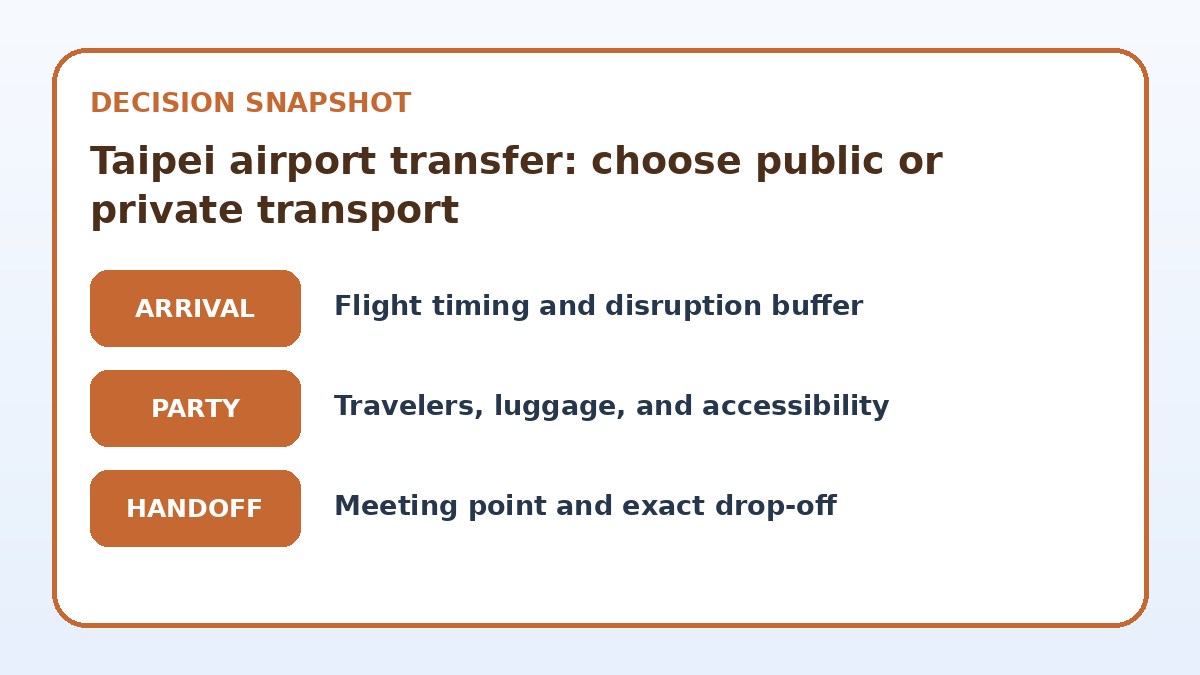
Count every piece of luggage and include items like strollers or sport equipment before choosing. If you have more than two medium-sized suitcases per person or bulky gear that won’t fit in overhead storage, a private vehicle is easier; the driver will load and unload for you and can confirm trunk capacity when you book. For solo travelers or light packers, Taipei’s public networks are designed for rolling bags and short walks, but expect to navigate metro stairs or shared elevators at stations.
For groups, compare how many seats and seatbelts you need rather than assuming one car will suffice. Many private-transfer options list vehicle types—compact, sedan, MPV, or van—so request a model that fits passengers plus luggage. If you’re splitting into multiple taxis from the airport, remember cumulative cost and coordination effort; a single booked transfer can save time and complication even if the per-vehicle fare seems higher.
Arrival details to have ready
- Confirm your flight number, expected arrival time, and airport terminal to share with any driver or shuttle operator.
- Count people and all luggage pieces, then select a vehicle type that explicitly lists adequate trunk and seat capacity.
- If booking private transfer, get the driver’s phone number, meeting point details, and instructions for delays directly from the booking page.
- If using public transit, note the nearest metro station or bus stop to your accommodation and the number of transfers required.
- Take a photo of where you’ll wait on arrival (terminal sign, exit number) and send it to your driver or host before landing.
- Check your accommodation’s drop-off accessibility (driveway, curbside rules, stairs or elevators) and inform the transfer provider if special access is needed.
Late or disrupted arrivals: contingency planning
Arrivals late at night or those that risk delays benefit from a transfer option that provides clear, real-time contact methods. Private providers often include a phone or messaging contact so drivers can adjust for late landings; always confirm what happens if your flight is delayed or diverted. For public transit, research the operating hours for the metro, airport express, and late-night buses. If services are limited when you land, be ready to pivot to a taxi or pre-arranged pick-up.
Have backup contact details for your accommodation and consider where you will wait if a pre-arranged transfer is delayed. Confirm exact meeting points—terminal, door number, or designated counter—because airports can have multiple exits and temporary changes due to construction or security. If your arrival is during a local holiday or peak period, expect longer waits for both public and private options and verify cancellation and rescheduling rules on the provider’s booking page.
Match the transfer to your arrival
| Arrival approach | Best for | Detail to verify |
|---|---|---|
| Metro and regular buses | Solo travelers or light packers staying near stations | Lowest apparent cost and frequent service but requires walking, transfers, and handling luggage on public platforms |
| Airport shuttle buses and express services | Passengers heading to major districts with direct shuttle stops | Simpler than metro for luggage but follows fixed routes and schedules, so may not drop you at the closest door |
| Private pre-booked transfer | Families, groups, heavy luggage, or late arrivals needing direct door-to-door service | Higher upfront cost and need to verify vehicle size, meeting details, and provider change/cancellation policies |
| Taxi or ride-hail from the airport | Travelers needing flexibility at short notice or heading to destinations off main routes | Convenient and flexible but variable wait times at peak arrival periods and potential challenges with excess luggage |
Make the meeting plan clear
Check the final pickup instructions, waiting conditions, and exact drop-off coverage.
Meeting points and communication: avoid confusion
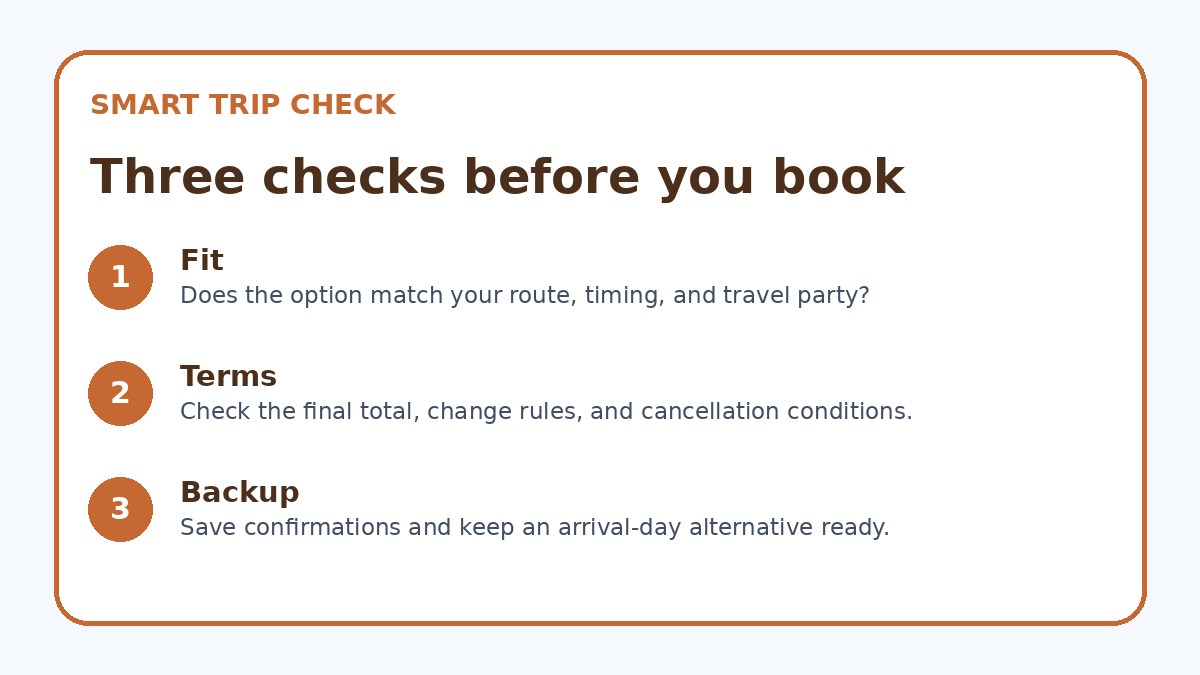
Clear meeting-point instructions save time and reduce stress on both sides. Airports use numbered exits, arrival halls, and official counters; write down the terminal, exit number, and a recognizable landmark near where you’ll wait. For private transfers, ask the provider what they display on arrival (nameboard, app icon, or vehicle description) and whether the driver can text or call when they arrive. If you have local roaming or Wi‑Fi access, confirm the driver’s contact details in case you need to change location.
For public transport, know the directions from your arrival gate to the nearest metro or bus connection and whether there are escalators or elevators for luggage. If you expect to meet a local host or hotel shuttle, confirm whether the hotel uses a dedicated counter or will meet you curbside. Photographs of the meeting area and the person you’re meeting help if language is a barrier; keep reservation numbers and arrival times handy in case anyone needs to verify details.
Drop-off fit: access and final-mile considerations
Think about the final part of your journey—how close does the vehicle get to your accommodation? Many Taipei neighborhoods are served well by the metro, and stations may be a short walk from hotels or short-term rentals. Confirm whether your hotel has a driveway or if drop-off is limited to curbside zones; small streets or pedestrianized lanes near old neighborhoods can mean a longer walk from the vehicle to your door. If door-to-door convenience is essential, choose a private transfer that confirms the driver can legally and practically reach your property.
Consider luggage handling at the drop-off point: steps, narrow staircases, and elevators with limited space can make a short walk cumbersome. If your accommodation has strict check-in hours, coordinate arrival times to avoid long waits outside. Communicate any special access needs—mobility equipment, very late check-in, or daytime noise restrictions—so the driver or hotel can plan the most suitable drop-off location.
Airport Transfer & Local Mobility questions travelers ask
How do I decide between Taipei Metro and a private transfer for a late-night arrival?
First, check the metro’s typical operating hours for the line serving the airport and whether it reaches your destination without multiple transfers. If the metro stops running before your arrival or would leave you with a long or complex walk, a private transfer or taxi reduces uncertainty—however, verify pick-up instructions and the provider’s late-arrival policy on their booking page. Also consider safety, luggage handling, and whether you’ll want direct door drop-off when sleep or rest is a priority.
Can I rely on taxis at the airport if my flight is delayed or I miss a connection?
Taxis are available at airport ranks and can be a flexible option for unexpected delays, but availability may vary during peak arrival waves, holidays, or late-night hours. If you rely on a taxi as a backup, look for the official airport taxi queue and confirm any applicable luggage handling expectations. For group travel or heavy luggage, a reserved private transfer can offer more certainty; whether you choose a taxi or booked service, save alternative contact numbers and the name of your hotel so you can coordinate on arrival.
What should I verify on a transfer provider’s booking page before paying?
Confirm vehicle type and passenger plus luggage capacity, clear meeting-point instructions, the provider’s policy for flight delays and rerouting, contact methods for the driver, cancellation and change terms, and any additional fees for extra stops or waiting time. If language support matters, check whether the provider offers English communication options. When possible, compare listings on a reputable platform—Trip.com can be one place to review current availability and provider details, but always check the final supplier terms before completing a booking.
Final decision note
For most first-time visitors, the practical choice hinges on luggage, party size, and arrival timing. Pick Taipei’s public transit if you travel light, your hotel sits close to a metro station, and you’re comfortable handling transfers and short walks. Choose a private transfer when door-to-door convenience, heavy or bulky luggage, or late-night arrivals outweigh the higher upfront cost. Use the checklist to verify flight, vehicle, and meeting details while your travel confirmations are open, and always confirm the provider’s handling of delays and specific drop-off access on their final booking page. That preparation makes your first hour in Taipei predictable and more relaxed.
Continue planning
Check current options and final conditions
Use the provider page to confirm live availability, the final total, cancellation terms, and every condition that matters to your trip.
This evergreen planning guide was created with AI-assisted drafting and a structured quality review. It does not display live prices, schedules, availability, visa guidance, or provider rankings. Verify current details before booking. Some links are affiliate links; we may earn a commission at no additional cost to you.