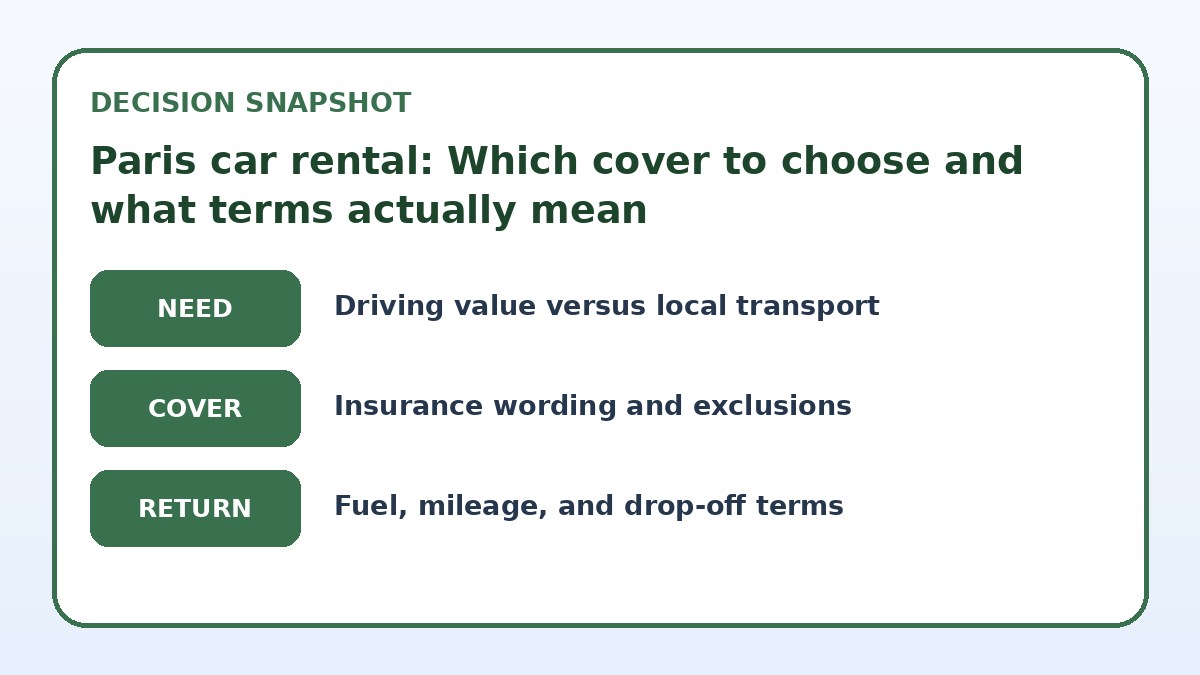
Deciding whether to drive in and around Paris often hinges on insurance wording. For couples weighing convenience against cost and stress, the practical answer is simple: only rent if a planned route or schedule meaningfully depends on a car and you understand the exact coverage terms listed on your rental confirmation. Many tensions arise from phrases like “CDW,” “excess,” “third-party liability,” or “supplemental driver” — each affects who pays, which damages are excluded, and how much you’ll be billed at return. Read the fine print, confirm what’s printed on the rental agreement and your payment card’s rental-car protection, and only commit if the combined coverage leaves you comfortable with the excess level and included protections. Below you’ll find route-value guidance, a plain-language breakdown of typical insurance terms, pickup/return friction points for couples, and a safe non-driving fallback plan.
Route value: when a car truly improves your couples’ trip
Driving around Paris itself is rarely worth the hassle for couples whose plans center on museums, restaurants, and riverfront walks. Congestion, restricted zones, and expensive central parking often make point-to-point transit faster by metro or taxi. However, a car becomes valuable for planned excursions outside the Île-de-France region: Loire Valley châteaux runs, Normandy beaches, or a multi-day loop through Champagne vineyards. For those trips, a car packs flexibility — you can stop at small villages, keep a loose schedule, and carry picnic supplies or gear without juggling public-transport timetables.
When evaluating route value, do a quick itinerary audit: list destinations, note nearest train stations, and estimate the number of stops where public transport requires long transfers or expensive taxis. If more than two destinations are rural or require frequent luggage handling, a rental may save time and stress. Couples should also weigh emotional tradeoffs: does driving together add to the experience or introduce the stress of navigation and parking? If both partners prefer relaxed sightseeing, factor in who will drive and whether both are listed as authorized drivers on the rental contract.
Decide whether driving earns its place
| Mobility strategy | Best for | Cost or friction to check |
|---|---|---|
| Rent a full-size car for the whole trip | Couples with multiple rural stops and significant luggage | Higher insurance exposure, parking difficulty in city, requires careful contract reading and possibly extra driver fees |
| Car for rural legs only (pick up outside Paris) | Couples staying central in Paris but touring the countryside on select days | Saves city parking hassles but adds pickup logistics and potential one-way fees |
| Public transport plus occasional taxis/rideshares | Couples focused on city attractions and short-day trips | Less control over scheduling and limited access to remote sites without prearranged transfers |
| Train travel with local car hire or tours at destination | Couples who prefer stress-free travel and guided logistics in rural areas | May be more expensive per trip and reduces spontaneity compared with having your own car |
Check live rental choices only after the route test
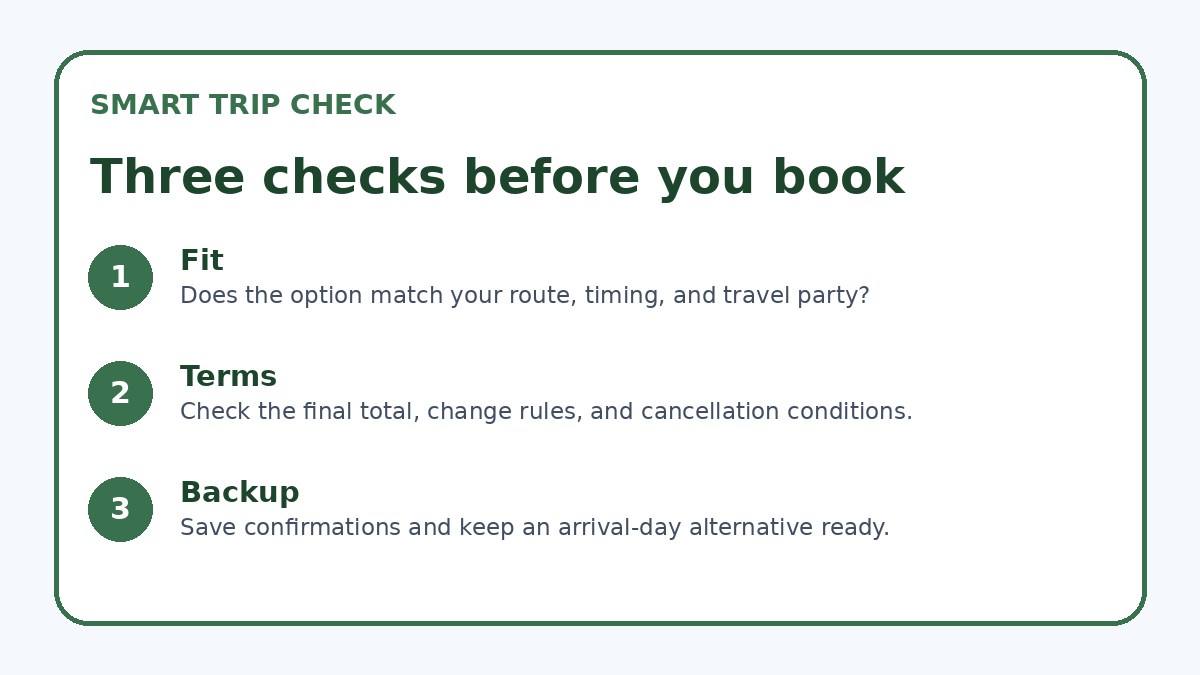
Use the exact driver, dates, pickup point, and return plan to compare current conditions.
Insurance wording decoded: plain language for couples
Common phrases appear on every rental contract, but their consequences aren’t always clear. Collision Damage Waiver (CDW) typically reduces how much you pay for damage to the rental vehicle, but it seldom removes all liability; the contract will state an excess (financial responsibility) remaining per incident. Third-Party Liability covers damage you cause to others’ property or injuries; verify the minimum limits and whether the rental includes additional protection for higher limits. Theft protection lowers your exposure if the car is stolen, but exclusions often apply if the keys were left inside or if the vehicle was left unlocked.
Watch for wording about ‘authorized drivers’, ‘uninsured motorist protection’, and ‘glass/tyre’ cover. Some policies explicitly exclude damage to tyres, windshields, or the undercarriage unless you purchase extra cover. Also check if deductible reduction products remove the excess entirely or only partially — the booking page or agreement will state the new excess. Couples should compare the rental company’s cover with any benefits provided by their credit card or travel insurance, but always verify on the final booking page which exact lines of coverage are included, which are optional, and how claims are processed.
Compare the full rental conditions
Confirm insurance wording, exclusions, deposit, fuel, mileage, and return terms on the final page.
Pickup and return friction: practical checks for two people
Pickup can be slow and costly if you aren’t ready for the contract details. Bring the driving license, passport, the credit card used for booking, and any paperwork from your insurer or credit card company confirming rental-car cover. Ask the agent to walk through the damage record on the vehicle and photograph any existing marks together; take your own time-stamped photos. Confirm who is listed as an authorized driver — adding a second driver at the desk can incur a daily fee unless the rental already includes it. Clarify fuel policy, local mileage limits, and where to return the car after hours.
Return friction is often about disputes over damage and fuel. Before handing back keys, do one last joint inspection and request a stamped return receipt or email confirmation. If the company suggests additional charges, ask for itemized documentation and the clause in the contract that supports the fee. If you expect to rely on a credit-card rental protection or third-party insurance, verify the claim process and phone numbers while still at the desk. Having both partners involved in every step reduces confusion and future billing disagreements.
Car rental terms to verify
- List every planned stop outside central Paris and mark which are difficult to reach by train or require extra luggage handling.
- Compare the rental confirmation’s stated excess and any optional deductible-reduction wording on the final booking page before accepting.
- Confirm both partners’ driving licenses and add the second driver to the contract or bring proof that additional-driver fees are waived.
- Photograph the vehicle thoroughly at pickup and email time-stamped photos to yourself and the rental agent for evidence of pre-existing damage.
- Ask the agent to point out exclusions for tyres, glass, undercarriage, and theft; get those exclusions in writing if possible.
- Store copies of any credit-card rental coverage terms and travel insurance policies and note the phone numbers and claim steps while still at pickup.
Non-driving fallback: stress-free alternatives for couples
If the insurance wording or logistic costs make driving unattractive, a simple fallback is a mixed mobility plan: use trains or regional buses for longer distances and reserve taxis, rideshares, or short-term car hires for rural legs or heavy-luggage pickups. Many rural destinations in France are reachable by regional trains with local taxi connections or organized tours tailored to couples. This approach keeps flexibility while avoiding rental-car liabilities and parking hassles in Paris.
To prepare, map train connections and a realistic taxi/transfer backup cost for the most remote stop on your itinerary. If you anticipate occasional short drives, consider booking a local hourly car-sharing service or a one-way rental for just those days; that way insurance exposure is limited to necessary segments. Whatever fallback you choose, confirm cancellation and refund terms for any reservations, and keep digital copies of bookings and insurance confirmations so both partners can access them quickly while traveling.
Car Rental & Road Trip questions travelers ask
Does Collision Damage Waiver (CDW) mean I won’t pay anything for damage?
CDW commonly reduces or limits your financial responsibility for damage to the rental, but it rarely eliminates it entirely. Most contracts specify an excess — an amount you remain liable for per incident — and list exclusions such as tyres, windscreen, or undercarriage damage. Some desks offer a deductible reduction that lowers or removes that excess for an extra daily fee; whether that makes sense depends on how comfortable you are with the remaining exposure and the cost of the reduction. Always read the rental agreement wording and confirm on the final booking page whether CDW is included or optional, and if included, what the exact excess is.
Can my credit card or travel insurance cover the rental so I can avoid buying extra at the desk?
Many credit cards and some travel-insurance policies provide rental-car protection, but the terms vary widely and often exclude certain vehicle types, countries, or parts of the vehicle. Before declining the rental company’s options at the desk, request written confirmation of coverage from your card issuer or insurer and check whether they cover the contract’s stated excess and the process for filing claims. Rental companies sometimes require you to use the card that covers the rental for the hold, and claims can require submitting the rental contract and damage reports. Verify these details on the insurer’s and card issuer’s official pages and keep copies with your booking documents.
If a dispute arises over damage after return, what steps should couples take?
First, gather evidence: the stamped return receipt, time-stamped vehicle photos from pickup and return, and any email confirmation of condition. Contact the rental company’s local office immediately to request itemized charges and the clause in the contract supporting those charges. If you used a third-party or credit-card insurer, notify them promptly and follow their claims process, including submitting the rental contract and damage documentation. Keep a written record of all communications and, if necessary, escalate through the rental company’s official dispute channels. Being two people involved in the pickup, inspection, and documentation reduces the risk and strengthens your position if you need to contest charges.
Final decision note
For most couples staying inside Paris, driving adds more hassle than benefit. Choose a rental only when your itinerary includes multiple rural stops or remote sites that public transport cannot serve conveniently, and only after confirming the exact insurance wording on the final booking page. Learn what CDW, excess, third-party liability, and specific exclusions mean for your personal exposure; photograph the car at pickup, add both drivers to the contract, and get return receipts. If the insurance details or pickup logistics feel unclear, use a mixed mobility plan — trains plus local hires or tours — to keep your trip relaxed and your financial risk limited. If you want to compare availability or current offers while planning, Trip.com can be one place to check listings and terms, but always verify coverage clauses on the rental company’s official confirmation.
Continue planning
Check current options and final conditions
Use the provider page to confirm live availability, the final total, cancellation terms, and every condition that matters to your trip.
This evergreen planning guide was created with AI-assisted drafting and a structured quality review. It does not display live prices, schedules, availability, visa guidance, or provider rankings. Verify current details before booking. Some links are affiliate links; we may earn a commission at no additional cost to you.