Practical answer up front: for most families leaving Busan for Jeju, depart from the airport that minimizes your door-to-gate time and connection complexity even if the base fare is a little higher. The tradeoff is simple — save time, stress, and baggage transfer risk by choosing the more convenient airport or terminal on travel day, especially with young children or lots of luggage. If your schedule is rigid or you can’t absorb extra transfers, prioritize the airport with the shortest and simplest access from your accommodation. If fare is the primary constraint and you can handle extra logistics, choosing the cheaper airport or a connection can make sense. Below I explain routing differences, baggage and connection risks, schedule-fit strategies, and the fare conditions families should check before completing a booking.
See live routes for your exact travel day
Compare direct and connecting choices with the same baggage and traveler details.
Routing: direct vs. connecting and which Busan airport to choose
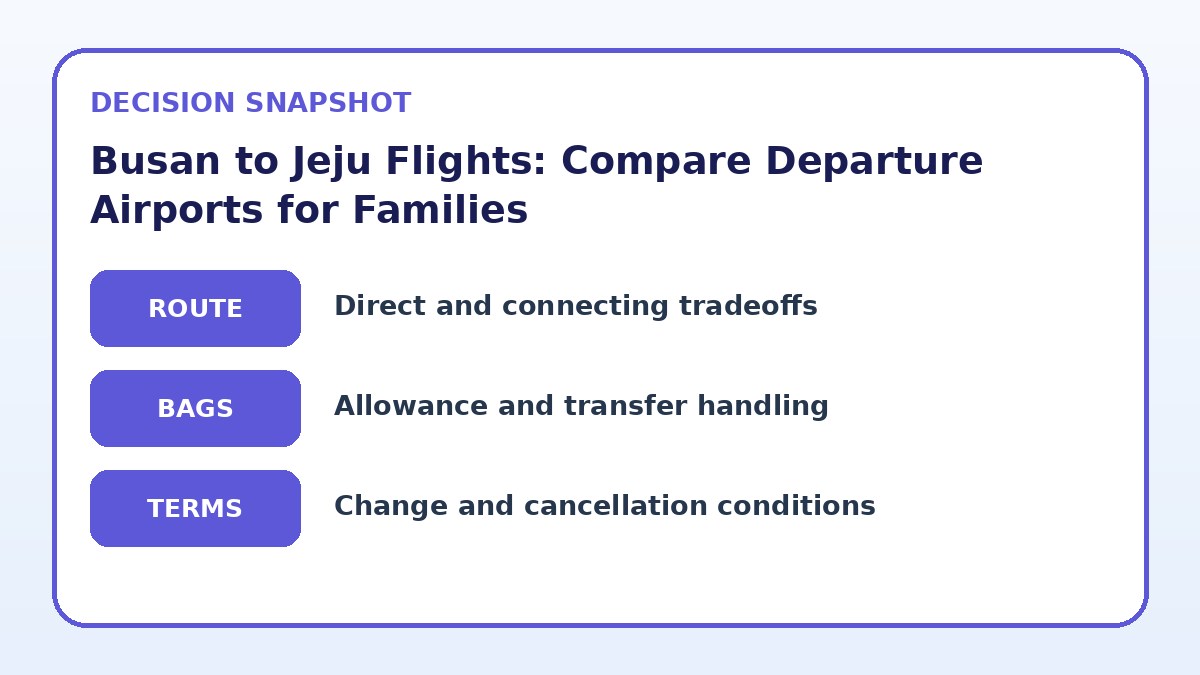
When planning Busan to Jeju flights for a family, start by checking whether direct flights are available from each Busan airport you can reach. Direct routing beats connections for families because it removes the need to change planes, collect and recheck luggage, and navigate unfamiliar terminals with children. If both airports offer direct options, prioritize the one with easier access from your lodging or a shorter transfer time. If only one airport provides regular direct flights, that airport will typically be the more practical choice despite potential fare differences.
Connecting routes can be acceptable when the total travel time and the number of handoffs remain low, but they require careful scheduling. For families, look for connections with generous minimum connection times and single-ticket itineraries where the airline guarantees baggage transfer; verify this on the booking page. Avoid tight connections and overnight layovers unless you have an explicit plan for accommodation and childcare. In short, use direct flights where possible; when using connections, choose the simplest single-ticket path with comfortable margins between flights.
Baggage and connection risk: protecting luggage and minimizing transfer stress
Families typically travel with more luggage and gear, so protect against baggage mishandling by preferring flights that do not require transfers between terminals or airports. If your outbound journey requires a bus or train transfer to another airport, consider the risk of delays and the added effort of moving children and luggage. When comparing fares, include checked-bag fees and the cost or inconvenience of transporting bulky items like strollers or car seats. On the airline’s final booking page, confirm exactly what is included in each fare: number of checked bags, cabin bag dimensions, stroller policies, and any fees for priority boarding or seat selection.
If you must connect, try to keep connections within the same airport and on the same ticket so the airline takes responsibility for delayed or misplaced baggage. For multi-carrier itineraries, verify whether the carriers have interline baggage agreements and how they handle transfers for families. Consider carrying essential child items in a carry-on—medication, a change of clothes, snacks, and entertainment—to reduce the impact of any delayed checked luggage. Always note the carrier’s policy on gate-checked strollers and the process for retrieving them at arrival.
Compare flight-selection strategies
| Flight strategy | Best for | Risk to check |
|---|---|---|
| Choose the closest airport even if the ticket is slightly more expensive | Families prioritizing minimal commute and lower stress | You may pay more in base fare, but you save time and reduce connection and luggage risks. |
| Pick the cheapest fare regardless of airport transfer time | Families on a strict budget willing to handle logistics | Savings might be offset by higher transit costs and added effort moving luggage and kids. |
| Select an airport with more frequent direct flights | Families who value schedule flexibility and backup options | More frequent service can mean higher fares but reduces risk of big delays or missed plans. |
| Book a single-ticket itinerary with a connection that offers protection | Families accepting a connection but wanting baggage and delay protection | Often slightly more expensive than separate tickets but reduces transfer risk and responsibility gaps. |
Recheck the complete itinerary
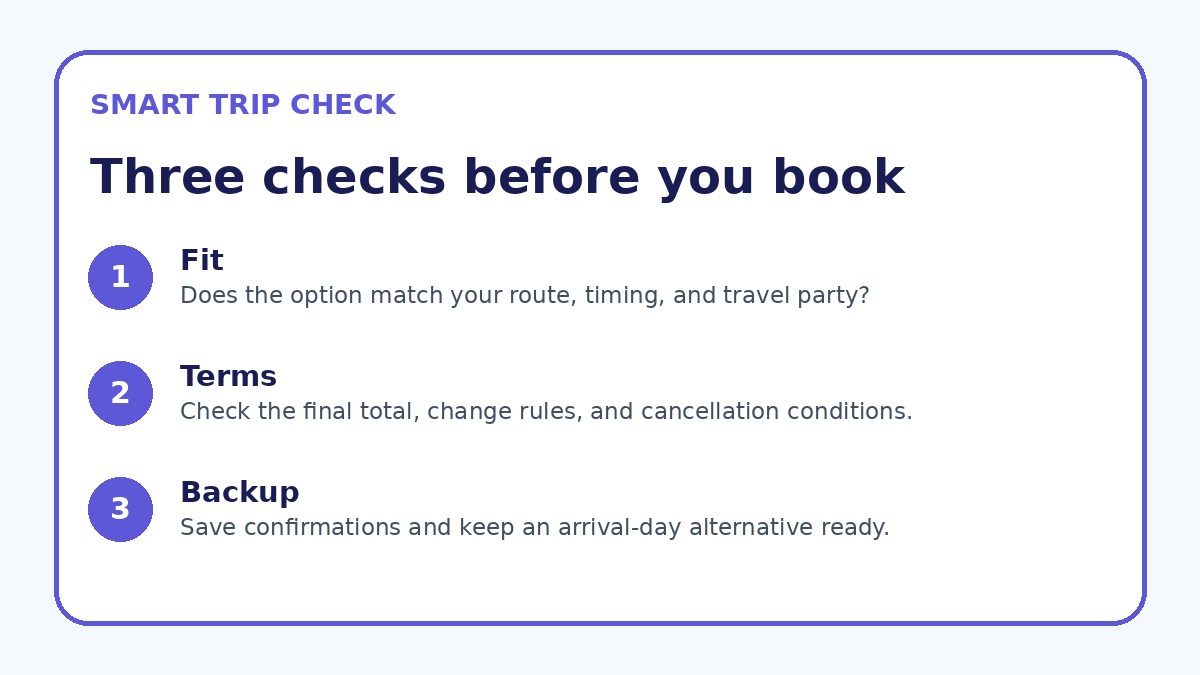
Confirm airports, connection handling, baggage, and change conditions before deciding.
Schedule fit: matching flights to family routine and practical travel windows
Schedule fit matters more for families than solo travelers. Identify the time windows of the day when your children are most comfortable: sleep schedule, nap times, and meal routines should guide flight selection. Early morning flights may be appealing for faster airport processes and potentially calmer cabins, but they mean an early wake-up and longer commutes to the departure airport. Midday flights can align with normal activity times, while evening departures might let children sleep on board. Balance these human factors against public transport links and local traffic patterns to avoid last-minute stress.
Also weigh airline schedule reliability and frequency when choosing between airports. More frequent service from one airport gives you flexibility if plans change, while limited daily flights from the other airport narrow backup options. For families who want minimal risk of missing a connection, select flights with more buffer time between arrival and any planned activities in Jeju. Before booking, map out door-to-door timing: leaving home, reaching the airport, recommended check-in times for families, and estimated arrival at your Jeju accommodation.
Flight details to verify
- List exact travel dates, number and ages of travelers, and any infant or lap-child requirements before searching fares.
- Measure door-to-gate transit time for each Busan airport option at the time of day you plan to travel.
- On the airline booking page, confirm baggage allowances, stroller and car-seat rules, and fees for checked luggage.
- Check seat assignment policies and pay for adjacent seats if the fare does not guarantee family seating.
- Verify change and cancellation rules, and note any fees or credit policies in case you must adjust travel plans.
- Prepare a small carry-on with child essentials—medication, snacks, spare clothes, documentation, and entertainment—for every family member.
Fare conditions: how to read tickets for family flexibility and total cost
Low base fares can look attractive but often exclude essentials families need. When checking Busan to Jeju flights, compare the total landed cost including checked-baggage fees, seat selection charges, infant and child ticketing rules, change and cancellation fees, and boarding priority. Also review refundability and how name changes, date changes, or cancellations are handled, because family plans can shift. Use the booking page to confirm baggage allowances and whether seats for infants or children are free or require payment. If the page is unclear, contact the carrier before you book.
Consider fare rules for upgrades or family seating: being split across rows can complicate a flight with small children. If a low-cost fare saves money but charges extra to guarantee adjacent seats, calculate that added cost before making a decision. For tickets purchased on a single carrier, check whether the fare conditions allow free rebooking or at least lower change fees; these options are valuable if illness or unexpected delays force you to change travel dates. Finally, keep proof of any fare rules and baggage allowances at hand during travel in case agents need to confirm your entitlements.
Flight Guide questions travelers ask
Which Busan airport is usually more convenient for families traveling to Jeju?
Convenience depends on where your family is staying in Busan and how you plan to get to the airport. The most convenient airport is the one that gives the shortest, simplest door-to-gate transfer for your group, even if its base fares are marginally higher. Check public transport schedules, taxi or ride-share times, and parking availability at both airports for your planned departure time. Then compare direct flight availability and total travel time to Jeju rather than judging only by ticket price.
How do I minimize baggage problems when flying as a family from Busan to Jeju?
Minimize baggage issues by choosing either a direct flight or a single-ticket connection where the airline handles transfers. Confirm on the booking page what is included in your fare—specifically checked-bag allowance and stroller policies—and buy the baggage allowance you actually need rather than assuming one piece is included. Keep critical items in carry-ons and gate-check strollers if allowed. If you must transfer between airports, factor in ample time and consider shipping bulky items ahead or renting gear in Jeju to reduce what you carry.
Should I prioritize an earlier or later flight for a family heading to Jeju?
Prioritize the time that fits your children’s routines and reduces stress. Early flights can reduce airport crowds and potential delays, but they require an earlier wake-up and possibly longer commutes to the airport. Later flights might let children travel in a calmer state, possibly sleeping onboard, but can introduce more traffic and less margin for schedule disruptions. Balance these factors with the frequency of flights from your chosen airport and pick a departure that gives you comfortable buffer time before planned activities in Jeju.
Final decision note
For families planning Busan to Jeju flights, the practical move is to prioritize the departure airport that minimizes transfers, door-to-gate time, and baggage handling complexity. Direct flights or single-ticket itineraries with generous connection windows reduce the chance of stressful last-minute changes and lost luggage. Always total the real cost of travel by adding baggage fees, seat selection, and transfer expenses to base fares, and confirm all baggage and change policies on the airline’s final booking page. Prepare exact traveler details and preferred dates before checking live fares, and use the checklist above to make a calm, practical booking decision.
Continue planning
Check current options and final conditions
Use the provider page to confirm live availability, the final total, cancellation terms, and every condition that matters to your trip.
This evergreen planning guide was created with AI-assisted drafting and a structured quality review. It does not display live prices, schedules, availability, visa guidance, or provider rankings. Verify current details before booking. Some links are affiliate links; we may earn a commission at no additional cost to you.