For most business travelers making the Osaka to Kyoto trip, the practical choice balances terminal proximity, luggage handling, and predictable door-to-door time. That often means choosing rail when you need a reliable city-center arrival and low transfer friction, or a private car when your schedule is tight, you carry bulky equipment, or you have multiple meetings at locations poorly served by stations. Coaches and ride-share combinations can work when cost and seat availability matter, but they add possible waiting and transfer time. This guide starts with a short recommendation so you can act quickly, then breaks down the tradeoffs—terminal fit, luggage and transfer friction, timing flexibility, and a disruption backup—so you can pick the approach that suits your itinerary and risk tolerance. Verify final schedules, seat availability, luggage policies, and exact drop-off points on provider booking pages before you commit.
Terminal fit: where each mode drops you off
Consider where your trip begins and ends before choosing a mode. Trains tend to serve central stations in both Osaka and Kyoto, which is ideal when meetings and hotels are clustered near those hubs. If your meeting is in a suburban office park or at a conference center outside the station area, a direct train may still be efficient but will require an extra taxi or local transit connection. Private cars typically offer door-to-door service, removing the walk or short transfer, while coaches usually use major bus terminals that can be farther from business districts. Always map your actual start and end addresses to the nearest station, bus terminal, or common taxi drop-off to see which mode minimizes total travel time.
Think beyond the drop-off to the first and last 10 minutes of your journey—walking from a station can cost you crucial minutes between meetings. Evaluate elevator and escalator access if you have heavy luggage or need quick, accessible transfers. For multi-meeting days in Kyoto, staying near a major station simplifies returns to Osaka. If your Kyoto appointments are spread across the city, a private vehicle that drops you at each location may be the more practical option despite higher cost. Check where your hotel allows pickups and whether it offers luggage storage if you plan to travel light between meetings.
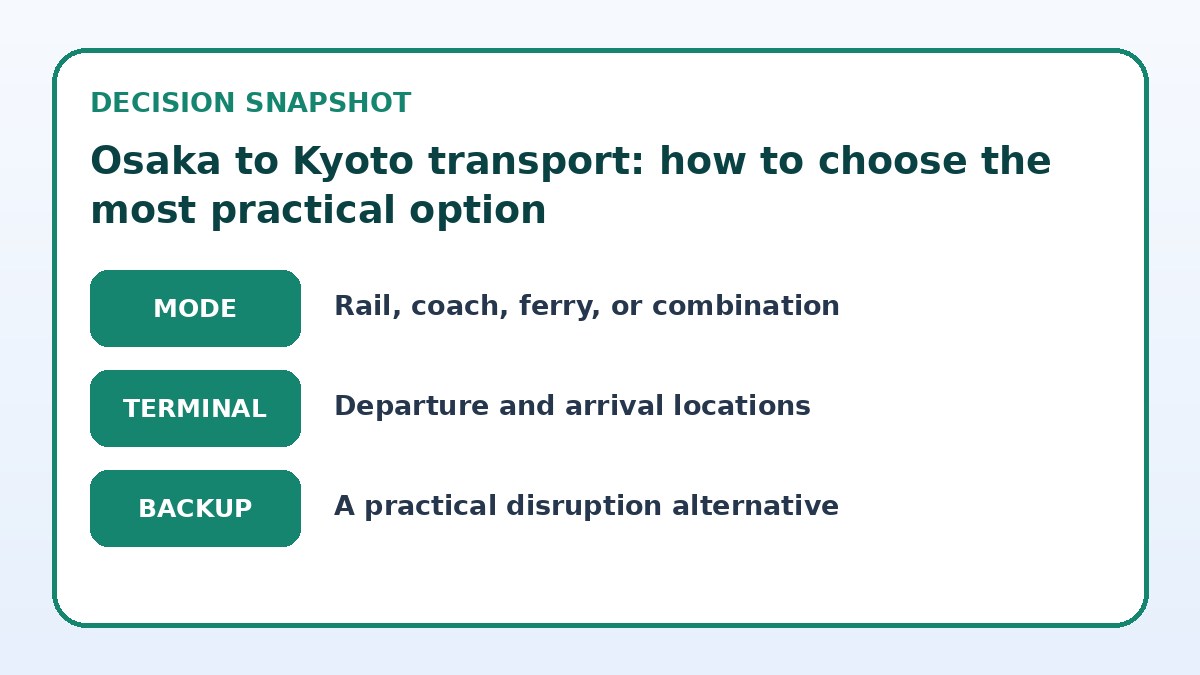
Choose the end-to-end journey plan
| Journey approach | Best for | Friction to check |
|---|---|---|
| Prioritize rail (frequent trains, central stations) | Travelers needing predictable city-center arrival with minimal transfers. | May require a taxi if the final address is not near a station; platform transfers can add friction with heavy luggage. |
| Prioritize private car (door-to-door service) | Those with multiple stops, oversized luggage, or tight, inflexible schedules. | Subject to road traffic and usually higher cost; verify pickup/drop-off rules and parking at destinations. |
| Prioritize coach (direct bus services between terminals) | Simple itineraries with light luggage where seat availability and cost control matter. | Less frequent and generally slower than trains; bus terminals can be further from business districts. |
| Mixed approach (train plus short taxi or rideshare) | Balancing speed and convenience when hotel or meeting location is not station-adjacent. | Requires coordination across providers and small transfers, which add complexity under tight schedules. |
Check live intercity options
Look beyond the ride itself and compare terminals, transfers, luggage, and arrival fit.
Luggage and transfer friction: keep the chain short
Business travelers often carry a laptop bag plus a briefcase or rolling suitcase; for those with additional equipment, luggage handling drives the decision. Trains generally have luggage areas and level-platform access in many carriages, letting you move quickly between door and platform with minimal handling. However, transferring between lines or stations multiplies friction—stairs, ticket gates, and crowded escalators can slow you. Private cars eliminate repeated handling: load once at departure and unload at arrival. If you choose coach, verify how luggage is stored (under-bus compartments versus carry-on) and whether handling on arrival is straightforward for tight schedules.
When planning a multi-modal trip, schedule buffer time between connections to account for ticket gates, baggage checks, and urban traffic. Reserve seats or assign cars if the operator allows it to reduce last-minute scrambling. If you frequently travel with fragile items, use a private car or a reserved courier service for critical pieces, or consider specialized luggage transfer services that move bags independently of you—just remember to confirm drop-off points and timing on the carrier’s booking page. Always factor in the time it takes to get from the train or bus platform to street level when estimating total door-to-door time.
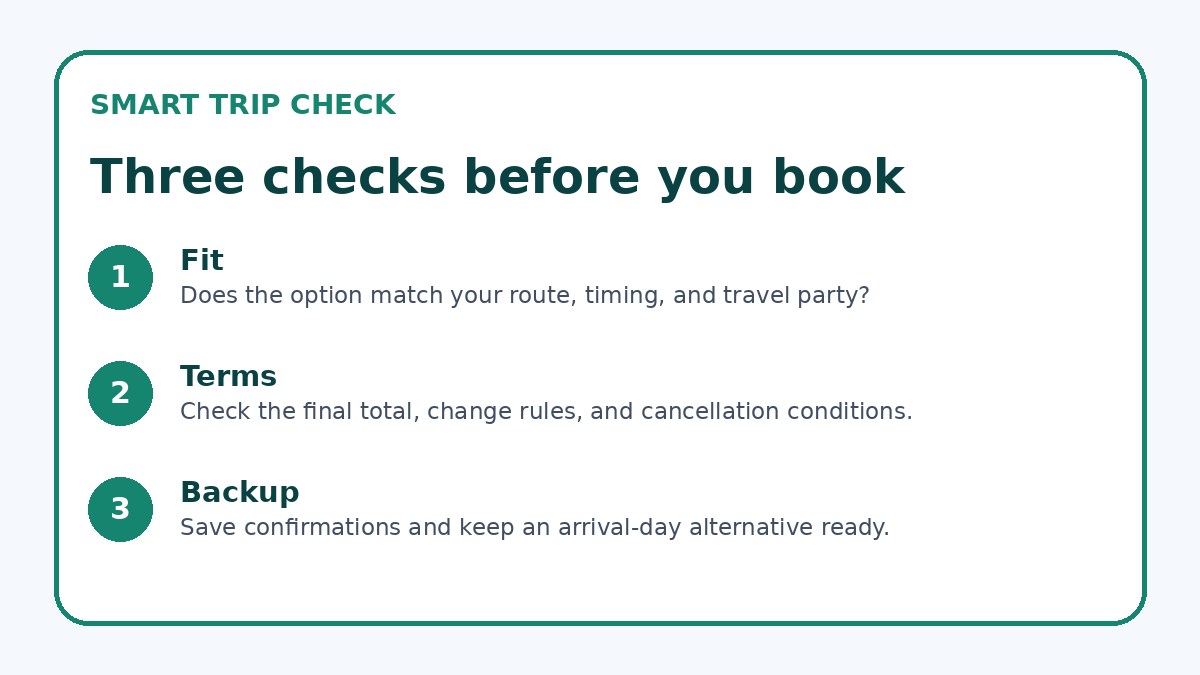
Timing flexibility: schedule control versus predictability
Rail services provide predictable departure and arrival windows and high frequency on the Osaka–Kyoto corridor, which helps when you need to arrive with a narrow tolerance. If your schedule can absorb variability of a few minutes, rail is often the most time-efficient option during peak hours. Private cars give the greatest schedule control—you leave when you want and can be routed around localized delays—but they are subject to road traffic, which introduces variability during rush periods. Coaches may run to fixed timetables and be less frequent than trains, so they are best when you can book a specific departure and accept a single-seat, longer ride.
Account for check-in and boarding time when you plan: trains commonly require only a short platform access time, while coaches might open baggage holds earlier, requiring earlier arrival. If your itinerary includes early-morning or late-evening meetings, confirm the availability of your chosen mode at those hours. Also consider evening transit options back to your accommodation—some services reduce frequency after peak times. For last-minute schedule shifts, choose the mode that offers the fastest recovery: a frequent rail service for short delays or a car to preserve an appointment when train schedules don't align.
Compare the practical alternatives
Use the final page to confirm what is actually offered on your dates and save a workable fallback.
Intercity travel checklist
- Map door-to-door time now: check walking distance from your Osaka origin and Kyoto destination to nearest station or terminal.
- Confirm luggage rules on the service booking page and reserve extra space or a private car if transporting bulky or fragile equipment.
- Identify two alternative departures or routes and note their boarding locations in case of delays.
- Check pickup and drop-off rules with your hotel or meeting venue, including whether they allow curbside loading.
- Build at least a 20–30 minute buffer for transfers between modes during peak hours or tight connections.
- Keep digital copies of meeting materials and a local contact number for quick rescheduling if you are delayed.
Disruption backup: practical fallbacks and what to check
Plan a specific backup before you travel. For rail-dependent plans, identify the next two departures and a reliable taxi stand near your arrival station in case of cancellations. For car plans, have a rail alternative mapped if road congestion is extreme. If you rely on a coach, know nearby rail stations and how to connect from them. Always confirm on the provider’s booking page the latest status, cancellation and rebooking terms, and any luggage restrictions so you can switch modes quickly. Trip.com can be used to compare current options, but verify final availability and rules on the operator’s official page before booking.
A practical disruption plan includes time buffers and a ranked list of alternatives: 1) next available train; 2) short taxi ride; 3) scheduled coach; 4) remote meeting as last resort. If carrying high-value or time-sensitive items, consider insuring them or using a dedicated courier. Communication is key—inform your host or meeting contact immediately about delays and revised ETAs and have digital copies of meeting materials to avoid missing critical deliverables. Keep local payment options and contact numbers ready for taxi or private car bookings to shorten recovery time.
Rail & Intercity Transport questions travelers ask
Is taking the train between Osaka and Kyoto usually faster than driving for business travelers?
Trains typically offer the most consistent travel time between city centers because they avoid road congestion and have frequent departures. For a business traveler whose meeting and accommodation are both near major stations, rail often yields the quickest door-to-door result. Driving or a private car can be faster only when origin or destination locations are far from stations, when you need multiple on-route stops, or when carrying large, sensitive equipment. Verify stations and driving distances on a map and check provider pages for up-to-date schedules before choosing.
How much transfer time should I plan when combining rail and taxi during a business day?
Plan for the time to alight, pass through ticket gates or concourse, and reach the taxi stand or rideshare pickup spot—this often takes 10–25 minutes depending on station layout and crowding. Add extra time for luggage handling and elevator waits. If you are making a tight connection between a train arrival and an important meeting, add a safety buffer beyond your minimum estimate to account for delays. Verify station layouts and designated taxi/rideshare pickup areas on station or operator pages to refine your timing.
What should I verify on a provider’s booking page before committing to an Osaka–Kyoto option?
On any provider page, check departure and arrival locations (exact station or terminal names), baggage allowances and handling procedures, seat reservation options, cancellation and change policies, and any stated accessibility features. For private cars, confirm pickup instructions, allowed waiting time, and whether tolls or parking charges are included. For coaches and trains, review the boarding policy and the latest service status. Use reliable comparison sites like Trip.com only as a starting point and confirm specifics on the official operator’s page before booking.
Final decision note
Choosing the most practical Osaka to Kyoto transport for business travel starts with your door-to-door needs: where exactly meetings or hotels are located, how much luggage you have, and how flexible your schedule can be. Rail is often the most predictable choice for city-center-to-city-center trips; private cars win for multiple stops or heavy equipment; coaches work for straightforward, light-luggage itineraries; and mixed approaches can combine the strengths of each. Before you book, map your precise addresses, verify luggage and boarding rules on the provider’s page, and name a clear backup option. With those checks completed you’ll minimize transfer friction and keep your day’s schedule under control.
Continue planning
Check current options and final conditions
Use the provider page to confirm live availability, the final total, cancellation terms, and every condition that matters to your trip.
This evergreen planning guide was created with AI-assisted drafting and a structured quality review. It does not display live prices, schedules, availability, visa guidance, or provider rankings. Verify current details before booking. Some links are affiliate links; we may earn a commission at no additional cost to you.