If you need to get from Seoul to Jeju for work, the central decision is simple: save time with a direct flight or chase a lower fare and greater schedule variety with a connection. For business travelers the real tradeoff is total door-to-door time and schedule reliability versus potential savings and more departure times. Before shopping, pick exact travel dates, preferred departure windows, baggage needs, and your minimum buffer for meetings — that will quickly narrow whether a direct option or a connecting itinerary makes sense. This guide lays out the routing differences, where connection risk shows up, how baggage rules and fare conditions affect your day, and what practical checks to run on the carrier’s final booking page so you don’t discover restrictions or transfer problems at the airport.

See live routes for your exact travel day
Compare direct and connecting choices with the same baggage and traveler details.
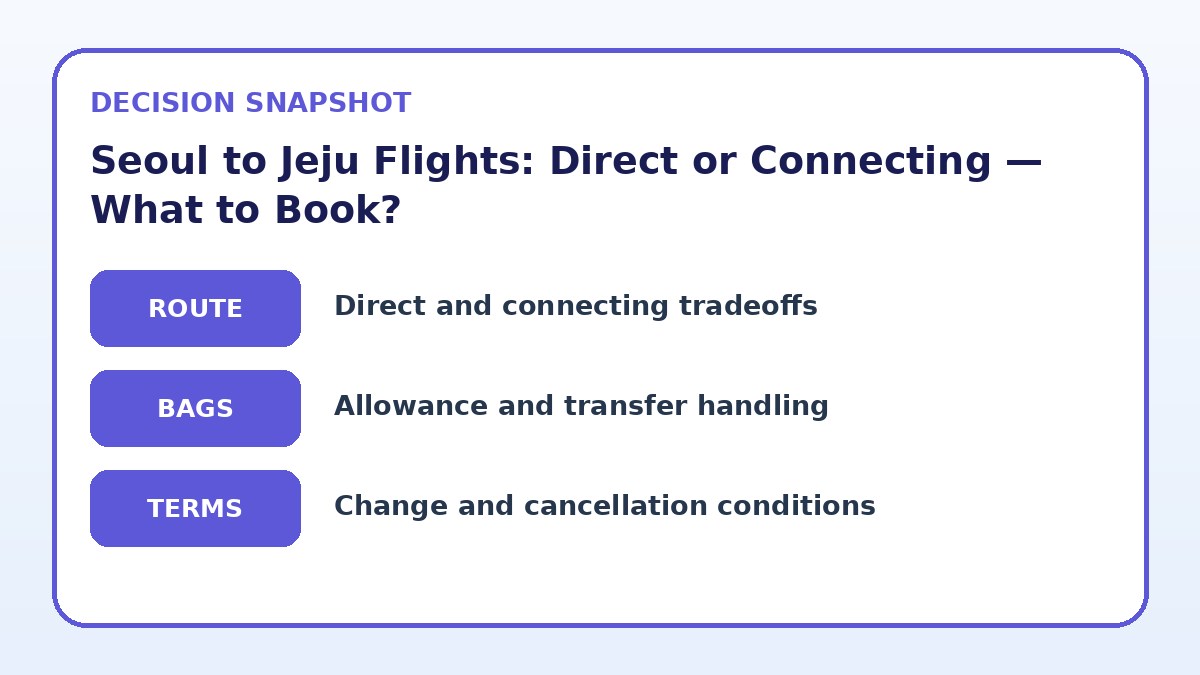
Routing and total travel time
Routing choices matter most because business travel values predictability. A direct flight between Seoul and Jeju eliminates ground or air connections, cutting complexity and usually shortening total travel time. When assessing routing, calculate door-to-door time: include transfer to the airport, check-in and security, the flight time, baggage reclaim, and onward travel at the destination. A direct flight’s shorter airport time often outweighs a small fare difference when you must reach meetings or return the same day.
Connecting itineraries can still be useful if direct schedules don’t align with your obligations. They offer more departure windows by combining services through another city, but each connection adds minimum transfer time, potential waits, and the need to move between gates or terminals. Compare sample itineraries for the exact travel date and time — don’t rely on generic averages — and prefer connections with at least the carrier-recommended minimum connection time plus an extra buffer for delays during busy periods.
Baggage, transfers and connection risk
Baggage rules and how airlines handle transfers are practical issues that affect whether a connection is workable for a business traveler. On a single-ticket itinerary, checked bags are often checked through to the final destination; on separate tickets you may need to reclaim and recheck luggage, which adds time and risk. Verify on the booking page whether transfers are handled by the same carrier or alliance and whether the transfer includes baggage through-checking, because this determines how much time you must allow and whether you need to travel light with carry-on only.
Connection risk also includes missed-connection policies and rebooking procedures. If the same carrier sells both legs, they typically have processes for re-accommodation when delays cause missed connections; if you piece together flights from different sellers, that protection may be absent. For assured continuity, choose single-code itineraries when possible, or add generous connection buffers and flexible fares to cover potential rebooking costs and lost time.
Compare flight-selection strategies
| Flight strategy | Best for | Risk to check |
|---|---|---|
| Book a nonstop direct flight | Travelers prioritizing minimal transfer risk and shortest door-to-door time | Fewer departure windows and sometimes slightly higher base fares compared with connecting options |
| Book a single-ticket connecting itinerary | Those needing specific departure times with carrier-provided rebooking protection | Longer total travel time and dependence on the carrier’s minimum connection windows |
| Book separate tickets for each leg (self-connection) | Price-conscious travelers willing to accept higher risk to access otherwise unavailable schedules | No guaranteed re-accommodation for missed connections and likely need to recheck baggage |
| Choose flexible or refundable fares | Business travelers whose plans may change and who want easy rebooking | Higher upfront cost that can be offset by avoided change fees and reduced stress |
Recheck the complete itinerary
Confirm airports, connection handling, baggage, and change conditions before deciding.
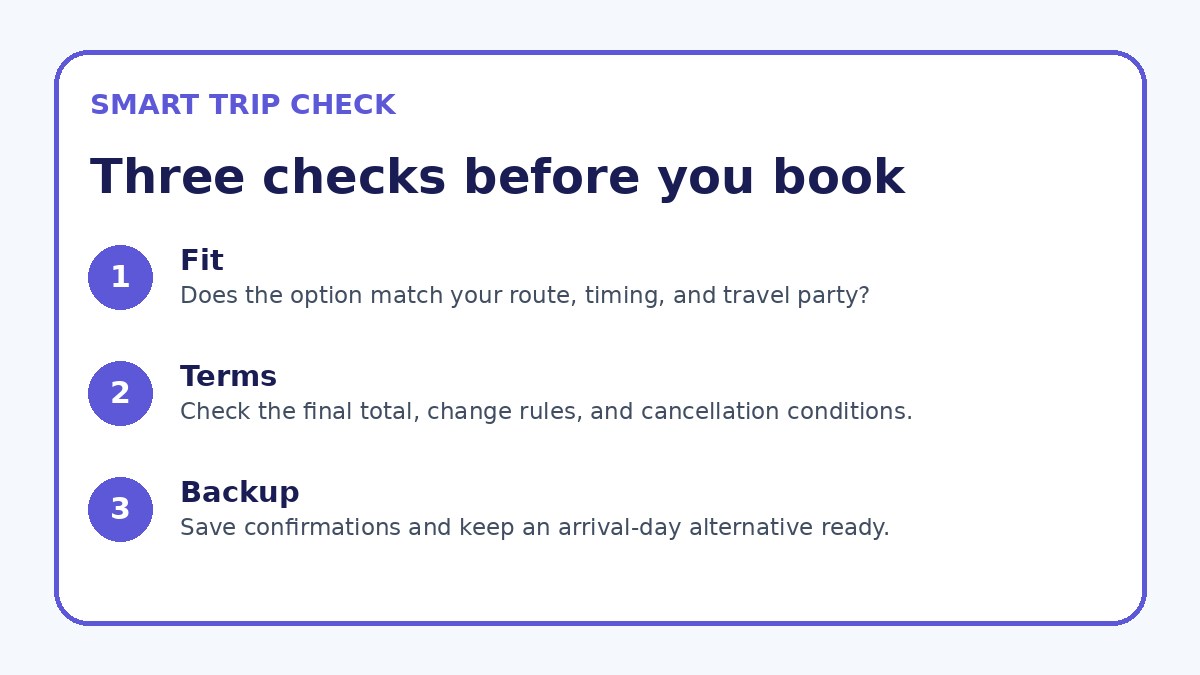
Schedule fit and workday productivity
For business travelers, consider how travel fits into your workday. Direct flights reduce time in transit and unpredictability, making them preferable for same-day roundtrips or tight meeting schedules. Think beyond airborne minutes: consider when you actually leave the office, arrival time at the destination, and whether you can work en route. If you depend on in-flight Wi-Fi or a quiet cabin for last-minute prep, confirm service availability and realistic connection times that won’t chop into productive hours or force you to skip key calls.
Connecting flights can be acceptable if you need an early departure time or a return after business hours that direct services don’t provide. Use connection windows to schedule calls or prepare deliverables, but factor in the likelihood of interruptions: gate changes, boarding delays, or crowded transfer corridors may reduce the productive value of that buffer time. If timely arrival for client meetings is paramount, prioritize schedule certainty over minor savings.
Flight details to verify
- Set exact travel dates and preferred departure/arrival windows before searching fares so you can compare total travel time accurately.
- Confirm whether potential itineraries are single-ticket or separate bookings and verify baggage through-checking on the carrier’s final booking page.
- Check the fare’s change and cancellation rules, including any fees and refund conditions, on the airline’s confirmation screen.
- Calculate door-to-door time for each option including airport transfers, typical security wait times, and minimum connection buffers.
- If considering a connection, choose enough buffer beyond the carrier’s minimum connection time to protect against common delays.
- Compare total trip cost after adding likely ancillary fees (baggage, seat selection, fast track) to understand real value.
Fare conditions, change flexibility and what to verify
Fare rules frequently determine whether a lower headline fare is really better for a business traveler. Look for change and cancellation fees, how refunds are processed, and whether name changes or voluntary rebooking are permitted without heavy penalties. Also confirm baggage allowances tied to the fare class, carry-on limits, and when ancillary fees apply. These details are often buried on the carrier’s final booking page, so check the exact itinerary there before buying to avoid surprise fees that negate any up-front savings.
Other verification points include minimum connection times specified by the carrier, whether the booking is under a single confirmation code, and which airport terminals are involved in a multi-leg itinerary. If you might need to rebook after a delay, verify the carrier’s re-protection policy and whether it applies to separately ticketed flights. Finally, consider travel insurance or refundable fares for high-stakes trips — but always read the policy terms and the airline’s final booking conditions before relying on coverage.
Flight Guide questions travelers ask
How much connection time should I allow between flights when traveling for business?
Aim for more than the operator’s published minimum connection time when schedules are critical. Minimums vary by airport and whether you change terminals. For business travel, add a sensible buffer — commonly 45–90 minutes above the carrier minimum for domestic connections — to allow for arrival gate delays, deplaning, walking, and security lines. If baggage must be reclaimed and rechecked, add extra time. Always verify required minimum connection times on the carrier’s booking page for your specific itinerary and factor in peak-hour congestion.
Are connecting itineraries risky for same-day return meetings?
Connections add risk compared with nonstop flights because a delay on an earlier leg can cause a missed onward flight and lost time. For same-day returns where punctual arrival is essential, nonstops usually offer better reliability and predictability. If you must use a connecting itinerary, pick a single-ticket option with the same carrier or alliance for protection, and select a longer buffer between flights. Consider a refundable or flexible fare to simplify rebooking if delays make you miss your connection.
What should I verify on the airline’s final booking page before paying?
On the final booking page confirm exact flight times, total itinerary duration, whether the booking uses a single confirmation code, checked and carry-on baggage allowances, and change/cancellation penalties. Also verify terminal information, minimum connection times, and whether any legs are operated by partner carriers — partner-operated segments may have different baggage or boarding rules. If the booking is through a third-party site, cross-check the carrier’s official page for policy details and see Trip.com or similar platforms for current availability, but rely on the airline’s confirmation for binding terms.
Final decision note
For Seoul to Jeju business trips the practical choice comes down to whether schedule certainty outweighs potential savings or schedule fits. Direct flights deliver the simplest, most predictable option when meetings demand punctuality and minimal transfer risk. Connecting itineraries can expand timing options and lower upfront costs but require careful attention to baggage handling, connection buffers, and fare rules — especially if you buy separate tickets. Before you book, set exact travel dates, identify your must-have departure or arrival windows, and verify all conditions on the carrier’s final booking page. That sequence of checks will tell you whether a nonstop, a single-ticket connection, or a flexible fare best protects your schedule and peace of mind.
Continue planning
Check current options and final conditions
Use the provider page to confirm live availability, the final total, cancellation terms, and every condition that matters to your trip.
This evergreen planning guide was created with AI-assisted drafting and a structured quality review. It does not display live prices, schedules, availability, visa guidance, or provider rankings. Verify current details before booking. Some links are affiliate links; we may earn a commission at no additional cost to you.