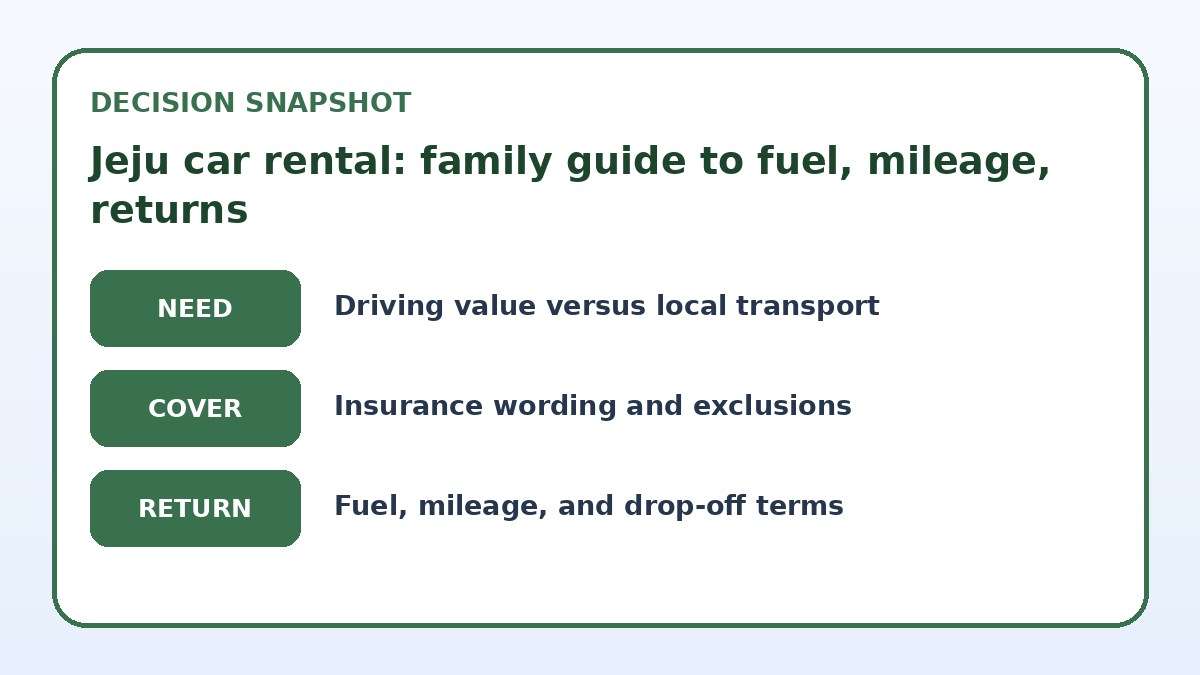
Practical answer up front: renting a car in Jeju usually improves family flexibility, but only if you verify fuel policies and mileage allowances before you book. Those two contract items determine whether a day of sightseeing becomes simple or expensive. Read the fine print on required refueling, whether you must return with a full tank, how mileage is counted or capped, and what penalties apply for overage. Also confirm how insurance handles damage and roadside assistance wording for island-specific incidents. If any of those terms are unclear, ask the company for a written clarification or compare alternatives. Later sections explain the key clauses to check, how they affect routes parents typically choose, the pickup and return friction families face with children and luggage, and a realistic non-driving fallback.
Route value: when driving really helps a family on Jeju
Driving is valuable on Jeju when your itinerary includes dispersed attractions—beaches, waterfalls, coastal drives, and rural villages—where public transit is infrequent or requires long waits. For families with small children or strollers, a car lets you align travel with nap and meal schedules, carry extra gear easily, and stop spontaneously. If you want to follow a loop around the island, reach remote viewing spots, or visit several sites in one day, a rental car often saves time and reduces stress compared with coordinating multiple buses or taxis.
However, if your plan centers on the compact city areas around Jeju City or Seogwipo with mostly nearby restaurants and a few short outings, the cost and hassle of a car may not be worth it. Consider how many daily miles you’ll realistically drive, whether you’ll face parking fees at popular sites, and if any part of your itinerary includes narrow rural roads that might be difficult for inexperienced drivers. Use your intended daily stops to estimate whether mileage allowances and fuel terms align with actual needs.
Decide whether driving earns its place
| Mobility strategy | Best for | Cost or friction to check |
|---|---|---|
| Full rental car with unlimited or high mileage | Families planning long daily drives and flexible sightseeing | Higher base cost but fewer surprises from mileage overage; still check fuel return rules and insurance excesses. |
| Short-term rental with strict mileage cap | Families staying mostly in one area or doing light driving | Lower rental rate may come with tight mileage limits and heavy overage charges if plans expand. |
| Public transport plus taxis for first/last mile | Families open to scheduled routes and minimal driving stress | Less flexibility and possible time lost in transfers; good for lower daily mileage and no rental responsibilities. |
| Private tours or shuttle services | Families who prefer door-to-door service without handling paperwork | Fixed itineraries reduce spontaneity; can be pricier per trip but remove fuel and indemnity concerns. |
Check live rental choices only after the route test
Use the exact driver, dates, pickup point, and return plan to compare current conditions.
Insurance wording: what to read and ask in plain language
Insurance pages often use jargon—collision damage waiver, third-party liability, excess, and comprehensive—that matters to families. Look for the deductible or excess amount and whether it applies per incident or per rental day. Verify whether insurance covers damage to tires, windshields, undercarriage, and damage from unpaved roads; some policies exclude those items. Ask whether there’s a separate fee for adding young drivers or reducing the deductible, and whether child-seat damage is covered if the seat is supplied by the company.
Don’t accept verbal assurances alone. If an agent describes coverage, request the exact clause or a screenshot from the provider’s policy page before you commit. When comparing options, list the deductible, the items explicitly excluded, whether roadside assistance is automatic, and whether the policy requires police reports for claims. If insurance terminology still looks opaque, ask for a simple example: what you would pay out of pocket for a cracked windshield or a parking-lot scrape involving another vehicle.

Compare the full rental conditions
Confirm insurance wording, exclusions, deposit, fuel, mileage, and return terms on the final page.
Pickup and return friction: real-world family considerations
Pickup and return are often the most painful parts of a family drive. Airports and ferry ports may have long queues; downtown counters might require an extra walk with luggage and tired kids. Confirm where the vehicle will be parked at pickup—will you collect the keys right at the desk or walk to a remote lot? Ask whether the company will inspect the car with you and document existing damage to avoid disputes on return. If you need a child seat, confirm its availability, age and weight suitability, and whether there’s a fee to reserve it in advance.
Returning with full tanks, within a narrow window, or at a different drop-off point can create unexpected stress. Check how strictly the company enforces fuel levels, what size grace period they allow for late returns, and whether there are additional fees for cleaning or excess mileage. For ferry-to-ferry or airport-to-city transfers, ask if they accept one-way returns or if a shuttle is needed. Planning these steps in advance prevents last-minute bargaining when everyone is tired and ready to move on.
Car rental terms to verify
- Read the fuel policy: confirm whether you must return the car full, can prepay fuel, or will be charged a refueling fee and exactly how that fee is calculated.
- Confirm mileage allowance: note daily or total caps, overage rates per kilometer, and whether tolls or ferry mileage count toward the cap.
- Obtain written insurance details: deductible amount, covered damage types, and whether roadside assistance or towing is included; screenshot or save the policy page.
- Reserve child seats and specify sizes: confirm free or paid seats, installation method, and whether the seat meets your child’s weight and height requirements.
- Inspect and document vehicle condition at pickup: take time-stamped photos of all four sides, interior, and odometer reading to prevent dispute on return.
- Plan pickup/return logistics: confirm exact pickup location, parking walk distance, allowed grace period for late return, and rules for one-way drops if needed.
Non-driving fallback: workable alternatives for families
If you decide not to drive, you still have reliable options on Jeju. Public buses cover many main routes between towns and attractions—useful for families comfortable with schedules and short walks from stops. Frequent travelers can combine buses with local taxis for first- and last-mile trips; taxis are plentiful but add up across multiple outings. Organized small-group tours or private day tours provide door-to-door pickup and eliminate parking and fuel concerns, though they limit spontaneity.
When comparing alternatives, think about door-to-door convenience, total travel time with kids, and how much luggage or gear you’ll carry. If your kids need naps on the go, a private shuttle or taxi might be worth the cost for flexibility. If you want to compare current availability and conditions, you can check options on Trip.com as one place to view schedules and bookings, but always verify provider pages for the precise fuel and mileage rules before confirming.
Car Rental & Road Trip questions travelers ask
Do I always have to return a rental car in Jeju with a full tank?
Not always—there are a few common fuel arrangements: full-to-full (you pick up full and must return full), prepaid fuel (you buy a tank from the company), or full-to-empty with refueling fees charged on return. The only reliable way to know which applies is to read the rental company’s fuel policy on the booking page before you finalize the reservation. If the wording is unclear, request a plain-language confirmation from the company and ask how they calculate refueling charges and any administrative fees.
How does mileage usually work and how can I avoid overage fees?
Mileage policies vary: some rentals offer unlimited mileage, others set a daily or total kilometer cap. To avoid overage fees, estimate your planned daily driving using your itinerary and map distances between stops; choose a rental with a matching or higher allowance or a short-term upgrade with more kilometers. If you end up close to the cap, avoid unexpected detours and factor in extra kilometers for parking searches and local errands. Always record the odometer at pickup and return to resolve disputes cleanly.
What insurance points matter most for families on Jeju?
Focus on the deductible (how much you pay if there’s damage), what is excluded (glass, tires, undercarriage, and off-road damage are common exclusions), and whether roadside assistance or towing is included. Also verify whether additional drivers need to be listed and whether child-seat damage or theft is covered. For peace of mind, get clear written confirmation of coverage limits and the claims process, including whether a police report is required for minor incidents, and keep emergency contact numbers easily accessible while you drive.
Final decision note
For families, a rental car on Jeju can transform a constrained holiday into a relaxed, flexible trip—provided you check fuel and mileage rules before booking. The core decision comes down to matching your planned routes to the rental’s mileage policy, understanding fuel-return expectations, and clarifying insurance excess and roadside support. If any key term is vague, get it in writing or select a different option. If driving seems likely to add stress rather than convenience, public transit combined with taxis or a private shuttle offers a credible fallback. In all cases, document the car condition at pickup, reserve child seats in advance, and verify policies on the provider’s final booking page so your family’s time on Jeju stays focused on enjoying the island, not negotiating fees.
Continue planning
Check current options and final conditions
Use the provider page to confirm live availability, the final total, cancellation terms, and every condition that matters to your trip.
This evergreen planning guide was created with AI-assisted drafting and a structured quality review. It does not display live prices, schedules, availability, visa guidance, or provider rankings. Verify current details before booking. Some links are affiliate links; we may earn a commission at no additional cost to you.