If your family is planning a visit to Sapporo, the first practical question is whether renting a car will genuinely improve your trip. The short answer: for short stays centered on central Sapporo, public transit and short taxis usually win on convenience and cost; for family itineraries that include day trips to Otaru, ski resorts, hot-spring towns, or exploring rural Hokkaido at your own pace, a car can add flexibility and save transit connections. This guide helps you decide by weighing route value (what you want to see beyond the city), the real friction of pickup and return, the small-print in insurance and driver eligibility, and a concrete non-driving fallback. Read on to compare the mobility choices most families actually consider, plus a checklist and questions to verify on booking pages so you aren’t surprised at the rental counter.
Route value: when driving adds clear family benefits
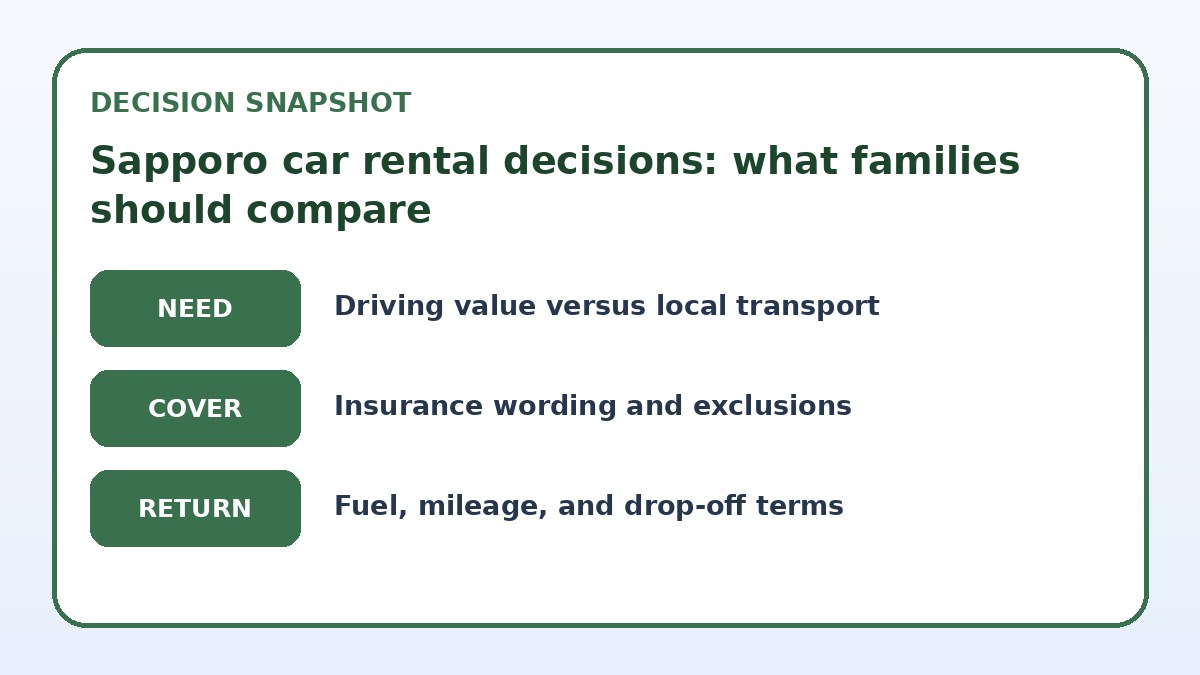
Start with what you want to do. Driving usually wins for families when your plan includes multiple day trips away from central Sapporo—Otaru’s canal and glass studios, coastal viewpoints, ski resorts near Niseko or Teine, or onsen towns that sit off main public transport lines. A car turns a multi-leg train-and-bus day into a single door-to-door journey, which helps small children, rigid nap schedules, and packing for weather or skis. If your itinerary has flexible days with stops in different small towns, the ability to leave when you want and carry more gear is a real advantage.
By contrast, if your trip is mostly museums, markets, city parks, and the snow festival areas (if visiting in season), Sapporo’s municipal and rapid transit network plus short taxis usually make more sense. Central districts have dense services and frequent trains that avoid parking hassles and winter driving stress. To judge route value, map each day’s start and end points, estimate public-transport transfers and wait times, and compare that to estimated driving durations plus time to find parking and settle children on arrival.
Decide whether driving earns its place
| Mobility strategy | Best for | Cost or friction to check |
|---|---|---|
| Full rental for the whole trip | Families with multiple remote day trips or heavy equipment (strollers, skis). | Higher parking and pickup friction; requires careful insurance and winter-driving readiness. |
| Short-term rental for selected days | Families who mainly use public transit but want a car for one or two specific excursions. | More coordination for pickup/return and potential extra fees for one-way or airport transfers. |
| Public transit plus taxis | Short city-centered stays where ease and avoiding parking are priorities. | Less flexibility for rural sightseeing and limited cargo space for larger gear. |
| Car-sharing or one-way rentals | Families wanting flexible day trips without a full-trip rental commitment. | Vehicle availability and child-seat options may be limited; check pickup and drop-off logistics. |
Check live rental choices only after the route test
Use the exact driver, dates, pickup point, and return plan to compare current conditions.
Insurance wording and driver eligibility you must verify
Insurance descriptions can sound simple but hide crucial limits. Look specifically for liability coverage limits, what the collision-damage waiver (CDW) or excess reduction covers, and whether roadside assistance is included. The words to verify: who is an authorized driver, what counts as an approved child restraint or booster, whether gravel or mountain roads are excluded, and what happens in a snow-related incident. On the rental provider’s final booking page check the deductible amount, whether supplements (like young-driver fees) apply, and if your travel insurance or credit-card coverage can reduce the excess.
Driver eligibility is equally important: confirm acceptable international driving permits or translations, minimum and maximum driver ages, and whether your family’s primary driver must show an insurance history or credit card for a hold. If you plan to cross prefectural borders or go onto unpaved roads, verify those permissions explicitly. If any policy wording is unclear, contact the provider and request a written clarification before you pay—don’t rely solely on summary pages or verbal assurances at the counter.
Compare the full rental conditions
Confirm insurance wording, exclusions, deposit, fuel, mileage, and return terms on the final page.
Pickup and return friction: where time and stress add up
Pickup friction can eat a large slice of a short family day. Airports and major stations often have consolidated rental centers, a shuttle transfer, or long queues for check-in. Factor in time to install child seats correctly, get winter tires if needed, and have staff explain the console and toll systems. If your pick-up location is an airport, check whether a free shuttle is required and how frequent it runs. Also verify the provider’s fuel policy, late-return grace period, and whether the return lot is easy to reach with luggage and children.
Returning a car can also be stressful: remote return locations, odd opening hours, or long transfer rides back to your accommodation complicate plans. If you have an evening flight or train, confirm the provider’s after-hours drop-off process and whether they inspect the car on the spot or later—this affects how quickly holds on your card are released. For city hotels without private parking, consider whether parking costs at your hotel plus city parking rules offset the convenience of the car. Always check the exact pickup and drop-off addresses and ask for a photo or map of where to meet staff.
Car rental terms to verify
- Map each planned day’s start and end points and compare door-to-door travel time by car versus public transport.
- Confirm acceptable driver documents (international driving permit or translated license) and the minimum/maximum driver age on the booking page.
- Read the full insurance wording: deductible amount, excluded road types, and whether roadside assistance is included.
- Verify exact pickup and return addresses, shuttle requirements, opening hours, and after-hours drop-off procedures.
- Decide child-seat needs and request models in writing; confirm installation help at pickup if you need it.
- Check hotel parking availability, costs, and whether the hotel can store luggage if you return the car early.
A non-driving fallback that keeps families moving smoothly
If you decide against driving, put a reliable fallback plan in place so the family still travels comfortably. Structure days around transit hubs (Sapporo Station and Susukino) that have easy access to trains, trams, and bus lines. For day trips, book express trains or limited-stop buses where possible and buy reserved seats for longer runs to ensure you can travel together. Arrange for hotel concierge help with local taxi bookings—many hotels can call larger vans or taxis equipped for children with advance notice.
Also prepare a logistics kit: a foldable stroller that fits train entrances, a compact child booster pad, and clear directions to the nearest taxi rank and bus stops from your accommodation. If you need extra flexibility for one or two days, short-term car-sharing services or one-way rentals to a nearby town can combine benefits of both approaches. When comparing options, use a site like Trip.com to see current availability, but always confirm vehicle details, insurance wording, and pickup/return addresses on the rental provider’s official booking page.
Car Rental & Road Trip questions travelers ask
Is winter driving in Hokkaido suitable for families without snow experience?
Winter driving around Sapporo and wider Hokkaido can involve heavy snow, ice, and rapidly changing conditions. If no driver in the family has recent experience with winter tires and snowy roads, renting a car increases stress and safety risk. If you still prefer to drive, insist on vehicles with studded or reliable winter tires, confirm the provider’s winter driving guidance and snow-related coverage in the insurance wording, and plan only short, well-maintained routes. Alternatively, use trains and buses for longer winter routes and hire local taxis for short transfers.
Can I rely on child seats from rental providers in Sapporo?
Many providers offer child seats but models, sizes, and availability vary. Always request the exact type (infant carrier, convertible, booster) on the booking page and ask the provider to confirm the seat’s certification and suitability for your child’s weight and height. If possible, bring your own portable booster or properly fitted restraint. At pickup, check that seats are correctly installed or ask staff to install them; document the claim with a photo and written acknowledgment if installation confirmation is important for insurance or safety reasons.
How do I compare total time and cost between driving and public transport?
Compare door-to-door travel times rather than raw driving or train schedules. For driving, include time for pickup, installing child seats, parking search, and return inspection. For public transport, add walking between platforms, transfers, waiting times, and potential taxi legs. For cost, add rental base rate plus insurance supplements, parking fees, tolls, and fuel, then compare that to train/bus fares and expected taxi rides. Use a simple spreadsheet or notes to total estimated time and expense for each day to decide which approach saves family energy and stress.
Final decision note
Deciding whether to rent a car for a family trip to Sapporo depends on the balance between route value and friction. If your days stay inside central Sapporo, public transit and occasional taxis generally reduce hassle and parking costs; if your plan includes several rural day trips, ski areas, or tight schedules with young children, a car can deliver decisive convenience. Whatever you choose, verify the exact insurance wording, driver eligibility, and pickup/return logistics on the rental provider’s final booking page. Prepare a non-driving fallback for at least one day, and use the checklist above to ensure the chosen option keeps your family safe and on schedule.
Continue planning
Check current options and final conditions
Use the provider page to confirm live availability, the final total, cancellation terms, and every condition that matters to your trip.
This evergreen planning guide was created with AI-assisted drafting and a structured quality review. It does not display live prices, schedules, availability, visa guidance, or provider rankings. Verify current details before booking. Some links are affiliate links; we may earn a commission at no additional cost to you.