If you’re planning to drive in Dubai by yourself, the practical question is simple: will renting a car actually improve your trip, or will insurance wording, pickup friction and city driving make other options wiser? For many solo travelers the answer depends on route value — will you be using the car for desert excursions, day trips to nearby emirates, or mostly moving inside the city? Insurance wording is often the dealmaker or dealbreaker: how much liability, what the excess (deductible) really covers, whether third-party damage, tyre and windscreen cover, and named-driver rules apply. This guide gives the quick decision, then walks through the specific contract phrases to verify on the final booking page, the pickup and return frictions you might face, and a clear non-driving fallback. Read these points with your itinerary in hand so you can match coverage to risk before you commit at checkout.
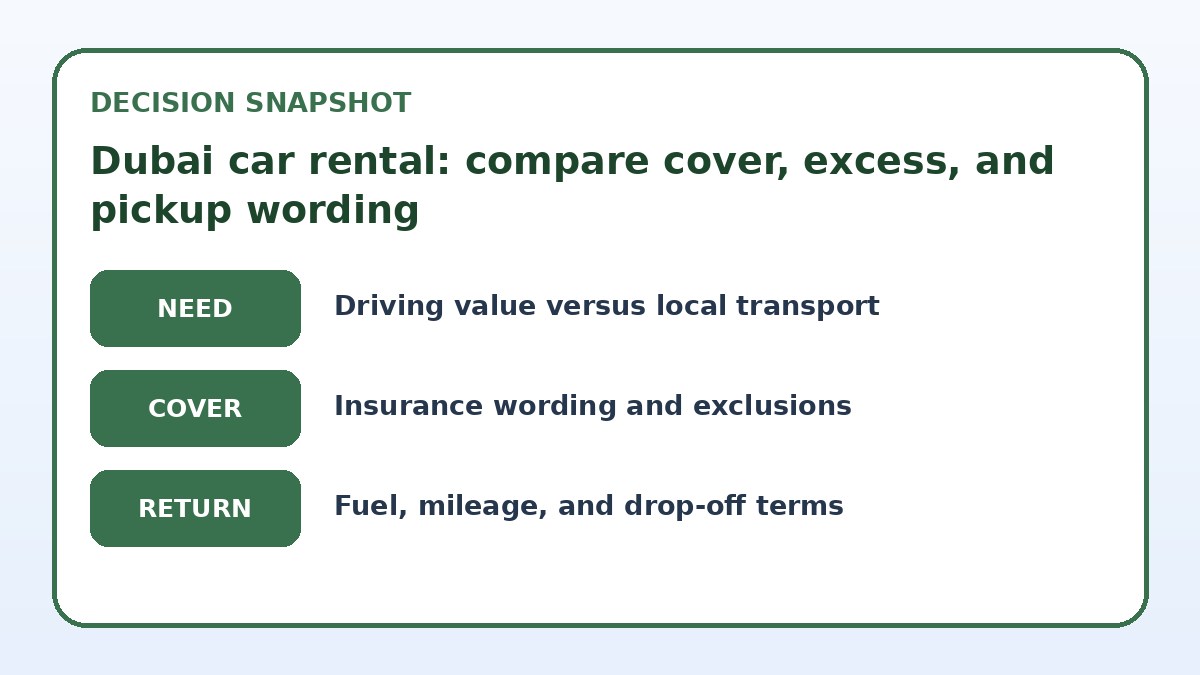
Decide whether driving actually improves your Dubai itinerary
Start by listing the concrete trips you expect to make: desert excursions, coastal drives, trips to Abu Dhabi or Sharjah, or mostly city runs. If your day plan includes multiple early starts or sites with limited public transport — remote deserts, off-hour photo spots, or flexible day trips — a car can save time and enable spontaneous detours. By contrast, if you plan to stay inside central Dubai with ready ride-hailing or organised tours, the convenience benefit of driving shrinks and fixed costs and insurance constraints take on more weight.
For solo travelers, the time and attention you must give to navigation, parking, and local driving norms are real costs. Weigh those against the itinerary benefits. If the trip only uses a car for one or two organized excursions, booking those excursions or private transfers can be easier than taking on the administrative and insurance complexity of a rental. Use this decision first: if driving brings clear route value, proceed to parse the insurance wording closely; if not, skip straight to the non-driving fallback section.
Decide whether driving earns its place
| Mobility strategy | Best for | Cost or friction to check |
|---|---|---|
| Rent a car with basic insurance | Short local drives where cost is more important than comprehensive cover | Lower upfront cost but higher excess and exclusions you must accept in writing |
| Rent with reduced excess or full cover add-on | Solo travelers planning longer road trips or remote stops who want lower financial risk | Higher rental charge but much lower out-of-pocket risk after incidents |
| Rideshare and taxis for city travel | Urban-only itineraries avoiding rental admin and insurance complexity | Less freedom for multi-destination day trips and potentially higher cumulative cost |
| Guided day tours or private transfers | Inter-emirate trips and desert excursions without handling insurance or navigation | Schedule and route are less flexible, though paperwork and risk are minimised |
Check live rental choices only after the route test
Use the exact driver, dates, pickup point, and return plan to compare current conditions.
How to read the insurance wording: words that change the cost and risk
Insurance summaries on the booking page are shorthand; the details live in the rental conditions and policy documents. Start with excess (deductible): the excess is your financial responsibility after a claim. Look for phrases like ‘collision damage waiver (CDW),’ ‘partial cover,’ or ‘zero excess’ and then read the fine print to see what exceptions apply. Check whether theft protection excludes keys, personal items, or certain locations. Note also whether windscreen and tyre damage are included or excluded — those often look trivial until an incident occurs.
Next, confirm who is covered to drive: terms such as ‘additional drivers allowed’ or ‘named drivers only’ determine whether you can swap drivers or add someone during the rental. Read the liability limits and third-party coverage wording to know whether the policy covers property damage and bodily injury to others. Finally, search the contract for geographic limits, age-related restrictions, and speed-limit exclusions; these are the clauses that can void cover. Always verify these exact phrases on the provider’s final booking page before you accept the rental.
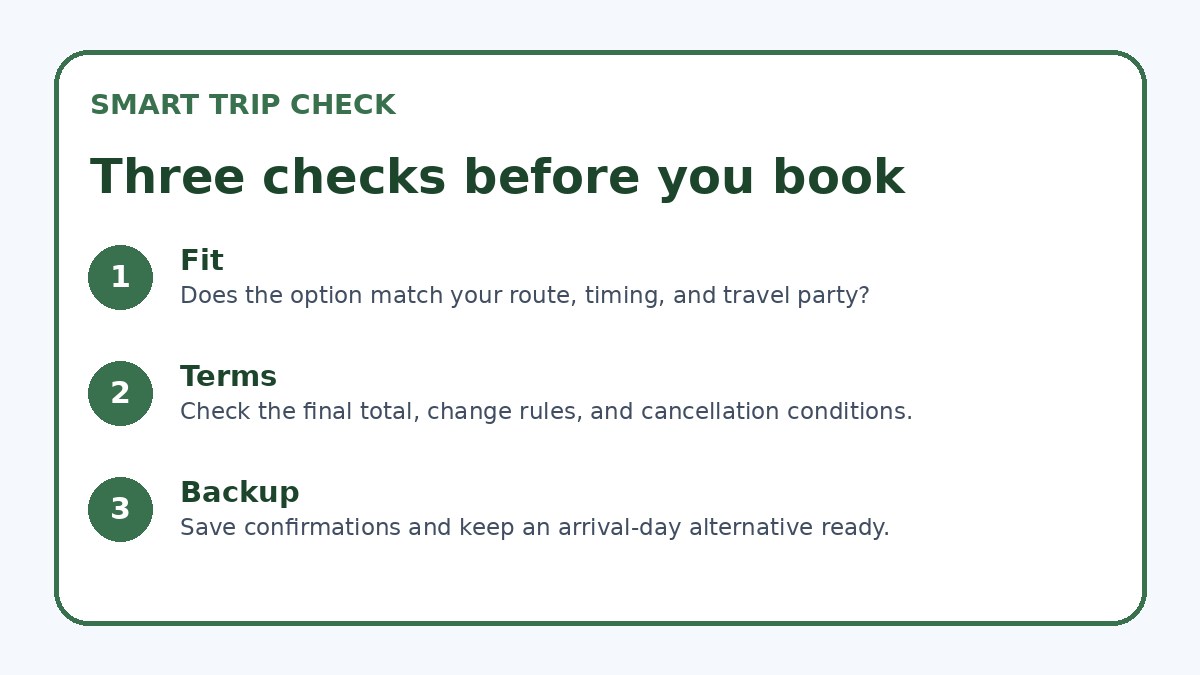
Compare the full rental conditions
Confirm insurance wording, exclusions, deposit, fuel, mileage, and return terms on the final page.
Pickup, return and other friction points to check on the booking page
Pickup and return wording affects both time and unexpected cost. Confirm where the vehicle will be collected and dropped off — airport counters, curbside meet-and-greet, or city office — and whether there are extra charges for airport collection or out-of-hours returns. Read the booking page for the required documents: most providers list driving licence requirements, passport, credit card for deposit, and whether an international driving permit is needed. These items are often highlighted on the final booking screen and the local rental terms.
Fuel and damage inspection rules are also important. Look for the fuel policy wording (full-to-full is simplest) and whether the company charges refuelling fees. On damage, confirm how pre-existing marks are recorded: some providers require a joint inspection and a signed checklist at pickup. If the contract mentions third-party damage reporting procedures, note the timeframe and documentation required to file a claim. If any of these items are unclear or onerous on the booking page, treat them as red flags and ask questions before finalising.
Car rental terms to verify
- On the rental booking page, open and download the full rental conditions and the insurance policy PDF before you confirm.
- Verify the listed excess amount and the exact terms that reduce or waive it, including whether a credit-card hold is required.
- Confirm which damages are excluded (tyres, windscreen, underbody, keys) and whether separate cover for these items is offered.
- Check the allowed geographic area and whether travel to other emirates or nearby countries is permitted in writing.
- Note pickup and return locations, after-hours procedures, and the document list required at collection (license, passport, card).
- Compare the total out-the-door cost of rental-plus-add-ons with a private transfer or guided tour for the same route.
Non-driving fallback: get the same mobility with less paperwork
If insurance wording looks restrictive or too costly relative to your route value, choose a non-driving plan that preserves your itinerary. Taxis and ride-hailing apps cover most urban travel and short day trips without deposit or excess exposure. For full-day excursions to the desert or between emirates, compare guided day tours or private transfers that include pickup and drop-off, which often bundle transport and local knowledge so you don’t need to worry about insurance wording.
Public buses and inter-emirate coaches are cheap and increasingly frequent for longer hops, while local metro and tram networks handle central Dubai efficiently. If your goal is solo flexibility without administrative hassle, combine ride-hailing for short trips with a single private transfer or organised tour for destinations beyond easy public transport. When you compare these options, use Trip.com or the provider’s booking page to check cancellation policies and what is included in the service so you aren’t surprised at checkout.
Car Rental & Road Trip questions travelers ask
Do I need an international driving permit to rent a car in Dubai as a solo traveler?
Whether you need an international driving permit depends on your country of licence and the rental provider’s stated requirements. Many national licences are accepted, but some providers require an international driving permit or certified translation. The correct place to verify this is the provider’s final booking page or the detailed rental conditions PDF linked there. Bring both your passport and licence to pickup; if the booking page lists additional ID or permits, arrange them before arrival to avoid refusal at the desk.
What does 'excess' or 'deductible' mean and how can I reduce my financial exposure?
Excess, also called deductible, is the amount you are responsible for if a claim is made after damage or theft. The rental contract will state the base excess and any conditions that can increase it. You can reduce exposure either by purchasing the provider’s reduced-excess or zero-excess product, buying a third-party rental excess insurance from a specialist, or using a credit card that includes car rental cover — but all of these have specific exclusions. Always read and compare the precise wording on the booking page and policy before relying on any reduction.
If I’m stopped by police or have an accident, what insurance wording should I check now?
In an incident, the key clauses relate to reporting procedures, liability limits, and exclusions. Check how quickly you must report to the rental company and local authorities, what documentation they require, and whether failing to follow reporting steps voids cover. Also look for clauses about driver responsibility for traffic violations, towing and recovery, and whether any behaviour (speeding, off-road driving) is specifically excluded. Keep a copy of the rental terms and the insurer’s contact details in your phone for immediate reference.
Final decision note
For solo travelers in Dubai, the decision to rent comes down to route value and reading the insurance wording carefully. If your itinerary truly gains from flexible drives — desert access, multiple emirate stops, or early starts — choose a rental only after confirming excess, covered damage types, named-driver rules and pickup procedures on the final booking page. If the insurance terms are restrictive or the added cost outweighs the flexibility, use ride-hailing, public transport and guided transfers to cover the same ground without the paperwork. Whatever you choose, verify the explicit contract phrases and keep digital copies of all terms so you’re not surprised at pickup or on the road.
Continue planning
Check current options and final conditions
Use the provider page to confirm live availability, the final total, cancellation terms, and every condition that matters to your trip.
This evergreen planning guide was created with AI-assisted drafting and a structured quality review. It does not display live prices, schedules, availability, visa guidance, or provider rankings. Verify current details before booking. Some links are affiliate links; we may earn a commission at no additional cost to you.