Practical answer first: for most business travelers, a high-speed rail service between Florence and Milan offers the best balance of city-center terminals, luggage convenience, and predictable travel time; keep a coach or private transfer plan as a disruption backup. If your schedule needs absolute door-to-door control, a private transfer or driving solves the first-mile/last-mile problem but adds unpredictability in traffic. Choosing means weighing terminal fit, luggage and transfer friction, timing flexibility, and how you’ll handle delays or cancellations. This article explains how to compare the four main approaches end-to-end, what to check on provider booking pages before committing, and how to build simple backups so your meeting day stays on track.
Choosing your mode: rail, coach, private transfer, or a mix
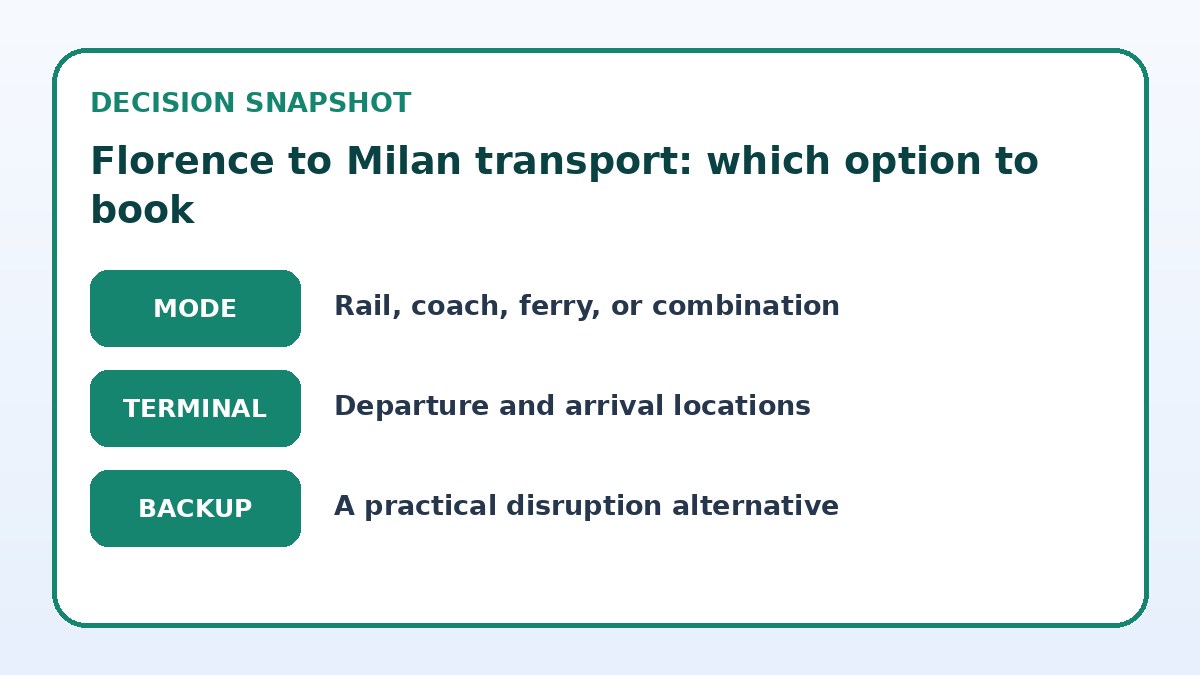
Start by mapping where your meeting begins and where you’ll end the day. Rail typically links central Firenze and Milano stations, which reduces local taxi time and is convenient if your itinerary stays within the urban cores. Coaches often serve peripheral terminals or dedicated bus hubs; that can be fine if you have a planned first- or last-mile transfer. Private transfers and door-to-door services remove the terminal step entirely, beneficial for tight schedules or transporting sensitive materials. A mixed plan—fast train plus a short taxi—can combine the reliability of rail with the flexibility of a private ride for short first or last-mile legs.
When choosing, don’t optimize solely for the ride’s advertised duration. Consider how each option integrates with hotels, office locations, and airport connections. Ask where the service actually stops, how far the stop is from your meeting address, and whether you’ll need to switch vehicles. For example, a coach that arrives 20 minutes outside the city may negate any price advantage if you then need a long taxi. Likewise, private transfers are convenient but may be delayed by congestion during peak commuting hours. Balance convenience against predictable travel margins.
Choose the end-to-end journey plan
| Journey approach | Best for | Friction to check |
|---|---|---|
| High-speed rail plus short taxi | City-center meetings that need predictable arrival and a short last-mile ride | Requires a quick transfer from station to final address and seat reservation checks for working onboard |
| Direct coach service | Travelers prioritizing luggage capacity and lower direct costs who can tolerate peripheral stops | Often lands outside central districts, which adds transfer time to business destinations |
| Private door-to-door transfer | Those needing full control of schedule and minimal handling of luggage or confidential items | Exposed to road traffic unpredictability and typically higher cost than public options |
| Mixed approach (coach or regional train plus local taxi) | Flexible schedulers who want to balance cost and convenience with planned transfers | Requires coordinating separate bookings and allowing buffer time for connections |
Check live intercity options
Look beyond the ride itself and compare terminals, transfers, luggage, and arrival fit.
Terminal fit and luggage/transfer friction
Terminal fit means more than station name: it’s about platform access, luggage handling, and the time it takes to get from arrival point to your meeting. Trains usually have straightforward platforms and level boarding for luggage, which simplifies moving between vehicle and taxi or tram. Coaches sometimes unload passengers at designated bays that lack quick taxi access or covered walkways, so check transfer distance and whether porter help is available. For private transfers, verify vehicle size and whether the operator can accommodate oversized bags or equipment; request vehicle specifications on the booking page if necessary.
If your journey includes an intermediate transfer—train to taxi, coach to tram—plan for extra time and physical effort moving luggage. Choose accommodations with luggage storage if you have early arrival or late departure. On the booking page, verify baggage allowances, whether you have guaranteed overhead or hold space, and how the provider documents special items. Don’t assume rapid platform-to-street transitions; schedule a buffer to collect bags, navigate ticket gates, and reach your onward vehicle without racing between appointments.
Timing flexibility and building sensible buffers
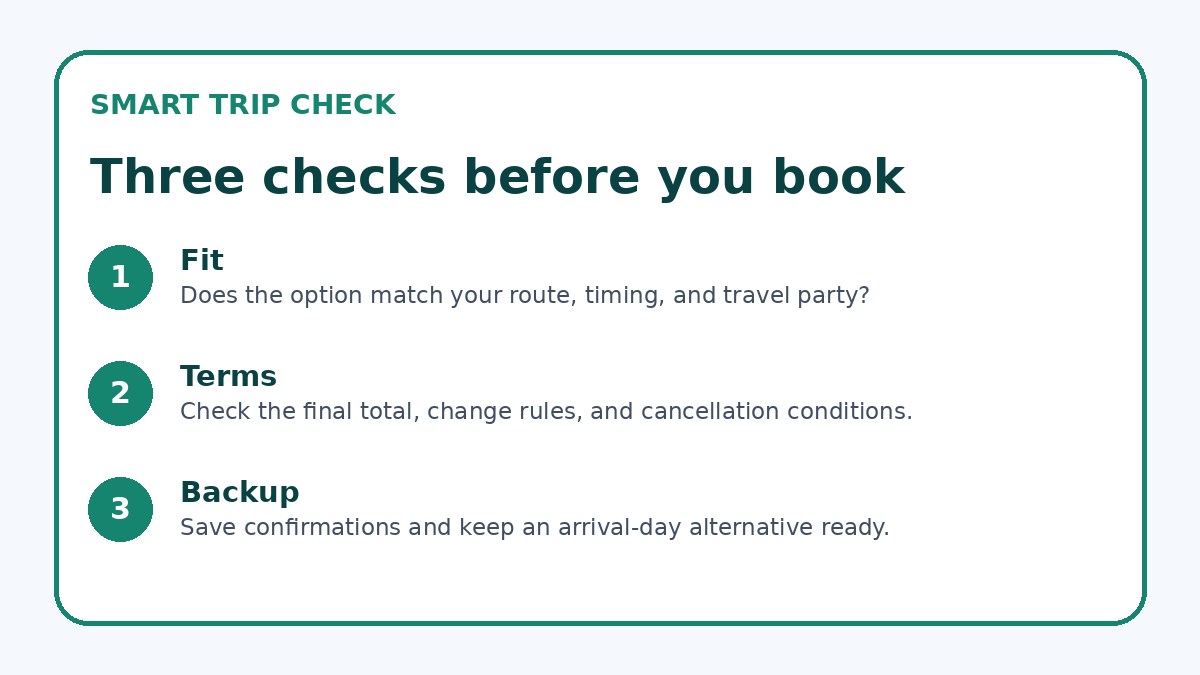
Business travel demands realistic timing. When you set your departure slot, work backward from the latest acceptable arrival time at your meeting venue and add clear buffers for connection friction, traffic, and unexpected delays. If you need arrival flexibility, look for services with multiple departures throughout the day rather than a single early option. For train travel, secure a seat or a flexible ticket if your plans might change; if you must arrive across the city, add additional time for local transfers. For private transfers, build in guard time for peak-hour congestion by consulting local traffic patterns rather than trusting scheduled drive durations alone.
Also consider check-in behavior: if you expect to work en route or prep materials, choose an option with reliable onboard connectivity or seat space suitable for a laptop. If uninterrupted focus is critical, a private transfer might allow phone calls but could be noisy; a train carriage reserved seat with a table often gives a better environment. Wherever you book, confirm on the provider page whether seat reservations, Wi-Fi, power outlets, or quiet compartments are available, and make reservations that match the level of productivity you require during the journey.
Compare the practical alternatives
Use the final page to confirm what is actually offered on your dates and save a workable fallback.
Intercity travel checklist
- Confirm exact arrival and departure addresses used by the provider and map transfer distance to your meeting venue.
- Verify luggage allowances, vehicle size, and whether special items need pre-notification on the provider’s booking page.
- Add at least 30–60 minutes buffer for station-to-office transfers and potential platform or gate walking times.
- Check seat reservation, Wi-Fi, and power outlet availability if you plan to work en route, and reserve accordingly.
- Note customer service contact details and flexible rebooking or cancellation terms before finalizing your booking.
- Save a local backup option (next train or a reputable transfer company) and a mobile contact to book it quickly if needed.
Disruption backup and what to verify before booking
Create a simple backup plan for common disruptions: missed connections, service cancellations, strikes, or road incidents. Your baseline plan should name the primary option and a second-choice leg—usually the next frequent train or a coach with a close arrival point—or the local transfer company you’ll call if the first provider fails. Note contact details, booking reference numbers, and flexible ticket rules. On the provider booking page, check change and cancellation policies, whether you can rebook on the same day, and what customer support channels are offered in English if you don’t speak Italian.
Also verify real-world entry and exit details: station address used for arrivals, recommended platform access times, and whether there are temporary engineering works on your date. If you plan to use Trip.com or another aggregator to compare availability, use it to surface options but always open the operator’s final booking page to confirm exact departure points, baggage allowances, and refund/change terms. Store a printed or screenshot copy of your itinerary and local contact numbers in case mobile data is unreliable mid-journey.
Rail & Intercity Transport questions travelers ask
Is taking the train from Florence to Milan better for same-day business trips?
Trains commonly offer a consistent city-center-to-city-center experience that minimizes first- and last-mile time, which is critical for same-day meetings. For business travelers, high-frequency services give multiple boarding options so you can pick a departure that fits meeting windows. However, ‘better’ depends on your exact door-to-door needs: if your appointment is outside the city center or you must transport bulky equipment, a private transfer or coach might be more appropriate. Before booking, check the train’s arrival station relative to your meeting address and whether reserved seating meets your work requirements.
How much time should I allow between an arrival in Milan and an important meeting?
Allow a buffer that accounts for disembarking, luggage collection, ticket barriers, and local transit or taxi travel—typically 30 to 60 minutes for central station arrivals. If you’re arriving at a peripheral bus terminal or expect heavy luggage, add more time. Also consider time for last-minute prep or finding a quiet space to join a call. If punctuality is critical, choose an earlier service and a transfer method with reliable local access. Confirm actual station exit points and taxi ranks on the provider page to refine your timing buffer.
What should I check about baggage rules and special items when planning this route?
Different operators have distinct baggage allowances and rules for oversized or fragile items. Before booking, read the provider’s baggage policy for hold and cabin dimensions, any fees, and whether advance notice is required for special cargo. For mixed itineraries, verify baggage arrangements on both legs: a coach may allow larger items than a train, or a private transfer may offer more trunk space. If transporting valuables or confidential materials, confirm secure handling options and keep a receipt or tag for each bag.
Final decision note
Planning a business travel day from Florence to Milan comes down to matching terminal fit, luggage needs, timing flexibility, and backup readiness to your meeting priorities. Trains typically serve central stations and offer a reliable baseline; coaches and private transfers fill specific needs around luggage or door-to-door control. Before you book, verify exact stop locations, baggage rules, seat or vehicle features, and change or cancellation provisions on the provider’s final booking page. Keep a clear backup plan—another train, a coach, or a transfer—and store contact information so you can pivot quickly if something disrupts your day.
Continue planning
Check current options and final conditions
Use the provider page to confirm live availability, the final total, cancellation terms, and every condition that matters to your trip.
This evergreen planning guide was created with AI-assisted drafting and a structured quality review. It does not display live prices, schedules, availability, visa guidance, or provider rankings. Verify current details before booking. Some links are affiliate links; we may earn a commission at no additional cost to you.