
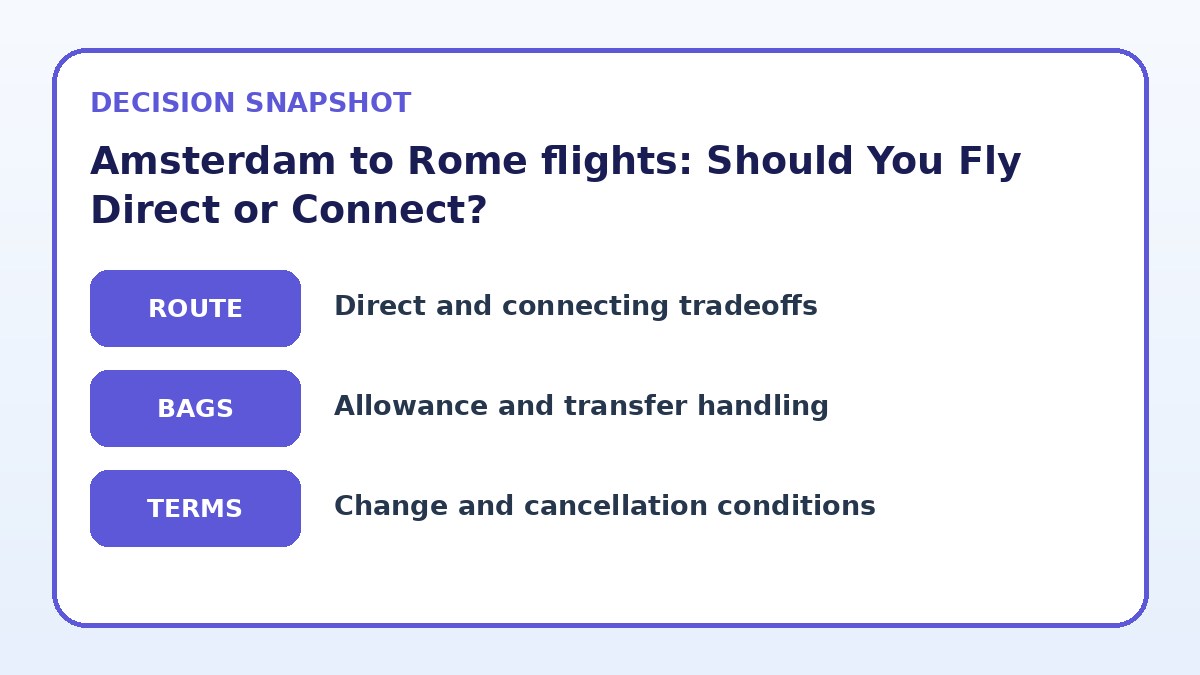
Practical answer up front: if you prize speed, simplicity and fewer transfer risks, choose a direct Amsterdam to Rome flight when available. If you prioritize a lower fare, greater schedule flexibility, or want to visit another city en route, consider a one-stop connection. For most first-time visitors, a direct flight shortens transit time and reduces the chance of missed connections or lost baggage, but connecting options can save money or open better departure times. When comparing your options, weigh total door-to-door time, transfer buffer, baggage transfer policies, the carrier’s protection for missed connections, and the airport logistics at your layover. Read the booking conditions on the airline or online travel agency’s final page — verify whether separate tickets are involved and what happens if a connection is delayed.
How to compare total travel time, not just flight time
When you compare Amsterdam to Rome flights, don’t fixate on the airborne time shown in search results. Total door-to-door travel time includes getting to Amsterdam’s airport, the official check-in and security recommendations, the flight time, layover duration, and the time from Rome’s arrival airport into the city. For first-time visitors, factor in unfamiliarity with airport layouts and potential queues; a tight connection that looks feasible on paper can become stressful if you need to change terminals or pass through passport control. Use realistic estimates for arrival at the airport (often earlier than seasoned flyers expect) and add a cushion for unexpected delays so you can compare options that truly meet your schedule and comfort level.
Some travelers value minimizing total elapsed time and will prefer a direct flight even at higher fare. Others accept a longer trip if it significantly lowers cost or creates an opportunity to stopover. When assessing a connecting itinerary, check whether the layover is a single long break in one terminal or requires changing airports or terminals — the latter greatly increases connection risk. Also consider secondary factors like the timing of arrival in Rome: arriving late at night may reduce ground transport options. Compare what you gain and lose in practical terms rather than just minutes in the air.
Baggage, checked connections, and single- vs separate-ticket risks
Baggage rules and how luggage is handled can flip the decision between direct and connecting flights. On a single ticket where both segments are ticketed by the same carrier or are interline partners, checked bags are usually transferred automatically to Rome, which simplifies transfers. However, if your connection uses separate tickets or low-cost carriers without baggage reciprocity, you may need to collect and recheck your suitcase, clear security, and possibly buy a second bag allowance. For first-time travelers, the simplest option is often preferable — fewer baggage handoffs mean less worry about lost luggage or last-minute recheck lines.
Before booking a multi-carrier connection, verify on the carrier’s or booking page whether baggage is through-checked and whether the airline protects you if the first flight is delayed. If protection is not provided, you’ll shoulder the risk of missed connections and extra costs for rebooking. Also check size and weight allowances; budget carriers on one segment might have stricter checked-bag policies than legacy airlines. When in doubt, choose a longer layover or purchase travel protection that explicitly covers missed connections and baggage problems, and always confirm the baggage transfer policy at the time of booking.
| Approach | Best for | Tradeoff to check |
|---|---|---|
| Direct flights | Travelers who want the fastest, lowest-stress door-to-door journey | Often higher fares and fewer schedule choices than connecting itineraries |
| Short connecting flights (single layover) | Passengers seeking lower fares or more departure/arrival time flexibility | Higher risk of missed connections and longer total travel time |
| Long layovers or deliberate stopovers | Travelers who want to visit another city briefly or split a long trip | Adds complexity, potential extra transport costs, and longer overall travel time |
| Separate-ticket connections | Budget travelers hunting lower fares across different carriers | You’re responsible for missed connections and baggage transfers unless you add protection or allow long buffers |
Cost tradeoffs, flexibility, and change/cancellation policies
Ticket price is often the deciding factor but it’s rarely the whole story. Connecting flights can be cheaper because carriers compete on certain legs or use hub pricing strategies, and they sometimes allow fare combinations that reduce cost. But cheaper fares may come with more restrictive change and cancellation policies, higher secondary fees for seat selection or baggage, and less protection if disruptions occur. For first-time visitors who value peace of mind, a slightly pricier direct fare that includes reasonable change flexibility or better protection for missed connections can be a better overall value.
When you evaluate fares, inspect the fare conditions on the airline or booking site’s final page. Look for change fees, the cost to cancel or rebook, refundability, and how the carrier handles delays that break connections. If you need schedule flexibility—work constraints, an uncertain arrival date, or plans that might shift—prioritize fares that allow reasonable changes without punitive fees. Remember that third-party aggregators are useful for comparison, and Trip.com can be used to view current availability, but verify the final terms on the airline’s booking page before committing to purchase.
Before you book
- Confirm whether your itinerary is on a single ticket or multiple tickets and read the carrier’s statement about baggage transfer and missed-connection protection.
- Calculate door-to-door time: include travel to/from airports, recommended check-in and security time, layover duration, and likely ground transit after arrival.
- Verify the terminal details and whether transfers require changing terminals or exiting and re-clearing security at the layover airport.
- Check fare rules on the airline’s booking page: change fees, refundability, and whether protective rebooking policies apply for delays or cancellations.
- If you have checked luggage, decide whether to purchase through-checked baggage or allow a longer connection to collect and recheck bags safely.
- Set a realistic minimum connection time for your comfort level—add extra buffer if you’re new to international airports, flying with family, or navigating passport control.
Airport logistics: which airports and how transfers feel on the ground
Amsterdam’s main airport and Rome’s airports have different layouts, transport links, and transfer conveniences that influence whether to choose direct or connecting routes. A direct flight to Rome’s primary airport usually delivers you closer to central Rome, while connections that route through other hubs may pass through airports with longer transfer walks, shuttle requirements, or separate terminals. For first-time visitors, consider ground transport options on arrival: how easy is it to get a taxi, train or airport shuttle, and how long will that trip take? These on-ground details change the practical appeal of both direct and connecting choices.
If a connection requires a terminal change at your layover airport, research whether transfers require exiting and re-entering security or even traveling between separate airport sites. These transfers add time and stress, especially if you’re unfamiliar with the language or signage. Also note evening connections that leave you with limited ground transport at arrival: a cheap overnight connection that arrives after public transport stops may incur extra taxi costs. Before booking, look at terminal maps, typical transfer procedures, and whether the airport offers assisted transfers if you’d prefer guidance during a tight layover.
Frequently asked questions
Is a direct flight always the fastest way from Amsterdam to Rome?
In most cases a direct flight will be the quickest airborne option, but total travel time depends on more than flight time alone. Door-to-door speed considers time spent traveling to and from airports, recommended check-in and security windows, and how long it takes to reach your destination in Rome after landing. A connecting itinerary with an overnight rail or well-timed daytime layover could fit your schedule better if it aligns with local transport or hotel plans. For practical comparison, calculate total elapsed time and include transfer buffers before deciding.
How much connection time should I allow when booking a flight with a layover?
There’s no universal minimum because airports and itineraries vary, but first-time visitors should err on the side of caution. Factor in time for deplaning, possibly clearing passport control, walking between gates or terminals, and passing a security checkpoint if required. A comfortable minimum for international-to-international same-terminal transfers might be 60–90 minutes; if you must change terminals, clear immigration, or collect and recheck luggage, allow several hours. Always check the airline’s recommended minimum connection time and plan extra buffer for unfamiliar airports.
If I choose a connecting flight and miss my connection, who pays for the next flight?
Responsibility depends on whether your flights are booked on a single ticket or as separate tickets. If the airline sold both legs on one ticket (or partners have an interline agreement), they typically rebook you on the next available flight at no extra fare, though conditions vary—check the carrier’s disruption policy. If you booked separate tickets, each carrier treats the segments independently, which can leave you covering rebooking costs and any added hotel or transport. Before booking, confirm protection terms on the airline’s or reseller’s final booking page and consider travel insurance that covers missed connections.
Final planning note
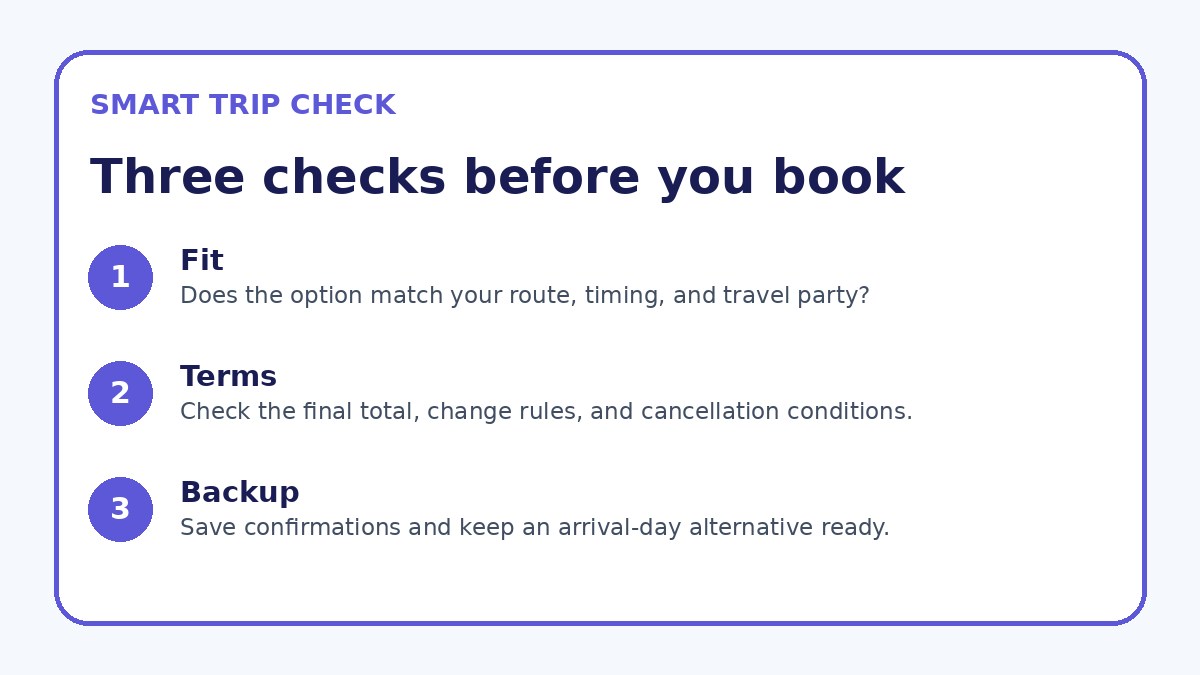
Choosing between direct and connecting Amsterdam to Rome flights comes down to how you weigh time, cost, and comfort. Direct flights reduce logistical complexity and transfer risk, which helps first-time visitors arrive less stressed and with fewer variables to manage. Connecting itineraries can be attractive for budget reasons or to create a planned stopover, but they introduce extra steps: baggage handling concerns, terminal changes, and exposure to missed-connection risk if segments are separately ticketed. Use a practical checklist—confirm ticketing, baggage transfer policies, total door-to-door time, and change-fee rules—before booking. Compare options side-by-side, verify final terms on the carrier’s booking page (and use Trip.com or other search tools for availability), then pick the route that matches your tolerance for complexity and your trip priorities.
Continue planning
Check current options and final conditions
Use the provider page to confirm live availability, the final total, cancellation terms, and every condition that matters to your trip.
This evergreen planning guide was created with AI-assisted drafting and a structured quality review. It does not display live prices, schedules, availability, visa guidance, or provider rankings. Verify current details before booking. Some links are affiliate links; we may earn a commission at no additional cost to you.