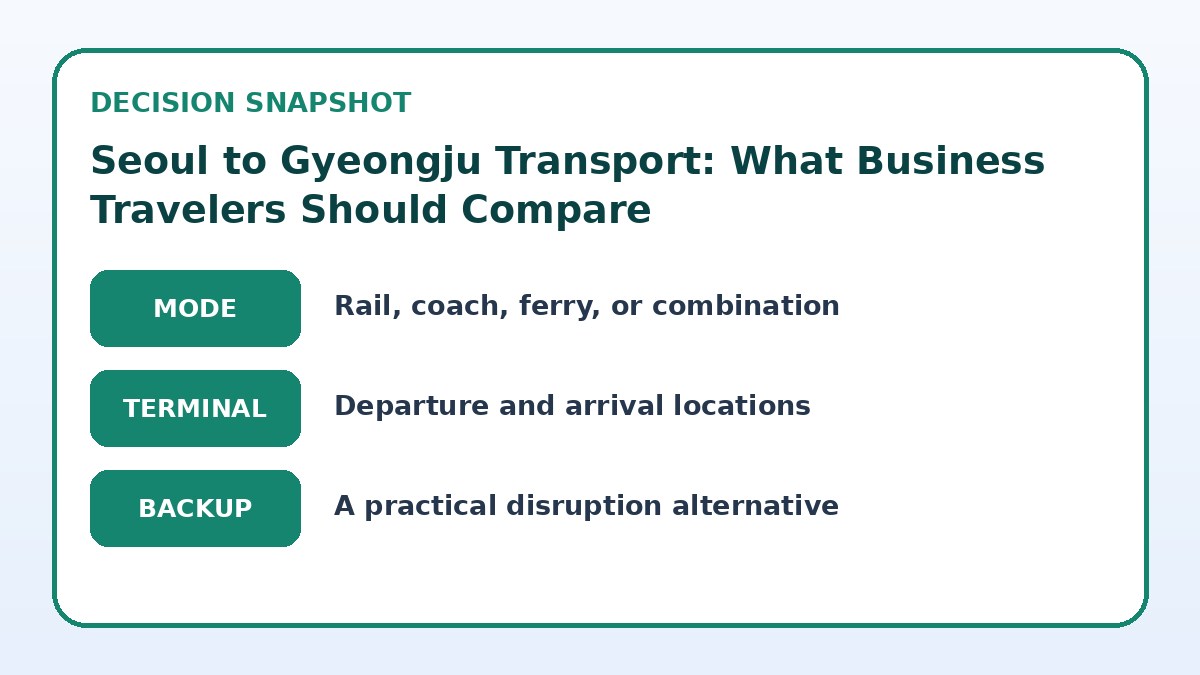
For most business travelers heading from Seoul to Gyeongju, the practical choice balances travel time, on-the-go productivity, and reliable arrival windows. Start by deciding whether minimizing travel clock-time or preserving flexible departure/arrival windows matters more for your schedule. Trains typically offer stable travel conditions and the ability to work en route; coach or bus services can be cheaper and allow earlier or later departures from different terminals; driving or chauffeured services give door-to-door control but require more margin for traffic and parking near meeting venues. Before booking, check how each option connects with your exact meeting address in Gyeongju, factor in local transit or taxi time at each end, and verify current availability directly on provider booking pages. If you want a single place to compare options and see live availability, you can check providers and schedules (including Trip.com) but confirm final details with the operator before committing.
See current options before you compare the details
Availability and final conditions change. Open Trip.com now or keep reading for the practical comparison.
How to weigh speed versus productive onboard time
Business travelers often equate faster travel with greater productivity, but the fastest option isn't always the most useful. Evaluate whether you need uninterrupted time to prepare for meetings, handle calls, or simply arrive alert. A mode that lets you sit with a laptop or phone and maintain reliable connectivity can be more valuable than saving a small amount of travel time if it reduces stress and increases meeting readiness.
To compare options, think about realistic door-to-door time rather than advertised travel time alone. Include transfer times to and from terminals, time to check in or board, and expected local transit in Gyeongju. If you must arrive with fresh focus, factor in whether you can work comfortably en route and whether the route’s variability (road congestion, transfers) may interrupt that time.
Practical tradeoffs: rail, coach, and private car
Rail services often score well for punctuality and onboard comfort; they typically provide consistent travel conditions that help you plan meetings precisely. Coaches and express buses are flexible with departure points and can be budget-friendlier, but ride quality, space to work, and stop patterns vary. Private car or chauffeur services offer maximum control over pickup and drop-off locations but demand extra planning for traffic, parking, and driver turnaround time.
When choosing, list the non-negotiables for your trip (arrival window, ability to work, luggage handling, cost ceiling) and see which mode meets most. Also verify current service frequency and the exact terminal addresses for each option so you can accurately estimate time from destination station to your meeting venue.
| Approach | Best for | Tradeoff to check |
|---|---|---|
| High-speed or intercity train | Travelers who need predictable travel time and a comfortable space to work. | May require transfers to reach central meeting locations and sometimes less frequent departures. |
| Express coach or scheduled bus | Cost-conscious travelers needing flexible departure choices from multiple Seoul terminals. | Longer or more variable travel time and limited onboard workspace compared with trains. |
| Private car or chauffeured service | Door-to-door convenience and tight schedules where direct access matters most. | Subject to traffic unpredictability and usually higher cost; parking and drop-off may require planning. |
| Combined options (train plus taxi or shuttle) | Balancing travel comfort with final-mile flexibility for meetings in specific Gyeongju areas. | Requires coordinating separate bookings and allowing transfer time between services. |
Ready to check the option that fits your plan?
Use your exact dates and traveler details so the provider page can show the current total and conditions.
Booking considerations and the details to confirm
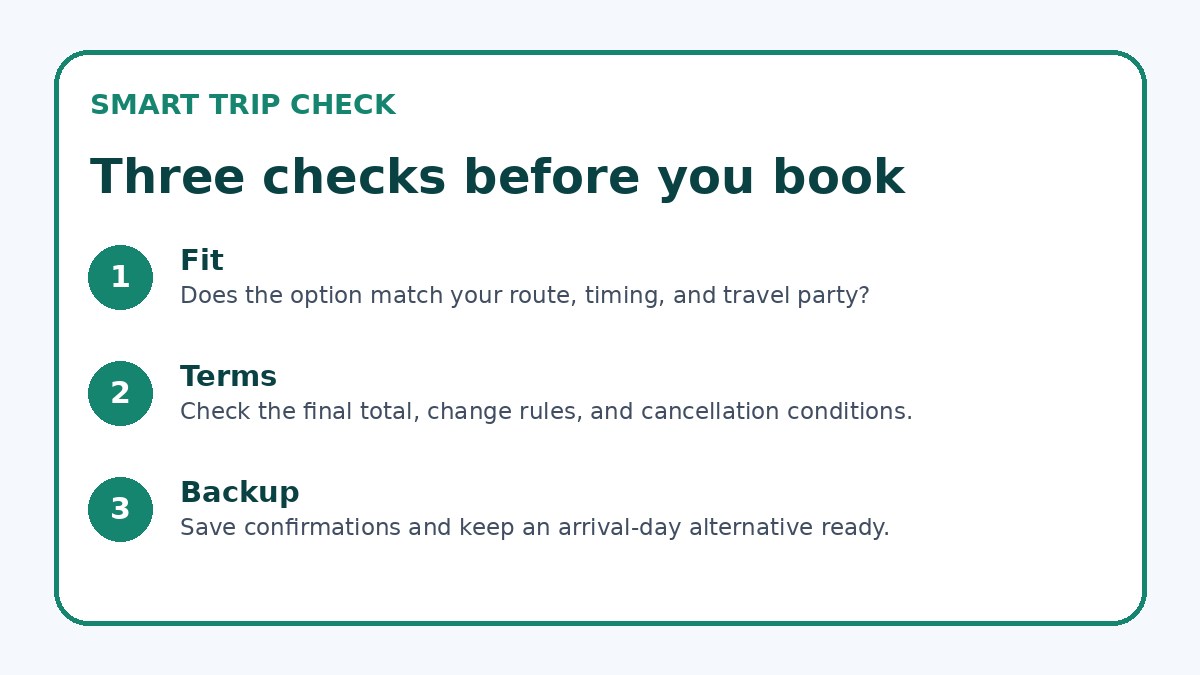
Before you book, confirm a few essential details that commonly change: the precise station or terminal for departure and arrival, baggage restrictions, refund and change policies, and whether the service allows seat reservations. Because operator policies can change, always check the provider’s final booking page for up-to-date terms, and print or save confirmation with clear pickup instructions you can forward to colleagues if plans shift.
If you need to compare current schedules and availability across modes, use official rail or coach websites and check aggregator pages as a starting point. Trip.com can be used once as a quick comparison reference, but do not rely on it as a final authority—verify times, seat availability, and cancellation rules directly with the carrier before making firm commitments.
Before you book
- Confirm the exact departure and arrival stations or terminals and map door-to-door travel time to your meeting address.
- Check seat reservation rules and whether you can choose a workplace-friendly seat with power outlets or table space.
- Verify cancellation, change, and refund policies on the provider’s final booking page before completing payment.
- Compare realistic total travel times at your scheduled departure hour, including transfers, taxi waits, and possible traffic.
- Save contact numbers for local taxis or shuttle services in Gyeongju and share expected arrival details with meeting hosts.
- Arrange a backup plan (later departure or alternate transport) and budget an extra time buffer in case of delay.
Last-mile logistics in Gyeongju and arrival planning
Gyeongju’s meeting venues can be spread out; arriving at a station doesn't necessarily mean walking distance to your appointment. Check distance and onward options like local taxis, shuttle services, or public transit; add a realistic buffer for peak-hour taxi wait times or transfer delays. If your meeting is in a less central part of Gyeongju, prioritize transport that drops you closest to the venue to reduce the stress of tight schedules.
Also plan for contingencies: have a contact number for local transport, share live arrival details with meeting hosts, and build extra time into your schedule for unexpected delays. If you expect to work after arrival, identify cafes or hotel business centers near your meeting place where you can join calls or finalize presentations without scrambling.
Frequently asked questions
Should I prioritize speed or the ability to work while traveling from Seoul to Gyeongju?
Prioritize based on your meeting needs: if you need uninterrupted time to prepare, choose the mode that reliably allows working en route—comfortable seating, stable connectivity, and power access matter. If arriving earlier by a slightly faster option gives you time to settle and rehearse at your hotel or a nearby meeting room, then speed may be the priority. Always factor in door-to-door time and potential transfers rather than only advertised travel time to determine the practical winner.
How far in advance should I book transport for a business trip on this route?
Booking lead time depends on how rigid your schedule is and whether you need guaranteed seating or a particular class of service. If you must travel at a specific time with minimal flexibility, book earlier to secure the desired departure and seat. For flexible schedules, you can wait until closer to departure but confirm cancellation policies and seat availability before making last-minute arrangements. Always verify the provider’s booking conditions on their official page before finalizing.
What should I check about last-mile options when planning arrival in Gyeongju?
Identify how far your arrival station is from the meeting location and what transport options are available at that station—taxis, local buses, or hotel shuttles. Confirm typical taxi wait times for the arrival hour and whether a shuttle requires reservation. If your meeting is not near the main station, plan a direct drop-off via taxi or arrange a local pickup to avoid delays. Keep local contact numbers handy and share your live arrival time with hosts.
Final planning note
Choosing the most practical Seoul to Gyeongju transport for a business trip means matching your priorities—punctual arrival, productive time en route, or door-to-door convenience—with the realistic limits of each option. Start by mapping your meeting’s location and immovable time window, then shortlist modes that fit those constraints. Verify terminal details, reservation rules, and cancellation policies on the provider’s booking page, and build in transfer and traffic buffers. With clear criteria and a simple backup plan, you’ll reduce stress and arrive ready for meetings rather than having to scramble upon arrival.
Continue planning
Check current options and final conditions
Use the provider page to confirm live availability, the final total, cancellation terms, and every condition that matters to your trip.
This evergreen planning guide was created with AI-assisted drafting and a structured quality review. It does not display live prices, schedules, availability, visa guidance, or provider rankings. Verify current details before booking. Some links are affiliate links; we may earn a commission at no additional cost to you.