If you're flying Seoul to Taipei on a business trip, the core planning choices you need to make are how much to check, what to carry on, and when to arrive at the airport. Start by deciding whether a carry-on-only strategy suits your meeting schedule and local mobility; if it does, you’ll save time at baggage drop and reclaim. If you need checked luggage, plan extra time for check-in and potential baggage screening. Also factor in immigration and security lines, lounge or fast-track access, and whether you need to collect bags at transfer points. The rest of this article explains the tradeoffs—speed versus convenience, luggage limits versus meeting preparation—and gives concrete steps to compare direct and connecting itineraries, verify airline baggage rules on your booking page, and set an airport arrival window that fits the realities of business travel between Northeast Asia’s two capitals.
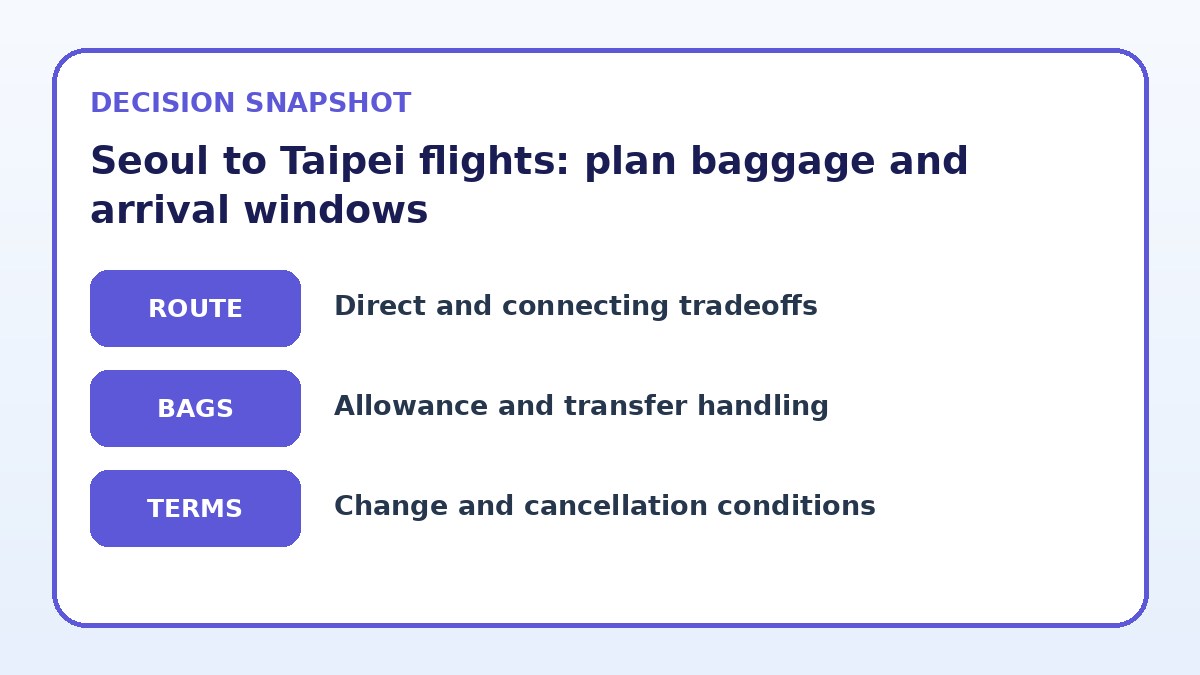
See current options before you compare the details
Availability and final conditions change. Open Trip.com now or keep reading for the practical comparison.
Decide carry-on versus checked luggage for business needs
Choosing carry-on only or checked luggage starts with your meeting requirements: do you need suits, samples, or printed materials that are bulky, or can you rely on a wrinkle bag, digital files, and local services? For many short Seoul to Taipei business trips, a single compliant carry-on plus a personal item covers essentials and avoids baggage claim time. However, if you transport promotional materials, equipment, or multiple changes of clothes, checked baggage may be unavoidable. Before you finalize, check the airline’s published cabin allowance and weight limits on the booking page because carriers vary, and some low-cost or basic fares restrict cabin weight more strictly.
Tradeoffs matter: carry-on saves time and reduces the number of failure points—lost bags, long waits, and re-packing—but forces tighter packing choices and increases stress if you must squeeze everything into a small suitcase. Checked bags let you bring more but require time at the check-in counter and baggage carousel and occasionally incur handling delays. If you must check a bag, choose luggage with an external ID tag and a clearly labeled contents list, and consider compressible packing cubes to protect items and make security inspections faster should your bag be opened.
Set the right airport arrival window in Seoul
Business travelers should set an arrival window that gives you margin for check-in, security, and immigration without wasting half the day at the terminal. For direct daytime flights, aim to arrive at the airport earlier than leisure guidelines—typically 90 to 120 minutes before departure—if you travel with checked luggage or during morning and evening peaks. If you have elite status, lounge access, or fast-track security, you can tighten that window, but always verify the specific services listed on your airline’s booking page because access and privileges depend on fare class and carrier policies.
Remember airport factors: the terminal you use in Seoul, shuttle or metro connections to the airport, and the time of day. If you travel from an outer suburb or have a morning meeting before leaving, allow buffer time for rush-hour traffic or train delays. When using connecting flights, add time for potential re-checking of luggage or clearing immigration at the transfer point. Finally, if your departure requires special handling—oversized items, sports equipment, or documents that may need manual inspection—add extra time beyond typical windows.
| Approach | Best for | Tradeoff to check |
|---|---|---|
| Carry-on only | Day trips, tight itineraries, quick transfers between airport and meetings | Limited clothing and samples; must strictly follow cabin-size and weight rules |
| Checked bag with express check-in | Multiple-day business trips needing varied attire or equipment | Extra time at check-in and baggage claim; possible handling delays |
| Direct flight | Minimizing transit complexity and luggage handling | Fewer schedule options and potentially less convenient departure times |
| Connecting flight with checked-through luggage | Flexible timing or specific carrier/fare needs | Longer total travel time and risk of missed connections if layover is tight |
Ready to check the option that fits your plan?
Use your exact dates and traveler details so the provider page can show the current total and conditions.
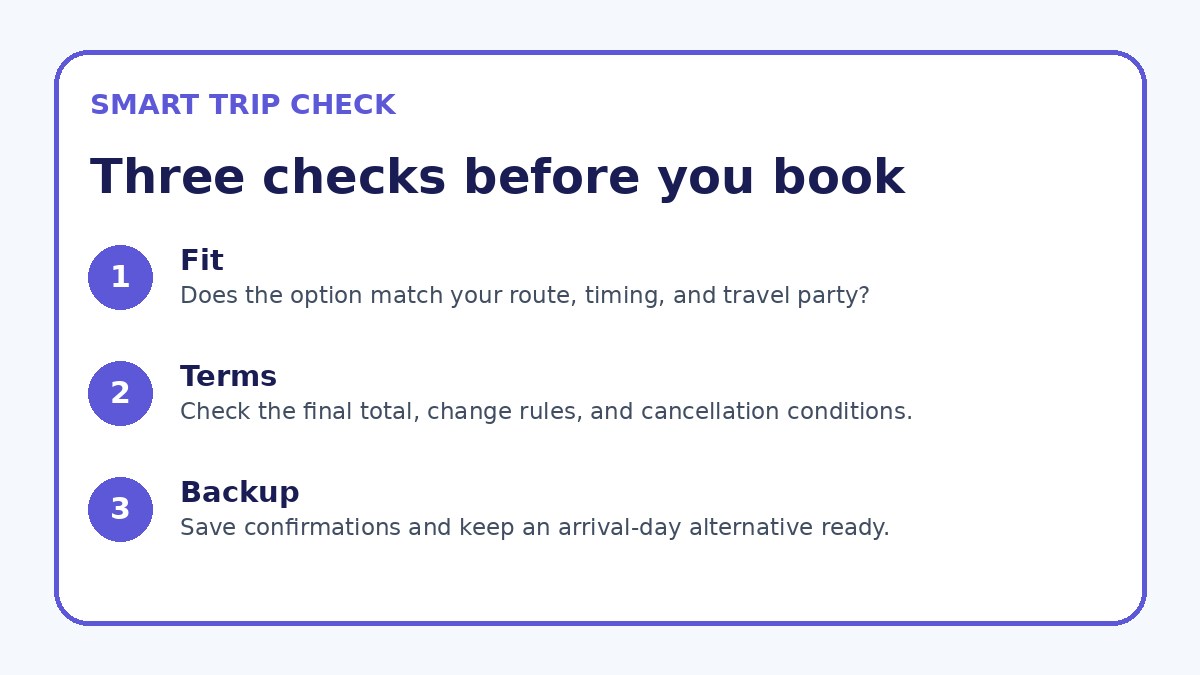
Comparing direct and connecting flight options
On the Seoul to Taipei route you’ll find both direct and connecting options depending on airline networks and schedules. Direct flights reduce complexity: no re-checking of luggage, a single boarding process, and fewer opportunities for missed connections. But direct options may depart at times that are less convenient for your meeting schedule or be offered on carriers with stricter cabin allowances on certain fare types. When weighing direct versus connecting itineraries, compare total door-to-door time, the number of times you must handle luggage, and whether a layover requires clearing immigration and picking up bags.
Connecting flights can give more schedule flexibility, potentially lower fares, or better alignment with meetings, but they increase time in transit and introduce transfer risk—delays, separate terminal transfers, and the need to satisfy minimum connection times. If you choose a connecting route, verify on the booking page whether your baggage is checked through to Taipei or needs collection and re-checking, and whether you must clear immigration at the connection airport. That single verification will change how much buffer time to build into each transfer segment.
Before you book
- Verify cabin and checked-bag size and weight limits on your airline’s final booking page before you pack.
- Check whether your ticket includes lounge access or fast-track security and confirm eligibility on the carrier’s site.
- Complete online check-in and download boarding passes the evening before travel to reduce time at the counter.
- Label checked luggage with a business card and add an external ID tag showing your contact details.
- Pack a compact outfit and essentials in your carry-on to handle unexpected delays or last-minute meeting needs.
- Allow a 90–120 minute airport arrival window for departures, adjusting earlier if checking bags or travelling at peak times.
Practical packing and airport routines for productivity
Pack with a business rhythm in mind: keep work essentials—chargers, laptop, presentation USB, and business cards—in your personal item, not in checked luggage. Use a slim, organized laptop bag that fits under the seat or in the overhead bin to ease security screening and to set up quickly at the gate or in a lounge. If you rely on press-ready clothing, include a portable garment bag or packing folder to minimize creases and keep a small stain-removal pen in the carry-on. Also keep digital backups of critical documents accessible in cloud storage and a printed itinerary and meeting addresses in case of connectivity issues.
At the airport, follow a repeatable routine to save time: complete online check-in the evening before when possible, pre-print or download boarding passes, and confirm lounge or fast-track access. At check-in, request priority handling for any checked bags tied to urgent meetings so they appear early on the carousel. If time is tight, consider using curbside check-in or dedicated business counters where available, after confirming those services on your carrier’s booking page. Finally, allocate time post-arrival in Taipei for immigration procedures and transit to your meeting location, building in a small cushion for unexpected delays.
Frequently asked questions
How early should business travelers arrive at Seoul airport for a direct flight to Taipei?
For most business travelers on a direct Seoul to Taipei flight, aim to arrive at the airport 90 to 120 minutes before departure if you have checked luggage or travel during peak hours. If you travel carry-on only and have verified online check-in, you can tighten that to around 75 to 90 minutes for many flights, especially if you have status that grants fast-track security. Always confirm check-in and boarding cut-off times on the airline’s booking page and add extra buffer for airport transfers or unexpected delays.
Can I avoid waiting at baggage claim if I check a bag?
You cannot always avoid baggage claim if you check a bag; however, you can speed the process by selecting priority baggage handling when offered at check-in or choosing a fare or status level that includes priority. These services vary by airline and are shown on the booking or check-in page. If avoiding baggage claim time is critical to meeting schedules, plan for carry-on-only or a minimal checked bag and coordinate ground transport to allow for typical carousel wait times.
What should I verify on the booking page if my Seoul to Taipei itinerary includes a connection?
On a connecting itinerary, verify whether your checked luggage is tagged through to Taipei or must be reclaimed and rechecked at the transfer point. Check whether you will clear immigration at the connection airport and whether you need to change terminals. Also look for minimum connection times the airline publishes, and whether the carrier provides through-connection protection for missed connections on single-ticket itineraries. These specifics directly affect how much buffer time you should schedule between flights.
Final planning note
Business travel between Seoul and Taipei rewards careful choices about baggage and airport timing. Decide early whether carry-on-only or checked luggage better fits your meeting needs, and verify the precise baggage allowances and privileges on the airline’s booking page. Build an arrival window that accounts for check-in, security, and immigration, and add extra time for connections or special items. Use direct flights when you must minimize handling, and reserve connecting options when schedule fit outweighs transfer risk. A predictable routine—online check-in, a dedicated carry-on with essentials, and confirming transfer rules—reduces stress and keeps you focused on the business at hand.
Continue planning
Check current options and final conditions
Use the provider page to confirm live availability, the final total, cancellation terms, and every condition that matters to your trip.
This evergreen planning guide was created with AI-assisted drafting and a structured quality review. It does not display live prices, schedules, availability, visa guidance, or provider rankings. Verify current details before booking. Some links are affiliate links; we may earn a commission at no additional cost to you.