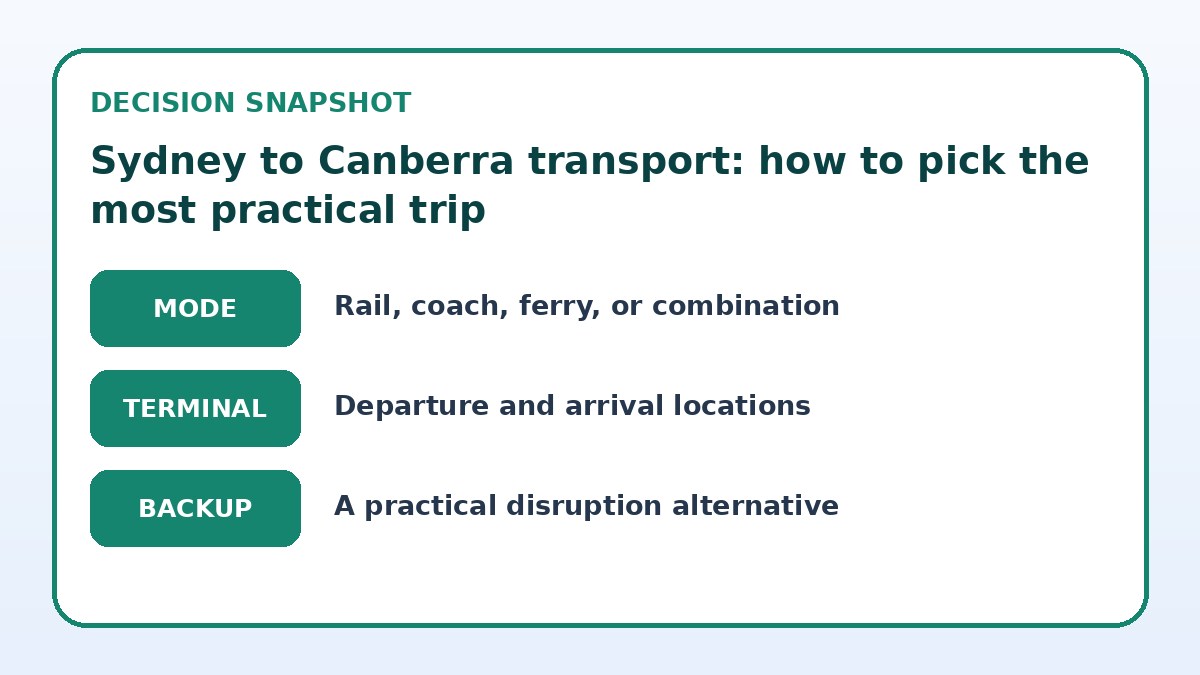
Practical answer first: for most solo travelers the easiest approach is to choose the public coach or express bus when you want the simplest door-to-door journey with minimal transfers, or pick the train if you value more legroom and a relaxed onboard experience. Flights can be competitive when you need the fastest travel time, but add extra steps getting to and from airports and managing luggage. Renting a car gives complete flexibility for stops and schedules but adds driving stress, parking decisions, and fuel considerations. Start by deciding whether you prioritize time, cost, or freedom, then compare total door-to-door time and door-to-door cost rather than just in-vehicle durations. Use provider booking pages to confirm schedules, baggage rules, cancellation terms, and exact pickup or drop-off points before you commit.
See current options before you compare the details
Availability and final conditions change. Open Trip.com now or keep reading for the practical comparison.
Decide your priority: speed, cost, or control
Before you compare providers, pick the travel priority that will decide everything else. If you need the shortest possible overall trip time, you’ll evaluate scheduled flights and then add realistic transfer times to and from airports. If price matters most, compare buses and advance train fares against the full cost of a rental and fuel. If having control over route and timing is the priority, a rental car or a flexible bus/train ticket that allows changes may be preferable. Being clear about this single priority simplifies deciding which factors to weigh heavily when you look at options.
Solo travel often adds a preference for simplicity and safety: fewer transfers, well-reviewed pickup points, and reliable mobile signal. Consider how fatigued you’ll be on arrival and whether you want to avoid extra navigation or luggage handling. Also think about what you’ll do in Canberra — if you plan to stay within the central area and won’t need a car, the savings and simplicity of public transport often outweigh the flexibility of driving. Use your priority as a lens: every option has tradeoffs, so let that initial choice narrow your shortlist.
Comparing door-to-door time and real costs
When comparing options, always calculate door-to-door time: add transit to departure point, recommended check-in or boarding buffer, in-vehicle time and transfer time at the other end, plus travel from arrival point to your accommodation. A flight with a short airborne time can still be slower overall after you include early arrival requirements and airport transfers. Coaches and trains that use city terminals often win on door-to-door time despite longer vehicle time because they start and finish closer to where solo travelers need to be. Write down each leg and compare totals rather than just reading single-segment durations.
For costs, compare the full outlay: seat or fare price, luggage fees, transfers, parking or rideshare on arrival, and any compulsory extras. If you consider a rental, forecast fuel and parking in Canberra, and check whether one-way rentals are allowed without extra penalties. Remember opportunity costs: could extra travel time mean lost time at your destination? Seasonality affects availability and typical fare levels, so verify final pricing and refund or change conditions on the provider’s booking page before you commit. Trip.com can be used as one place to compare current options if you want a quick cross-check.
| Approach | Best for | Tradeoff to check |
|---|---|---|
| Coach / Express bus | Budget-minded solo travelers wanting simple city-centre pickup and minimal transfers. | Longer in-vehicle time than flight; fewer facilities than premium train services. |
| Train | Passengers who prioritise onboard comfort, space to work, and a relaxed journey. | May have fewer daily departures and potentially longer station transfers compared with buses. |
| Flight | Those who need the fastest airborne segment and are comfortable with airport transfers. | Add airport transit, baggage rules and check-in buffers to the total travel time and cost. |
| Rental car | Travelers who want flexibility to stop en route and control their schedule. | Responsibility for driving, parking and fuel; potentially higher door-to-door costs in city centres. |
Ready to check the option that fits your plan?
Use your exact dates and traveler details so the provider page can show the current total and conditions.
Comfort, luggage and solo-traveller safety
Comfort matters more on this route when you have long journeys or important plans on arrival. Trains usually allow you to move about, work or stretch more easily, and coaches often have reliable reclining seats and storage for larger bags. Flights require handling luggage through airport processes and typically enforce stricter limits, so confirm baggage rules on the airline booking page. If you’re travelling with bulky luggage or equipment, prioritise services with easy door-side loading or central terminals rather than transfers with multiple changes.
Solo travellers should also factor safety and convenience: pick well-lit pickup points, book providers with straightforward customer service, and check whether the operator provides progress updates or onboard staff. Late arrivals or night travel may change your preferred option — a coach that drops you near central, well-serviced locations might beat a train that leaves you at a station farther from your lodgings. Always have a simple contingency plan — a local taxi app or a pre-saved ride-share option — for the last leg after arrival.
Before you book
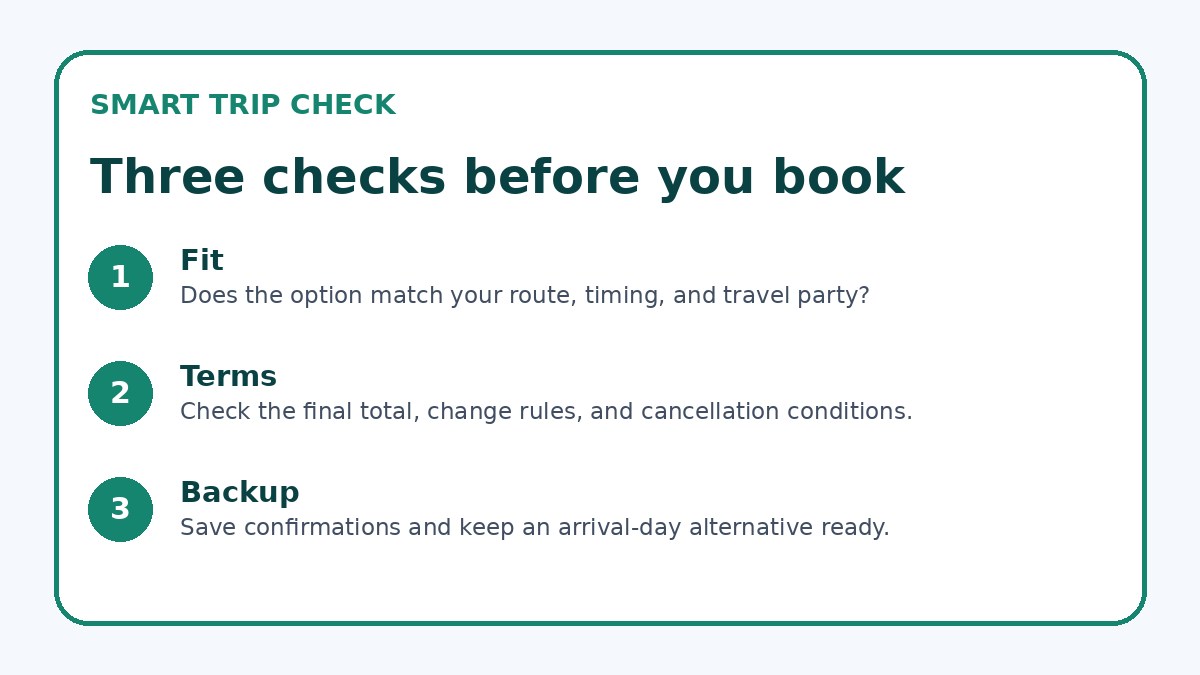
- Decide whether you prioritise total travel time, lowest cost, or route flexibility and write it down.
- Map door-to-door travel: add time to reach departure point, recommended check-in or boarding buffer, in-vehicle time, and arrival transfers to accommodation.
- Check baggage rules, seat assignment policies, and whether mobile tickets are accepted on the provider’s booking page.
- Confirm exact departure and arrival addresses or terminal numbers and save them to your phone and a printed note.
- Compare final cancellation and change terms on the operator’s checkout page before you pay.
- Have a backup last-leg plan (taxi app or pre-booked shuttle) in case your arrival time changes unexpectedly.
Booking checks and last-minute decisions
When you’re ready to book, verify a few concrete items on the provider’s final page: exact departure and arrival points, baggage allowances and fees, refund and change policies, and whether you need to print or show a mobile ticket. If choosing a flight, check recommended arrival times, whether online check-in is available, and the terminal used. For trains and coaches, confirm if seats are assigned, whether onboard power and Wi-Fi are offered, and if there are accessibility considerations you need. Don’t assume details from third-party listings — verify them at the operator level before finalising.
If you’re making a last-minute decision at the station or airport, favour options with the fewest transfers and clear staff presence. For solo travelers, having staff available to help with boarding or luggage reduces stress. If schedules are tight, weigh whether a slightly more expensive, guaranteed-seat option is worth the peace of mind. Keep copies of booking confirmations, the provider’s emergency contact, and basic directions for your arrival transfer. Small preparation steps before departure will make the final hours smoother and let you arrive ready to enjoy Canberra.
Frequently asked questions
Which option is safest for a solo traveler arriving late in Canberra?
For late arrivals, choose the option that leaves you closest to a well-lit, central drop-off point with an easy onward connection. Coaches and some trains use central terminals that are typically near accommodation and public transport; flights can be fine but factor in airport transfers and reduced public transit late at night. Check whether the operator has staff on-site on late services and verify local taxi or ride-share availability in advance. If safety and simplicity are your priority, favour a service that minimizes the need for additional navigation after you arrive.
How should I compare a cheap coach ticket with a slightly pricier train seat?
Compare the coach and train on total door-to-door time, baggage convenience, onboard comfort and change or refund conditions. A cheap coach that leaves you in the city centre with minimal transfers can be more convenient than a train that requires a long taxi on arrival, and vice versa. Consider whether you need onboard space to work or stretch and whether seat reservation is important to you as a solo traveller. Finally, check the provider’s terms for refunds and changes so you’re not surprised if plans shift.
Is it worth renting a car if I only need transport between Sydney and Canberra?
Renting a car can be worthwhile if you want to explore sites between the cities or arrive on your own schedule, but for a straight point-to-point transfer it often adds complexity: you’ll be responsible for driving, parking in Canberra, fuel and possibly one-way fees. If your itinerary keeps you mostly in central Canberra, public transport or coach services that finish near hotels may be simpler and cheaper overall. If you lean toward a rental, compare total expected costs and factor in the convenience of having a car versus extra driving fatigue.
Final planning note
Solo travelers have clear, practical choices between coach, train, flight and car when travelling from Sydney to Canberra. Start by choosing the single priority that matters most to you — time, cost or flexibility — and then compare options using door-to-door time and total cost rather than relying on advertised segment durations. Verify baggage rules, departure and arrival points, and refund or change policies on the operator’s booking page before you commit. Keep a simple backup plan for the final leg and book the option that leaves you least stressed on arrival so you can enjoy your time in Canberra.
Continue planning
Check current options and final conditions
Use the provider page to confirm live availability, the final total, cancellation terms, and every condition that matters to your trip.
This evergreen planning guide was created with AI-assisted drafting and a structured quality review. It does not display live prices, schedules, availability, visa guidance, or provider rankings. Verify current details before booking. Some links are affiliate links; we may earn a commission at no additional cost to you.