The most practical departure airport for a first-time visitor flying from Sydney to Auckland is usually the airport that minimizes total door-to-door time, fits your budget and luggage needs, and reduces stress on the day of travel. Rather than assuming one Sydney airport is always better, weigh convenience factors such as proximity to where you will be staying, public-transport or taxi access, the terminal you prefer, and whether you need extra time for check-in or security. For many travellers that means choosing the airport with the best balance of travel time to/from your accommodation, flight availability that matches your schedule, and clear transfer options to the city. Below you’ll find criteria and tradeoffs to help make that decision, a short comparison of common approaches, a practical checklist to finalize your booking, and answers to typical concerns first-time flyers have on this route.
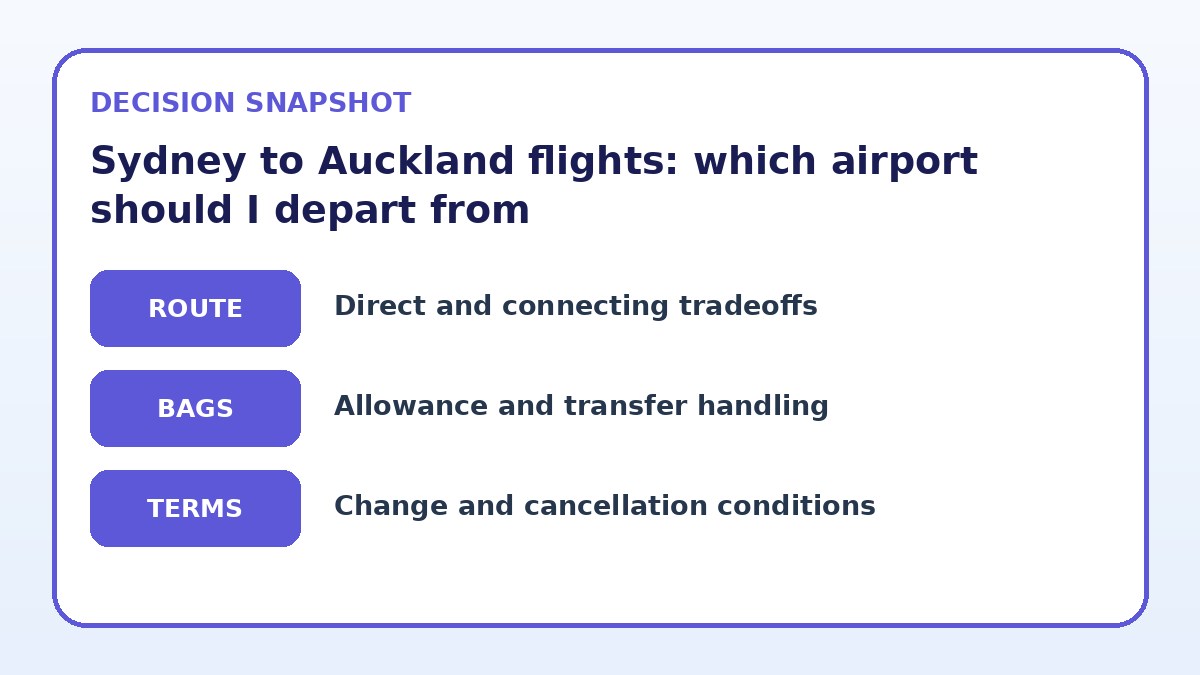
See current options before you compare the details
Availability and final conditions change. Open Trip.com now or keep reading for the practical comparison.
Practical decision criteria to apply
First, make an ordered list of what matters to you: travel time to the terminal, number of bags, preferred arrival time in Auckland, tolerance for connecting flights, and cost. Prioritize those items: for example, if you are jet-lagged or travelling with children, minimizing surface travel time and avoiding early-morning departures may be more important than shaving a small amount from the airfare. Use public transport options, taxi or rideshare timing, and the distance from your accommodation to estimate realistic door-to-door durations.
Second, translate those priorities into hard checks when comparing options: total travel time (door to gate), required check-in arrival time for your ticket class, terminal transfers at each Sydney airport, and whether the flights listed are direct or involve connections. For first-time visitors, allow buffer time for unfamiliar procedures like security lines or locating the correct terminal. Keep in mind the tradeoff between convenience and cost: saving money on an evening ticket could cost you significantly more in taxi fares or waiting time.
How to compare direct and connecting options
Never assume a flight advertised on a booking page is direct; many results combine legs. When you compare options, filter explicitly for nonstop services if you prefer a single flight. If a direct flight is available at a slightly higher fare but saves you an extra connection and potential missed-connection stress, it can be the better practical choice. Conversely, if cost savings are essential and you have generous connection time, a routed itinerary can work — but only if you’re comfortable managing potential delays or re-checking luggage.
When evaluating connections, check minimum connection times, whether you need to change terminals, and who is responsible if you miss a connection. On the booking page or the airline’s site, verify whether both legs are on the same ticket and whether baggage is checked through to Auckland. If different carriers or separate tickets are involved, plan for extra cushion time and confirm what happens to your baggage between flights.
| Approach | Best for | Tradeoff to check |
|---|---|---|
| Choose the closest airport to your accommodation | Minimizing door-to-gate time and reducing local taxi or rideshare costs | May limit flight choices or times compared with larger airports further away |
| Choose the airport with the most direct flights | Reducing chance of missed connections and simplifying travel with checked luggage | May require longer surface travel or higher local transport cost |
| Choose the cheapest available flight regardless of airport | Travelers prioritizing lower upfront fare who accept more travel time | Savings can be offset by higher transfers, extra baggage handling, or lost time |
| Choose based on schedule flexibility and frequency | Those who value multiple daily departure options and easier rebooking | Often involves accepting higher fares or selecting more popular travel times |
Ready to check the option that fits your plan?
Use your exact dates and traveler details so the provider page can show the current total and conditions.

Practical tradeoffs: location, cost and schedules
Location matters more than headline fare differences. A cheaper flight from an airport that adds one hour of commute each way might not be worth the saving unless you’re staying nearby or that airport has significantly better public transport. Consider the likely times you’ll travel to the airport: morning peak-hour traffic can lengthen a short distance into a much slower commute. Also consider the arrival time in Auckland — late-night or very early arrivals may increase onward transport costs or complicate first-night plans.
Cost is important, but beyond base fare compare baggage allowances, seat selection fees, and whether meals are included on longer flights. Schedules matter too: the number of daily services and their timing affects flexibility if you need to change plans. If you require predictable arrival times for onward connections or meetings, prioritize frequency and reliability over marginal cost savings.
Before you book
- Calculate door-to-gate time from your accommodation for each candidate airport at your planned departure hour.
- Filter booking results to show nonstop flights and compare total travel time including surface transfers.
- Verify baggage rules and whether luggage is checked through to Auckland on the final airline booking page.
- Confirm terminal and transfer logistics for your selected airport on its official site before you leave.
- Allow at least an extra 60–90 minutes buffer for unfamiliar processes when first travelling internationally.
- Compare arrival times in Auckland and plan onward transport options for the hour you expect to land.
Day-of-travel logistics and stress reduction
Choose an airport and a flight that match how you like to travel on departure day. If you prefer more time and lounge access or fast security lanes, pick a terminal and carrier that offer those services and confirm access rules on the airline or airport page. If you’d rather minimize time at the airport, choose earlier online check-in and carry-on only when possible, and confirm boarding gate distances: some terminals require long walks or shuttle transfers between concourses.
Plan transport to the airport with contingency: allow for traffic peaks, vehicle drop-off rules, and potential delays on public transport. If you’re unfamiliar with Sydney’s local transportation, look up the specific airport’s official site for ground-transport maps and terminal access notes and re-check the airline’s final booking page for any terminal assignments or last-minute changes before you leave for the airport.
Frequently asked questions
How do I decide if a connecting flight is worth the lower fare?
Start by comparing the total trip time and the connection gap. If the connection requires changing terminals, re-checking baggage, or tight layovers, factor in the added stress and risk of delay. Check whether both legs are on a single ticket and who handles missed connections. If you prefer certainty and minimal handling of baggage, a nonstop route might be worth the extra cost even if its fare is higher; if cost is the overriding concern and you have long connection windows, a connecting itinerary can save money but needs more active management.
What should first-time visitors verify on the airline booking page?
On the airline’s official booking page, verify whether the flight is nonstop or an itinerary of multiple legs, check exact baggage allowances and any extra fees for seat selection, and note the terminal and boarding gate details if available. Confirm whether your fare allows changes or cancellations and whether your baggage will be through-checked to the final destination. Because airlines sometimes adjust schedules or equipment, re-check these details before you travel to avoid surprises.
Can airport choice affect my arrival experience in Auckland?
Yes. Arrival experience depends on the flight time, whether the flight is direct, and how smoothly baggage is handled. Flights that arrive at convenient times for onward transport reduce stress and might save on overnight transfers. Also consider whether the departing airport’s check-in and security practices will affect punctuality; a crowded or distant terminal can increase the chance of rushed connections. Plan your departure so that arrival in Auckland matches your preferred onward travel options, whether that’s public transport, car hire, or a hotel transfer.
Final planning note
For first-time visitors deciding on a Sydney departure airport for flights to Auckland, focus on real-world convenience: door-to-gate time, nonstop availability, baggage handling, and the arrival time in Auckland. There is no one-size-fits-all answer — the most practical choice depends on where you’ll be staying in Sydney, how much luggage you have, and how much schedule flexibility you require. Use the decision criteria and checklist above to compare options, verify final baggage and terminal details on the airline’s booking page, and consider frequency of departures if flexibility matters. If you want a quick place to compare current availability and conditions, Trip.com can be used to view options, but always confirm final details with the airline before you book.
Continue planning
Check current options and final conditions
Use the provider page to confirm live availability, the final total, cancellation terms, and every condition that matters to your trip.
This evergreen planning guide was created with AI-assisted drafting and a structured quality review. It does not display live prices, schedules, availability, visa guidance, or provider rankings. Verify current details before booking. Some links are affiliate links; we may earn a commission at no additional cost to you.