Practical answer up front: for most first-time visitors to Tokyo who want simplicity, predictable logistics and one-stop support, a well-reviewed package can save time and reduce planning stress. If you value neighborhood choice, flexible arrival times, custom sightseeing and potential savings through self-led research, booking flights, hotels and rail passes separately usually works better. Your decision hinges on how much time you want to spend comparing options, whether you need flexible changes, and whether you prefer local control over lodging and daily plans. This article explains the tradeoffs clearly, lists the checks to make on provider pages, and gives a compact decision framework so you can pick the approach that matches your priorities without relying on current price claims or provider promises.
What a package typically includes and why it helps
Travel packages for Tokyo commonly combine international flights, hotel nights and sometimes airport transfers or a guided tour component. For a first-time visitor this can be attractive because one vendor handles the itinerary, customer support and often a single payment process. Packages reduce the number of decisions you must make and can simplify arrival logistics when you arrive at Narita or Haneda. That single-point contact also helps if you want a straightforward plan with fewer moving parts and prefer to avoid juggling multiple confirmation emails and calendars.
Packages also come with tradeoffs you should understand before booking. The hotel choices in a package might be a limited selection and biased toward centrally located, chain or partner properties rather than the smaller neighborhood ryokan or boutique hotels that could better fit your travel style. Flight times in a package are constrained to what the tour operator offers; that can mean early-morning departures or late arrivals that don’t match your preferred schedule. Always check baggage rules, transfer meeting points and how local taxes or city surcharges are handled on the provider’s final booking page.
How separate bookings give control — and what that costs
Booking flights, hotels and rail passes separately gives you full control over where you stay in Tokyo by enabling neighborhood-by-neighborhood choices: Shinjuku for nightlife and transport, Asakusa for traditional sights, or Ginza for shopping. You can pick flight times that minimize jet lag, choose a suite with a view, and arrange specific meet-and-greet transfers or time-limited rail passes. That granularity helps travelers who want to build a tailored daily plan or who have mobility or dietary needs that generic packages may not address.
However, this control demands more time and attention. You’ll need to compare seat types, cancellation policies, and luggage allowances across different airlines; check individual hotel policies for deposits and breakfast; and confirm how rail passes or IC cards are issued and activated. There’s also the administrative overhead of managing several confirmations and understanding whether each component is refundable or changeable. Before booking anything separately, list non-negotiable preferences and check provider final pages for the exact fees and change penalties you may face.
| Approach | Best for | Tradeoff to check |
|---|---|---|
| Package bookings | Travelers who want simple planning, single-point support and bundled logistics | Less neighborhood flexibility and constrained flight or hotel choices |
| Separate bookings | Travelers who prioritize specific neighborhoods, schedules and custom itineraries | More time researching and managing multiple confirmations |
| Hybrid approach | Those wanting a mix—book flights and main hotel, add guided tours or day trips | Requires careful syncing of timing and refund rules across bookings |
| Book-now, refine-later | People who need to lock a few elements early but want flexibility to tweak plans | You may pay change fees or face limited availability for added components later |
Cost comparison framework: how to evaluate real savings
To judge whether a package is cheaper than booking separately, add up the real costs for each element: ticket price plus taxes, hotel nightly rates including local taxes, transfers, and any organized tours you’d have taken. Don’t forget indirect costs such as daytime transport between neighborhoods, entry fees for attractions, and optional luggage forwarding. If a package includes extras like airport transfers or a guided day trip you would have booked anyway, that can tilt the balance toward the package—but confirm exactly what is included on the checkout page.
Equally important are the less-tangible financial considerations: change fees, cancellation policies and the value of your time spent researching. A slightly higher package price may be worthwhile for someone who values convenience and a single contact for issues. Conversely, if you can secure refundable flights and pay-as-you-go accommodation with free cancellation up to a late date, separate bookings might be financially and logistically better. Check each provider’s final booking terms to confirm refund windows, change fees and baggage rules before deciding.
Before you book
- Confirm exact inclusions and exclusions on the final booking page before payment.
- Compare total costs by adding all separate-item prices (flight, hotel, transfers, tours).
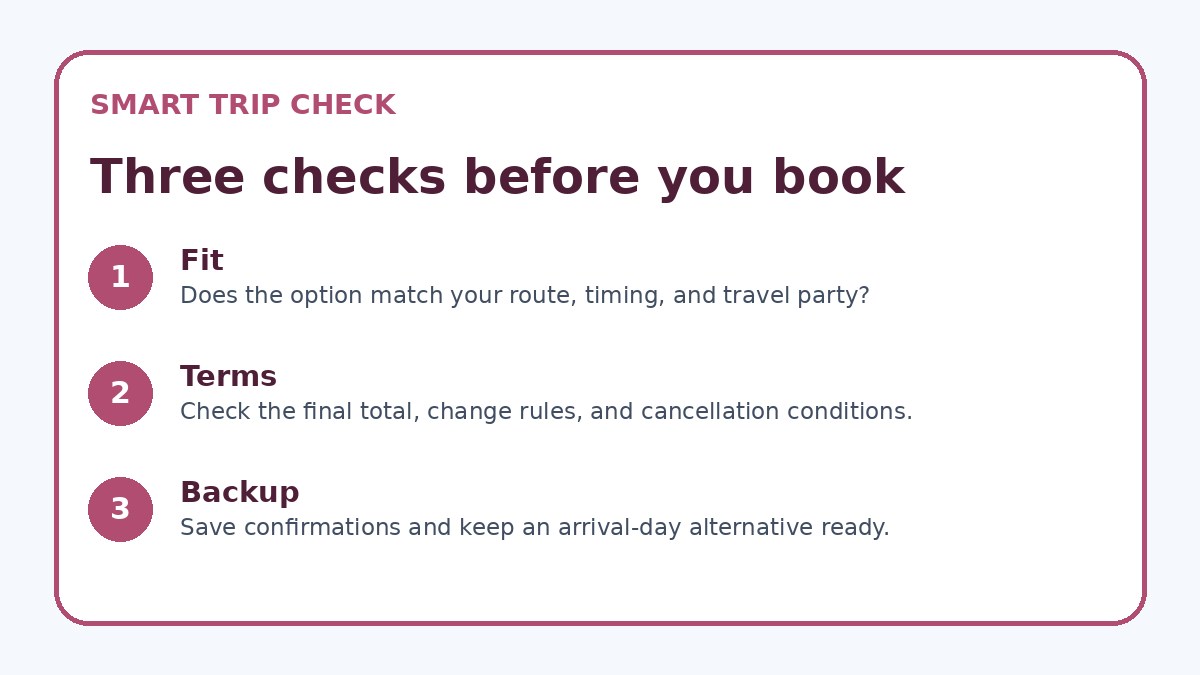
- Verify cancellation and change penalties for each component you plan to buy.
- Check baggage allowances and seat-selection rules on the airline’s booking page.
- Ensure hotel check-in/out times and deposit or ID requirements match your itinerary.
- Decide a fallback plan for delays and confirm how support works with your seller.
Practical checks and timing: what to verify before you hit Purchase
Before buying either a package or separate tickets, verify a few concrete things on the provider’s final booking page: exact inclusion list (meals, transfers, taxes), cancellation and change penalties, baggage allowance and whether seat selection is included. For hotels confirm check-in/out times, whether ID or deposit is required, and if breakfast is included. For trains and local transport, check whether passes need collection in Japan, home delivery, or activation at a specific station. If a package lists guided components, ask whether they run in English and how many participants per group.
Timing matters: if you need flexible dates, prioritize refundable or low-penalty change options and confirm how refunds are handled. When booking separately, stagger refundable options — book the flight first, then hold a refundable hotel rate while you confirm other elements. If you prefer a package but want more room choice, ask the operator about upgrade options or the ability to add nights independently. Finally, consult a booking comparison site such as Trip.com to view current availability, but always rely on the seller’s booking page for the authoritative terms.
Frequently asked questions
Will a package reduce stress for a first visit to Tokyo?
Yes, a package often reduces stress because one provider manages flights, hotels and sometimes transfers, so you interact with a single customer service for itinerary changes. This can be especially helpful if you prefer straightforward arrival logistics and minimal administrative work. However, stress reduction depends on the package’s flexibility and the clarity of its terms. Check the provider’s final booking page for cancellation rules, what to do if your flight is delayed, and whether local support is available in English before relying solely on a package for peace of mind.
How can I compare neighborhood value if I book separately?
Start by listing must-see areas and what you want to do in each—shopping, nightlife, traditional sites, or proximity to transit hubs — then compare hotel locations on maps and transit lines. Factor walking distance to the nearest major station, convenience of luggage storage, and breakfast options. Read recent guest comments for practical points such as noise or elevator access. When you find hotels you like, confirm on the final booking page the exact room type, cancellation window, and whether taxes or resort fees are added at checkout.
Is a hybrid approach worth considering for Tokyo travel deals?
A hybrid approach—booking major components like flights and a main hotel separately while buying a package day tour or airport transfer—can offer balance between control and convenience. It gives you neighborhood choice and flight timing while outsourcing complex logistics such as guided day trips or multi-day tours. The main downside is the need to sync timings and refund rules across suppliers. Always confirm on each provider’s final booking page how changes and delays are handled to avoid gaps in coverage or nonrefundable overlaps.
Final planning note
For first-time visitors to Tokyo the right choice depends on how much control you want over neighborhood selection, flight times and daily plans versus how much planning time and risk you want to manage. Packages simplify logistics and offer a single contact point, which may be preferable if you want convenience and a streamlined process. Separate bookings let you tailor the trip closely to your tastes but demand more comparison, math and attention to refund and baggage details. A hybrid approach often captures the best of both worlds—just verify inclusions and change rules on each provider’s final booking page before committing.
Continue planning
Check current options and final conditions
Use the provider page to confirm live availability, the final total, cancellation terms, and every condition that matters to your trip.
This evergreen planning guide was created with AI-assisted drafting and a structured quality review. It does not display live prices, schedules, availability, visa guidance, or provider rankings. Verify current details before booking. Some links are affiliate links; we may earn a commission at no additional cost to you.