Practical answer first: for most first-time visitors to Seoul, a rental car is unnecessary and often more hassle than help. The city’s subway, buses, taxis, and pedestrian-friendly neighborhoods cover the main tourist areas efficiently, and public transit removes parking and traffic stress. Consider renting a car only if your itinerary includes multi-day side trips outside the Seoul metropolitan area, a tight schedule that public transport can’t meet, or specific mobility needs that make driving easier. This article lays out the tradeoffs clearly—when a rental is worth it, what you must check before booking, and how to compare driving versus relying on Seoul’s transport. Use these criteria to match your trip style and priorities with the practical realities of getting around Korea’s capital.
When a Seoul car rental makes sense
A rental car can pay off when your itinerary leaves the Seoul metropolitan core. If you plan multiple day trips to destinations with limited public transport—mountain hikes, coastal beaches, or smaller towns in Gyeonggi-do and Gangwon-do—having a car gives you schedule control and access to trailheads or viewpoints where buses are rare. Families with young children or travelers with mobility needs may also prefer the privacy and convenience of a vehicle. Think about group size: splitting rental and fuel costs among several people often improves the value proposition compared with individual transit fares.
Assess distances and destinations before committing. A single long drive out of the city followed by convenient return transit could be handled without a long-term rental; conversely, back-to-back day trips to different regions usually justify keeping a car. Also consider luggage and equipment—if you’re carrying bulky sports gear, photography kit, or multiple pieces of luggage, the convenience of a vehicle can outweigh parking and traffic downsides. Plan specific routes and estimate driving times to see if the flexibility is worth the added steps of parking and navigating unfamiliar roads.
Why public transit is usually the better choice
Seoul’s subway network is extensive, frequent, and straightforward for first-time visitors after a little orientation. Major tourist areas—Myeongdong, Insadong, Hongdae, Gangnam, and Gyeongbokgung—are all easily reachable and often faster by subway than by car at peak times. Buses fill gaps between stations and connect suburbs; taxis are plentiful for short trips or late-night rides. Using transit avoids parking searches, unfamiliar driving rules, congestion, and the stress of navigating in Korean traffic. For short stays focused on central Seoul, transit typically wins on time, cost, and simplicity.
Beyond convenience, public transport allows you to relax between sights, use local apps for route planning, and avoid the cognitive load of real-time navigation. Seoul’s transit cards work across buses and subways and can be topped up easily; signage, station staff, and English maps are common in tourist areas. If you value a more immersive city experience—wandering neighborhoods, hopping between cafes and markets, or taking short evening strolls—a car can feel like an unnecessary encumbrance rather than a helper.
| Approach | Best for | Tradeoff to check |
|---|---|---|
| Rent a car for the whole trip | Travelers with multiple rural day trips or bulky gear who value schedule control. | Higher costs, parking hassle, and city driving stress. |
| Use public transit only | Visitors staying mostly in central neighborhoods and relying on subways and buses. | Less flexibility for remote sites and heavier luggage management. |
| Combine transit with one-day car hire | City stays with a planned excursion needing a car for a single or a couple of days. | Extra booking steps and limited window for car use; still need parking for the hire days. |
| Hire a driver or private transfer for specific legs | Groups or travelers who want door-to-door comfort without driving themselves. | Higher per-trip cost compared with self-driving, but removes navigation burden. |
Practical tradeoffs: cost, parking, and traffic
Cost comparison is more than daily rental rates: include fuel, tolls, parking fees, insurance excess, and potential fines. In central Seoul, hourly or daily parking in commercial areas can be expensive and sometimes limited, forcing you to walk from remote lots. Congestion during weekday rush hours and event-driven local traffic can turn short distances into long drives. Weigh these ongoing costs against public transit fares and the time savings you expect from driving; the arithmetic often favors transit unless your pattern of travel is strongly car-dependent.
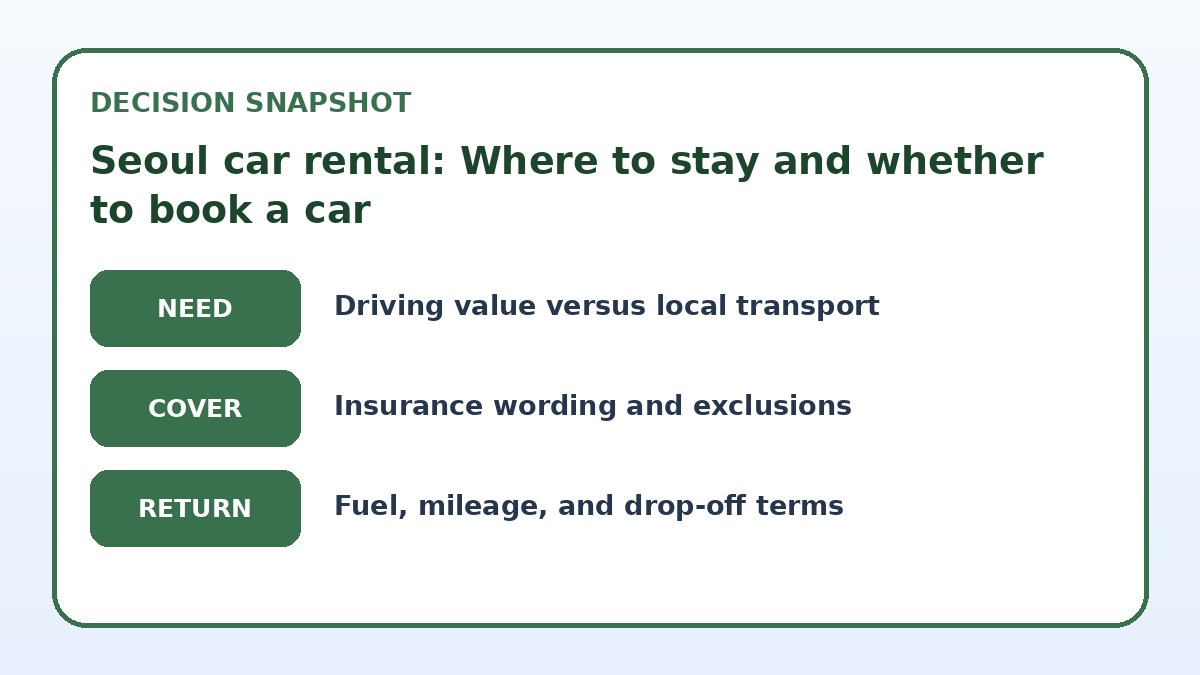
Also consider administrative and legal steps: you will need the correct driver’s license and potentially an international driving permit depending on your country. Car rental contracts include insurance options and liability terms you should review closely; when provider-specific facts matter, verify coverage, excess amounts, mileage limits, and cancellation terms on the rental company’s final booking page before you complete a reservation. These contract details can materially affect the value and risk of renting.
Before you book
- Map every day’s major stops and check subway/bus options to identify hard-to-reach locations before considering a rental.
- Confirm parking availability and fees at your hotels and main attractions you plan to visit.
- Verify driver eligibility requirements, such as international driving permits and age limits, on the rental company’s final booking page.
- Compare total trip costs including rental, fuel, tolls, parking, and insurance rather than just the base rate.
- Plan routes and realistic drive times with traffic windows in mind to avoid rush-hour delays.
- If renting, photograph the vehicle at pickup and note existing damage to avoid disputes at return.
How to decide before you book
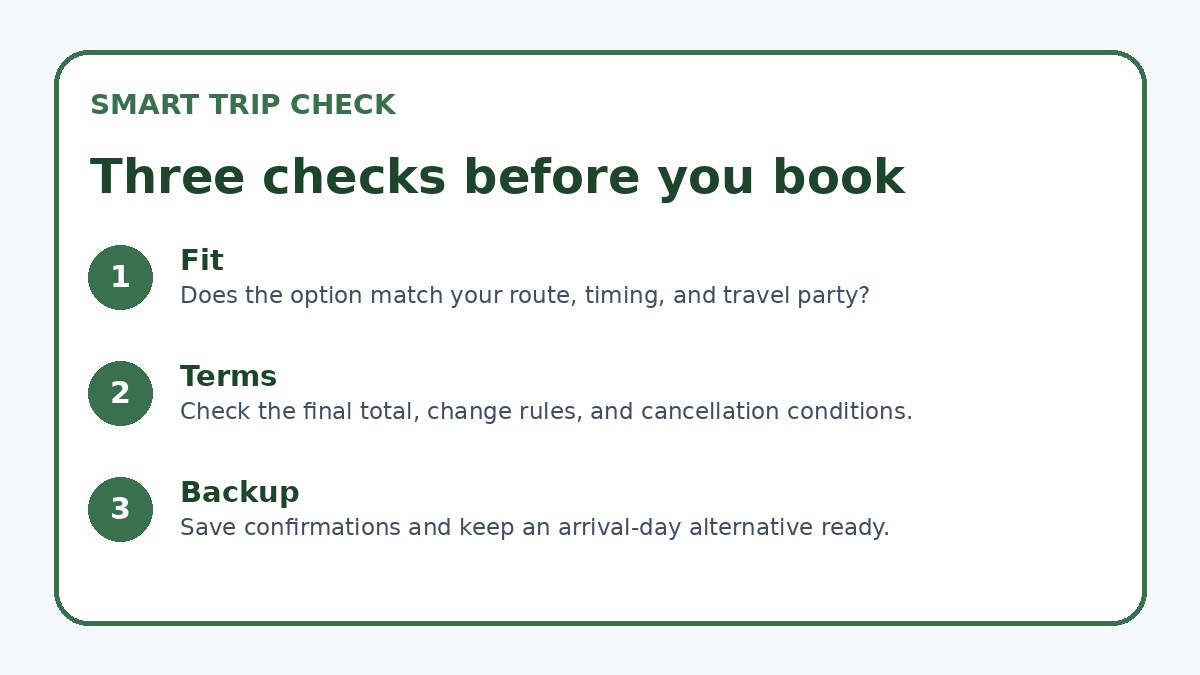
Start by mapping each day’s plan and flagging places that are hard to reach by subway or bus. Estimate door-to-door travel time for both transit and driving, and include walking time between parking, stations, and attractions. If most days show faster or similar timings with transit, skip the rental. If several days depend on sites with sparse bus service or long last-mile walks, a car may be justified. Check whether your chosen accommodations have on-site parking and note any restrictions or fees.
Next, factor in comfort and risk tolerance: are you comfortable driving in a city with different signage and lane behavior? Do you prefer the independence of a car even if it costs more? Finally, shop rental options for one-way drop-off flexibility if your route crosses regions. If you compare providers, verify exact pickup/dropoff locations, fuel policy, age requirements, and insurance coverage on the supplier’s final booking page; Trip.com can be used once to compare current availability, but always confirm details with the rental company before booking.
Frequently asked questions
Can I use an international driving permit (IDP) to rent in Seoul?
Many rental companies accept an international driving permit alongside your home-country license, but rules vary by provider and nationality. Before booking, check the rental company’s policy for the exact documents they require, the validity period of the IDP they accept, and whether translation of your license is needed. Review identification and payment requirements on the booking page and prepare scanned copies if the insurer asks. If in doubt, contact the rental company directly to confirm paperwork to avoid pickup delays.
How hard is parking in central Seoul and should I worry about parking fines?
Parking in busy central neighborhoods can be limited and often metered or restricted to permit holders; private lots exist near commercial areas at varying fees. Hotels sometimes offer on-site parking but charges and space availability differ widely—confirm with your accommodation. Familiarize yourself with local parking signs and rules; prohibited parking or improper payment can result in fines or towing. When renting, ask the provider about penalties and responsibilities for fines; always keep receipts or photos of where you parked as evidence if issues arise.
Are highways and tolls complicated for foreign drivers around Seoul?
Expressways require payment at toll booths or via electronic tolling, and several major routes connect Seoul to surrounding regions. The process is generally straightforward, but if you’re unfamiliar with local signage and lane setups, toll plaza navigation can feel busy. Confirm with the rental company how tolls are handled—some vehicles use in-car electronic toll devices and charge tolls to your rental account, while others require cash or card at booths. Verify the rental firm’s toll policy and any convenience fees on their final booking page so you understand how toll charges will appear on your bill.
Final planning note
For most first-time visitors, Seoul’s dense, reliable public transport and compact tourist areas mean a car adds cost and complexity more often than convenience. Choose transit when your plans focus on museums, markets, neighborhoods, and short trips inside the city. Opt for a rental—or a mixed approach—when your itinerary includes multiple rural day trips, bulky equipment, or specific accessibility needs that transit cannot meet. Whatever you decide, run the numbers, check parking and license rules, and verify rental contract specifics on the provider’s booking page before you reserve. A little planning up front ensures your chosen mode of transport supports the experience you want in Seoul.
Continue planning
Check current options and final conditions
Use the provider page to confirm live availability, the final total, cancellation terms, and every condition that matters to your trip.
This evergreen planning guide was created with AI-assisted drafting and a structured quality review. It does not display live prices, schedules, availability, visa guidance, or provider rankings. Verify current details before booking. Some links are affiliate links; we may earn a commission at no additional cost to you.