
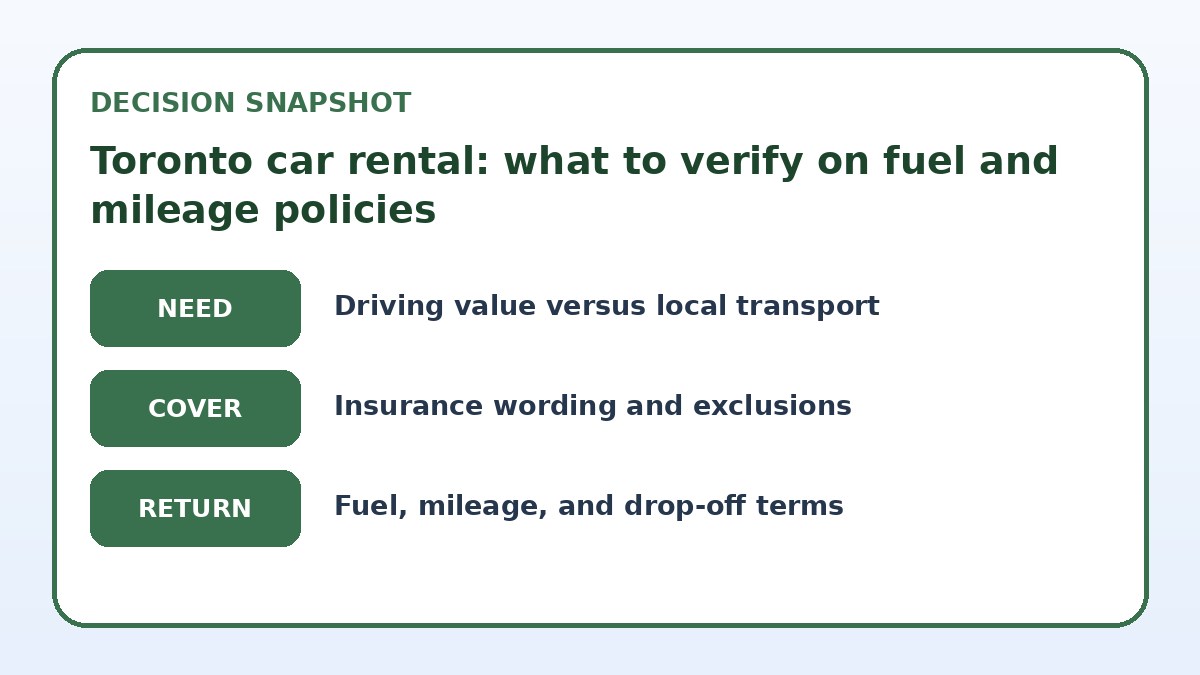
If you’re renting a car in Toronto for business, the single most useful step is to confirm the rental company’s fuel and mileage rules before you complete your booking. Fuel policies determine whether you must return the car with a full tank, pay for prepaid fuel, or accept a refueling charge; mileage rules tell you whether unlimited kilometres are included or daily/hourly caps apply. Those details directly affect cost and daily planning, especially if meetings span the Greater Toronto Area or take you beyond city limits. Read the provider’s rental terms line-by-line, check the booking page for wording on fuel and kilometre allowances, and, when in doubt, capture a screenshot or save the confirmation email that spells out these items to avoid disputes at return.
See current options before you compare the details
Availability and final conditions change. Open Trip.com now or keep reading for the practical comparison.
How fuel policies work and which to pick
Rental companies usually offer several fuel options; full-to-full is the most transparent: you pick up the car with a full tank and return it full, paying only for the fuel you use. Prepaid fuel or “full-to-empty” alternatives let you pay for a tank up front, but the effective cost and refund mechanics vary. Prepaid options can be convenient for short urban trips with unpredictable refuelling timing, while full-to-full suits those who prefer to only pay for what they actually use. For business travelers who submit expense reports, full-to-full typically provides the easiest documentation—save your pump receipts and photographed gauges to prove the return level.
When evaluating a fuel option, compare the provider’s stated per-litre or per-tank price to local fuel costs and consider the administrative charges applied if you don’t return the tank full. Some providers add a service fee plus a high per-litre markup for refuelling on your behalf. If your itinerary includes airport pickups, check whether airport locations impose separate refuelling surcharges. Always check the booking confirmation and the rental terms page so you can quote exact wording to a counter agent if a discrepancy arises at drop-off.
Mileage allowances and how they affect business routes
Mileage rules are phrased as unlimited kilometres or a capped allowance with extra charges per kilometre. For inner-city Toronto meetings, modest daily limits may be fine; but if your schedule includes trips to Mississauga, York Region, Durham, or Niagara, mileage accrual can be significant. When a booking shows a kilometre cap, multiply that cap by trip days and compare it with your planned itinerary distances, including potential detours, client site visits, and transfers to suburbs or airports. If you expect to exceed the cap, request unlimited kilometres or calculate the per-kilometre fee into your expense estimate.
Corporate policies sometimes require selecting specific vehicle classes or corporate contract rates that include different kilometre terms. If your company has a negotiated rate, confirm with your travel coordinator which mileage policy applies and whether you should book through the corporate portal. For one-off rentals, weigh the cost of upgrading to unlimited kilometres versus paying overage fees; an upgrade is often worth the predictability when schedules are tight and route changes are likely.
| Approach | Best for | Tradeoff to check |
|---|---|---|
| Full-to-full fuel policy | Travelers who want to pay only for fuel they actually use and keep clear receipts for expense reports. | Requires time to refuel before return and careful documentation to avoid refuelling fees. |
| Prepaid fuel or full-to-empty | Busy professionals who prefer speed at return and no need to stop for a final fill-up. | May cost more than filling yourself if you don’t use a full tank; refunds for unused fuel vary by provider. |
| Unlimited kilometres | Itineraries that include suburban or intercity travel where distances are unpredictable. | Higher base rate for the rental may make short-city-only trips less economical. |
| Capped kilometres with overage fees | Short, predictable city driving where you can reliably stay under the limit. | Risk of substantial additional charges if your schedule changes or routes extend unexpectedly. |
Ready to check the option that fits your plan?
Use your exact dates and traveler details so the provider page can show the current total and conditions.

Documenting fuel level and odometer at pickup and return
Before you drive away, perform a thorough check: photograph the fuel gauge, the odometer, and any existing body damage. These photos are your best evidence if the rental company later disputes return condition or kilometres. Make sure the agent notes the fuel level and odometer reading on the rental agreement and confirm that images or notes were attached to the file. If the counter staff refuse to initial specific markings, ask for a timestamped digital record or an agent’s email confirmation before you leave the lot.
At drop-off, repeat the same steps under similar lighting if possible and obtain a written receipt showing final odometer and fuel status. If returning after hours, follow the provider’s documented after-hours procedure and keep the key drop receipt and timestamped photos. For corporate expense reconciliation, attach these images to your expense report and include the rental agreement page showing fuel and mileage clauses so auditors can see the original terms you accepted.
Before you book
- Read and save the rental terms page showing fuel policy and kilometre allowance before you confirm the booking.
- Photograph the fuel gauge, odometer, and vehicle condition at pickup and include agent initials on the agreement.
- Confirm on the rental confirmation whether unlimited kilometres or a specific kilometre cap applies and note any per-kilometre rate.
- Ask the counter agent to state the refuelling charge method and any service fees; get the agent’s name and timestamp the conversation.
- Use credit card receipts and gas station printed receipts to document fuel purchases for corporate expense reports.
- If returning after hours, follow the provider’s documented process and keep proof of key drop and timestamped photos of the vehicle.
Questions to confirm on the booking page and at pickup
Before you click book, check for exact wording about fuel (full-to-full, prepaid, or third-party refuelling), kilometre allowances, and any airport or location surcharges. Look for key phrases such as “unlimited kilometres,” “per kilometre charge,” or “refuelling and service fee” and note the numerical values and units. If the site links to a longer rental policy, open and search that document for fuel and mileage to ensure there are no conflicting clauses that could apply at pickup or return.
At the counter, ask the agent to confirm three items aloud: the fuel policy you selected, the kilometre allowance or whether unlimited kilometres apply, and how refuelling charges are calculated and documented. If your company requires receipt-level fuel proof, ask whether credit card holds will be placed and what amount the provider will block. Record the name of the agent and the time of the transaction, and keep any emailed rental confirmation that repeats those points.
Frequently asked questions
Can I use my corporate card for fuel and avoid holds on personal cards?
Many companies allow corporate cards for fuel purchases, but rental companies commonly place an authorization hold on the card used at pickup to secure the rental. To avoid a personal card hold, confirm with your travel team whether your corporate card can be used to pay the deposit and fuel charges and that the rental company accepts that card for authorizations. At the counter, ask the agent to explain the authorization amount, whether it will be settled at return, and how long the hold typically remains on the card—then request this in writing on the rental agreement or confirmation email so your finance team understands the timing for card availability.
If I return the car with less fuel than when I picked it up, how can I dispute an unfair refuelling charge?
If you believe a refuelling charge is incorrect, present the photographic evidence of the fuel gauge and odometer taken at pickup and return, the rental agreement noting the fuel policy, and any gas receipts that prove you refuelled appropriately. Ask to speak with a manager and request an itemized invoice showing per-litre rates and service fees used in the charge calculation. If the dispute persists after return, follow the provider’s documented complaints process and keep all correspondence and images; your corporate travel or procurement contact may assist in escalating the issue with the rental company or with the payment card provider.
How do I estimate whether to buy unlimited kilometres or accept a capped allowance?
Estimate total driving distance by listing all planned destinations, using route tools to measure round-trip distances between meetings, and adding a buffer for detours and traffic. Multiply daily limits by rental days and compare that total to your estimated distance. If your projected kilometres approach or exceed the cap, calculate the cost difference between the unlimited option and projected overage fees. Consider schedule flexibility: if meetings could be added or relocated, the peace of mind and predictable billing of unlimited kilometres often outweighs the higher base rate.
Final planning note
For business travelers in Toronto, fuel and mileage rules are small details that often determine whether a rental is convenient or causes unexpected expense and administrative friction. The practical approach is simple: verify the exact fuel policy and kilometre allowance on the booking page, photograph gauges and odometer at pickup and return, and secure written confirmation of any corporate billing arrangements. Factor the cost of prepaid fuel or unlimited kilometres against the value of time saved and predictability, and keep all receipts and images for expense reconciliation. Taking these steps at booking and pickup will keep your focus on meetings, not disputes at the drop-off counter.
Continue planning
Check current options and final conditions
Use the provider page to confirm live availability, the final total, cancellation terms, and every condition that matters to your trip.
This evergreen planning guide was created with AI-assisted drafting and a structured quality review. It does not display live prices, schedules, availability, visa guidance, or provider rankings. Verify current details before booking. Some links are affiliate links; we may earn a commission at no additional cost to you.