
If you want the most practical way to travel from Seoul to Jeonju as a solo traveler, prioritize convenience, predictability, and how well the option fits your luggage and schedule. For most solo travelers who value a balance of comfort and ease, taking an intercity express train or a direct express bus will usually be the best choice—these options minimize transfers and let you use travel time productively. Your decision will hinge on a few straightforward factors: departure flexibility, station or terminal location in Seoul, how much walking or transfers you tolerate at each end, and whether you prefer reserved seating. Below I’ll summarize the quick practical answer, then walk through the tradeoffs and decision criteria so you can match your priorities to the right transport option for your trip to Jeonju.
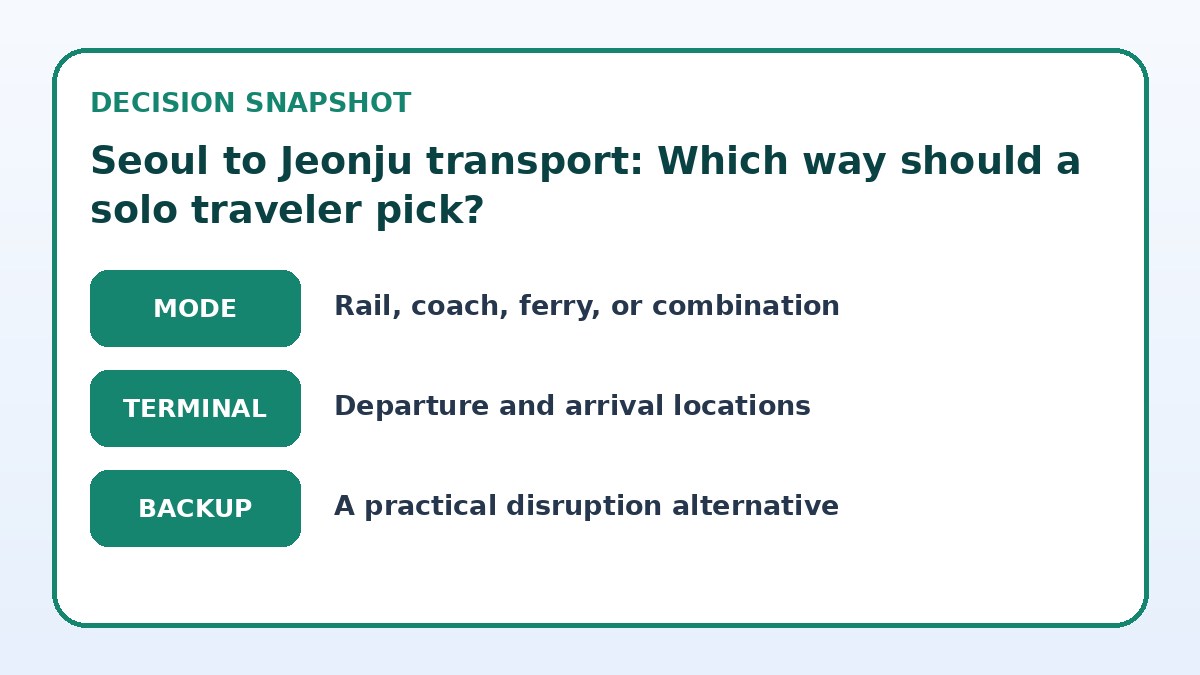
See current options before you compare the details
Availability and final conditions change. Open Trip.com now or keep reading for the practical comparison.
Practical recommendation up front
For a solo traveler who wants minimal hassle and predictable travel, choose a direct intercity service with reserved seating that departs from a convenient point in Seoul. That typically means selecting either a mainline intercity train or a long‑distance express bus that lists Jeonju as an endpoint or scheduled stop. These services reduce the need for transfers, lower the chance of getting on a crowded local vehicle, and make it easier to manage luggage. If you value being able to work, sleep, or relax en route, pick the option offering quiet, available seats and space for bags.
If your priority is schedule flexibility and you don’t mind standing or searching for a seat, an unreserved coach or more frequent local bus can be practical. Conversely, if time on the ground in Jeonju matters more than cost, locate departures that arrive close to the city center or the neighborhood where you’ll stay. Before booking, confirm whether a service is direct or involves a transfer; for any provider, check their final booking page to verify seat policies, baggage rules, and the exact station names you’ll use.
How to compare comfort, convenience and cost tradeoffs
Comfort usually correlates with reserved seating and onboard amenities like restrooms and luggage racks. Trains often give more stable seats and space to move than buses, but express buses can still be comfortable and may stop closer to Jeonju’s main attractions. Convenience includes not just the in‑vehicle experience but also how easy it is to reach the departure point from your Seoul lodging. A slightly slower service that departs from a nearby terminal can be more convenient—and less stressful—than a faster option requiring a long subway or taxi transfer.
Cost matters, but don’t let it be the only criterion. A cheaper bus that saves a small amount may add complexity with transfers or more walking after arrival. Also consider booking flexibility: look for services that allow changes or cancellations without heavy penalties, and verify this on the provider’s official booking page. Use a comparison site such as Trip.com only as a starting point to see options; always confirm final terms, exact departure and arrival locations, and luggage allowances directly with the operator before you commit.
| Approach | Best for | Tradeoff to check |
|---|---|---|
| Reserved intercity train | Travelers valuing seat certainty, smooth ride and space to work or rest. | May require traveling to a main train station and verifying seat/ballast luggage rules on booking pages. |
| Direct express bus | Those who want a simple, often city‑center arrival with easy terminal access. | Comfort varies by operator; confirm onboard facilities and luggage handling before booking. |
| Local bus with transfers | Budget‑minded travelers with flexible schedules who don’t mind extra transfers. | More walking, uncertain seating and potentially longer door‑to‑door times. |
| Private car or rideshare | Travelers prioritizing door‑to‑door privacy, flexible stops and direct routing. | Higher cost and variable traffic; check pickup/dropoff points and driver policies ahead of travel. |
Ready to check the option that fits your plan?
Use your exact dates and traveler details so the provider page can show the current total and conditions.
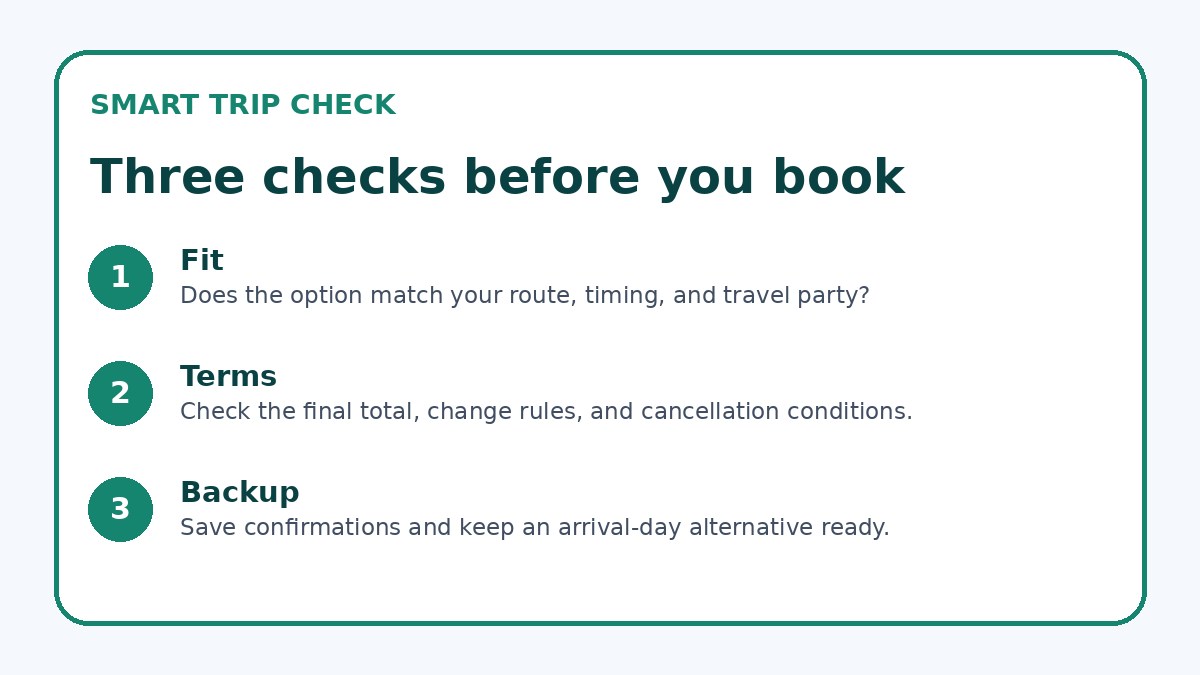
Safety, solo‑traveler specifics and luggage
Solo travelers should assess personal safety and comfort: daytime departures tend to feel safer and make navigation at arrival easier, while late‑night arrivals might require prearranged transport from the station. Choose well‑lit, busier terminals where staff and fellow passengers are present. Keep important items—passport, phone, chargers, medication—in a small daypack you carry onboard. For luggage, confirm whether the service stores bags in a hold, provides overhead racks, or requires you to keep bags with you; train and express bus pages will list these policies.
If you’re carrying a bicycle or oversized items, check operator rules before travel; not all intercity services accept large gear. Solo travelers should also decide whether to book a seat in advance: reserved seating guarantees your place and reduces stress at busy times, while unreserved seating can be fine on off-peak runs. Finally, have a fallback plan—such as the next departure time or a local taxi app—if your planned service is sold out or delayed. Always verify any provider-specific rules on the official booking platform.
Before you book
- Confirm exact departure and arrival station names on the operator’s official booking page before finalizing.
- Decide whether you need a reserved seat and book it to avoid standing during peak travel times.
- Verify the operator’s luggage policy for your bags, including any size or weight restrictions.
- Plan ground transfers in Seoul and Jeonju—estimate travel time from your accommodation to the terminal or station.
- Download offline maps and save your Jeonju hotel address in both English and Korean for taxis.
- Check cancellation or change policies on the booking page so you can adjust plans if schedules shift.
Timing, arrival logistics and what to do in Jeonju
When choosing a departure, think about arrival logistics: does the arrival stop place you within easy reach of Jeonju’s hanok village or your lodgings? Some services arrive at central terminals within walking distance of main attractions; others stop at peripheral stations requiring a short local bus or taxi. Factor in local transit schedules and the convenience of taxis, especially if you arrive with luggage. If you plan to explore immediately, aim for arrivals during daylight hours when sights, restaurants, and visitor facilities are open.
If your itinerary is tight, pick options with shorter transfer times and reliable arrival terminals. Plan time for clearing any ticket or seat confirmation steps at the arrival terminal, and identify a safe spot to retrieve luggage. For peace of mind, download maps and station exits in advance and store important addresses in both English and Korean. That way you’ll get from the station to your Jeonju destination quickly and confidently, leaving more time to enjoy the city’s food, craft shops, and historic neighborhoods.
Frequently asked questions
Should I take a train or a bus from Seoul to Jeonju?
Both trains and express buses are common choices; decide by weighing seat reservation availability, how close each terminal is to your accommodation, and your luggage needs. Trains often offer stable seating and roomier interiors, while some express buses may land you closer to Jeonju’s central neighborhoods. Check each operator’s schedule, whether the trip is direct or requires a transfer, and the luggage rules on their booking pages before you book. Use those facts to pick the service that suits your comfort and arrival location preferences.
How do I manage luggage as a solo traveler on this route?
Bring a manageable main bag and a smaller daypack for valuables and essentials. Confirm whether the service provides underfloor storage, overhead racks, or requires you to keep luggage with you. If you have oversized items, contact the operator or check their booking page for special handling rules. At stations, position yourself near staff or stall areas in case you need assistance, and keep important documents and electronics on your person to reduce risk.
What should I verify on the booking page before I buy a ticket?
Always confirm departure and arrival station names, whether the trip is direct or includes transfers, seat reservation options, luggage rules and the provider’s cancellation or change policy. Also check boarding procedures (which platform or terminal area), identification requirements and any additional fees. If a comparison site lists options, use it to shortlist choices but verify these specific details on the operator’s own booking page to avoid surprises at departure.
Final planning note
For most solo travelers heading from Seoul to Jeonju, the most practical choice balances convenience, a predictable seat and arrival location. Start by ruling out options that add complex transfers or long walks from the station; then choose between a reserved train for comfort or a direct express bus for convenient city‑center arrivals depending on which terminal is closest to your plans. Confirm seat reservation, luggage allowances and whether a service is direct on the provider’s booking page before committing. With those checks done, you’ll travel with less stress and have more time to enjoy Jeonju’s neighborhoods, food and cultural sites.
Continue planning
Check current options and final conditions
Use the provider page to confirm live availability, the final total, cancellation terms, and every condition that matters to your trip.
This evergreen planning guide was created with AI-assisted drafting and a structured quality review. It does not display live prices, schedules, availability, visa guidance, or provider rankings. Verify current details before booking. Some links are affiliate links; we may earn a commission at no additional cost to you.