
If you’re traveling to Da Nang with extra suitcases or bulky gear, the single most practical move is to build date flexibility into your search from the start. Shifting your outbound or return by a day or two, or opening a one-week window, can reveal flights with a different checked-bag allowance, lower baggage fees, or better connections that reduce the number of segments where you’d pay again. The same flexibility helps when choosing accommodation: some hotels waive or reduce charges for additional bags on quieter nights, or the timing may affect availability of airport transfer vehicles that can handle large items. Read the baggage rules and hotel luggage policies carefully on the provider’s booking page before you finalize any purchase.
See current options before you compare the details
Availability and final conditions change. Open Trip.com now or keep reading for the practical comparison.
How date shifts change flight baggage outcomes
Airlines’ baggage allowances and the fares that include them vary by cabin, fare bucket, and route. Searching a single departure date can hide nearby flights with a better baggage profile; for example, a flight one day earlier might be serviced by a different aircraft type or fare family that includes an extra checked bag. Use the flexible-date calendar on booking sites to compare the total cost field that includes ticket price plus expected standard baggage fees. When comparing options, add the known baggage fees yourself if the interface separates them, and treat the full trip cost as the decision metric rather than base fare alone.
Be cautious about connections: adding stops can sometimes lower the base fare but increase the chance you’ll pay baggage fees twice if different carriers or fare rules apply. When connecting, check whether all segments are on the same ticket and confirm through-checked baggage rules on the carrier’s final booking page. If an itinerary requires switching airports or rechecking luggage land-side, date flexibility that allows a direct or single-carrier connection may save both money and hassle even if the base fare is slightly higher.
Timing hotel bookings and transfers for large luggage
Hotel luggage policies and on-site handling vary with occupancy. Shifting your arrival by a night or two to non-peak days can increase the chance staff will assist with larger items or store them if you arrive well before check-in. When booking, scrutinize the hotel’s stated baggage assistance, storage, and any per-item fees on the provider’s page; contact the property directly if the policy is unclear. Flexible booking dates allow you to choose a night when a hotel’s housekeeping and porter team is more likely to be available, and you can ask about elevator access and room sizes to ensure your luggage fits comfortably.
Airport transfers and local taxis also have capacity limits. If you need a van or vehicle that can handle bulky equipment, shifting your pick-up time to off-peak hours or a different day can increase availability and lower the risk of extra charges. When comparing transfer suppliers, verify vehicle size and load limits on the booking page, and confirm how many suitcases and oversized items are included. If a supplier’s page doesn’t specify, message them and save the confirmation; with flexible dates you can swap to a slot that guarantees the larger vehicle.
| Approach | Best for | Tradeoff to check |
|---|---|---|
| Shift outbound by 1–3 days | Travelers with some schedule flexibility seeking improved baggage allowances | May miss fixed appointments or add a night of lodging; check total door-to-door cost. |
| Choose a nearby airport on different dates | Those willing to trade a short ground transfer for a more generous baggage policy | Adds ground time and potential transfer cost; verify vehicle capacity and logistics. |
| Book slightly higher fare with better baggage included | Travelers preferring certainty and fewer check-in hassles | Pays more upfront but may save time and risk; compare full-trip costs including baggage savings. |
| Use multi-city or open-jaw routing | Complex itineraries where routing yields better carrier baggage rules on main segments | Can complicate baggage handling and connections; confirm through-check rules on the ticket. |
Ready to check the option that fits your plan?
Use your exact dates and traveler details so the provider page can show the current total and conditions.
Search tactics: calendars, multi-city, and nearby airports
Use flexible-date calendars and +/- three-day search windows to reveal patterns: midweek flights often have different fare families than weekend services, and low-demand days may include flights marketed with higher baggage allowances at the same or slightly higher fare. Don’t overlook nearby airports—if your schedule allows, a short additional drive or a different arrival day at a regional hub could get you a carrier or aircraft type with a more generous baggage policy. When you test nearby-airport options, add ground transfer time and cost into the comparison so you’re evaluating total door-to-door impact, not just headline fares.
Multi-city searches can be a surprise ally for heavy-luggage travelers. For example, booking an open-jaw or adding a short positioning flight on a different day might let you route on carriers that offer checked-bag benefits for longer-haul segments. However, each added segment can complicate baggage handling rules, so verify whether the whole itinerary is on one ticket and if bags are checked through to the final destination. If the ticket is separate, you may need to recheck luggage and clear security, so allow extra time and consider whether the schedule flexibility outweighs that inconvenience.
Before you book
- Use a flexible-date calendar to compare total trip cost for a ±3 day window instead of only base fares.
- Add expected baggage fees to each flight option if the booking tool lists them separately before comparing totals.
- Confirm on the carrier’s or booking page whether luggage is checked through on connecting flights and under what conditions.
- Message the hotel to confirm luggage storage, porter availability, and any per-item handling fees for your intended arrival date.
- Include ground transfer capacity and vehicle size in your search, and reserve a van or larger taxi if you have bulky items.
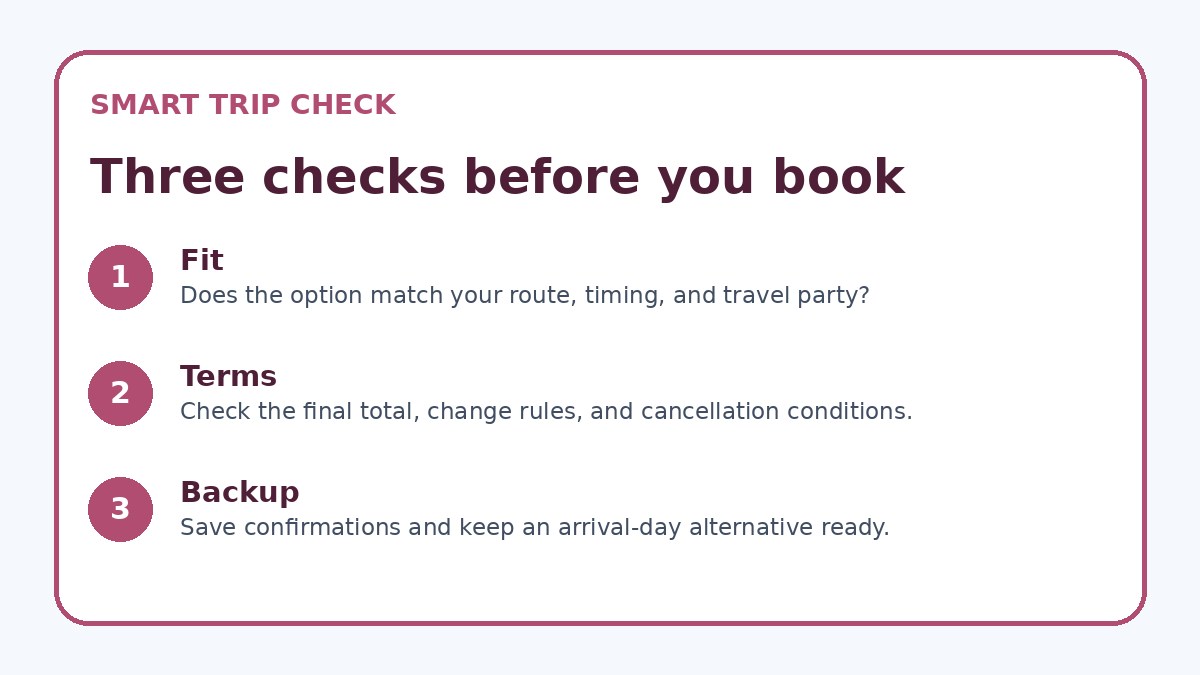
- Keep screenshots or saved confirmations of baggage policy statements and transfer vehicle specifications in case of disputes.
Decision criteria and tradeoffs to weigh before booking
When choosing between dates, weigh the financial savings from lower baggage fees against the value of your time and the risk of disruption. A cheaper flight with a strict change fee or no protection may offer better baggage terms but less flexibility to reschedule if plans shift. If you prioritize certainty, a slightly higher fare that includes more baggage allowance and a simpler connection on the same ticket may be a better bet. Factor in how crucial your extra luggage is—if the items are replaceable or can be shipped, a lower base fare could be preferable; for irreplaceable or time-sensitive items, prioritize direct routing and single-carrier itineraries.
Also consider arrival time and hotel check-in; shifting to a later arrival day may avoid long baggage wait times or give you the option to pay for an early-check-in on a day when the hotel is less busy. Balance the marginal savings from flexible-date searches against potential hidden costs: extra nights, longer ground transfers, or the administrative burden of managing multiple bookings. Always verify final baggage rules, transfer vehicle specs, and cancellation/change penalties on the booking page before committing—use Trip.com or the carrier’s and hotel’s official pages to confirm the current terms.
Frequently asked questions
Can shifting my travel dates really save money when I have extra luggage?
Yes — shifting dates often changes which fare buckets and aircraft operate on a route, and those differences can affect included baggage allowances and surcharges. However, savings depend on the specific carrier and route. Always compare the full cost—including expected baggage fees, transfer costs, and any extra night of lodging—rather than relying on the base fare alone. Before booking, verify the baggage terms on the carrier’s final booking page because displayed allowances can change between search snapshots and the actual ticketing step.
Is it safer to book a higher fare that includes baggage or to gamble on flexible-date finds?
That depends on your tolerance for risk and the value of your luggage. A higher fare that includes baggage and keeps your itinerary on one ticket reduces the chance of needing to recheck bags, pay separate fees, or be denied transfer baggage allowances. Flexible-date finds can save money but may require extra time, tighter connections, or separate tickets that complicate baggage handling. If your items are fragile, irreplaceable, or time-sensitive, prioritize simpler, single-ticket itineraries and verify allowances on the booking page before paying.
How do I verify a transfer vehicle or hotel will handle my oversized bags on the arrival day I choose?
First, look for vehicle size and baggage specs on the transfer supplier’s booking page; if details are missing, message them directly and request written confirmation of capacity. For hotels, check policy pages and the property’s operational notes, then email or call to confirm porter service, elevator access, and any per-item fees for your specific arrival date. Save the replies and include them with your reservations. If possible, reserve transfers for off-peak times or nights when staffing is higher to reduce the risk of refusal due to capacity constraints.
Final planning note
Using flexible dates is a practical lever when you travel to Da Nang with extra luggage: it lets you prioritize itineraries and nights with better baggage allowances, simpler connections, or more helpful hotel and transfer staff. The smart approach treats full-trip cost and operational risk as the decision criteria — not just headline fares. Before booking, compare several date windows, factor in ground transfers and potential extra nights, and verify baggage allowances and hotel handling on the provider’s booking page. With a bit of flexibility and careful verification, you can reduce both cost and stress when bringing larger or additional bags to Da Nang.
Continue planning
Check current options and final conditions
Use the provider page to confirm live availability, the final total, cancellation terms, and every condition that matters to your trip.
This evergreen planning guide was created with AI-assisted drafting and a structured quality review. It does not display live prices, schedules, availability, visa guidance, or provider rankings. Verify current details before booking. Some links are affiliate links; we may earn a commission at no additional cost to you.