
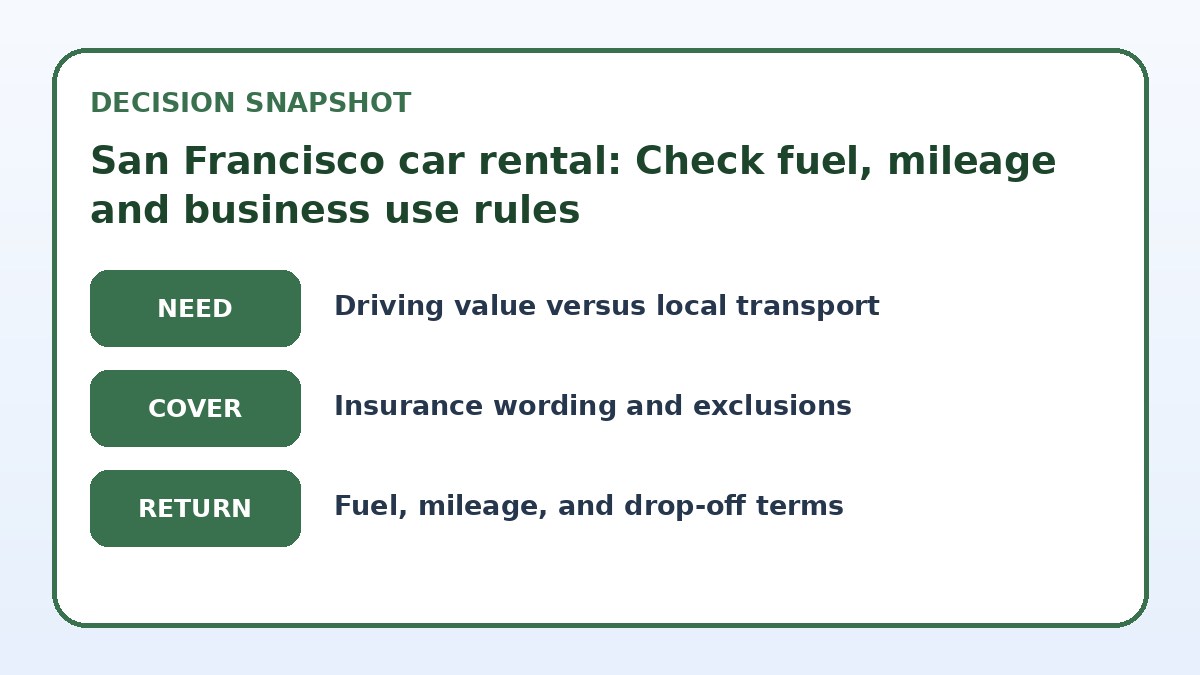
If you’re renting a car in San Francisco for business, the quickest decision to make is simple: confirm the rental company’s fuel policy and the contract mileage rules before you complete the booking. These two items most directly determine your reimbursement, out-of-pocket costs, and whether you need to refuel before returning the car. Fuel options (prepay, same-as-gas-station, or return full) and mileage allowances (unlimited, per-day cap, or limited total miles) can vary by location and vehicle category. For corporate travelers this affects expense reporting, receipt handling, and whether you’ll face surprises on the credit card after the trip. The rest of this guide explains how to compare fuel and mileage options, the tradeoffs for each approach, what to verify on the final booking page, and a practical checklist to use before you sign the rental agreement.
See current options before you compare the details
Availability and final conditions change. Open Trip.com now or keep reading for the practical comparison.
Understand the common fuel policies and what they mean
Rental companies typically offer a handful of fuel options and the contract’s language changes the cost implications. Prepaid fuel lets you buy a tank in advance at the company’s posted rate; this can be convenient if you want to avoid refueling before return, but it may not be cost-effective if you use only a portion of the tank. Full-to-full requires you to pick up the car with a full tank and return it full; it’s the cleanest financially when you refuel at local prices before drop-off and you keep the receipt for expense claims.
There’s also an option where the company refuels after you return the vehicle and charges a refueling fee plus per-gallon rate — often the most expensive. For business travelers who need predictable expense reports, the safest approach is to choose full-to-full when local station prices are reasonable, or request a fuel purchase policy in writing if a prepay option is used. On the booking page and rental agreement look for exact wording about per-gallon refuel charges, administrative refuel fees, and whether fuel charges appear immediately or post-rental.
Mileage rules: unlimited versus capped plans and when they matter
Mileage allowances vary: some corporate or premium bookings include unlimited miles, others set a daily or total limit before overage fees apply. If your business schedule includes longer trips — for example, drives to wine country, the Peninsula, or down the coast — mileage caps can quickly result in unexpected charges. When you see a per-day mileage limit, calculate your planned distance (including meetings, airport transfers, and any buffer) to estimate potential overage costs before you book.
For urban-only itineraries in San Francisco where parking and congestion encourage short trips, a capped plan can be cheaper if it lowers the base rate. But be cautious: rental paperwork may define “miles” strictly and charge per mile overage at a set rate. To make a well-informed decision, compare the per-mile overage fee versus the premium for unlimited miles and factor this into corporate expense approvals or personal charge limits.
| Approach | Best for | Tradeoff to check |
|---|---|---|
| Choose prepaid fuel | Travelers who want to avoid refueling hassle at drop-off | May cost more than local pump rates and is nonrefundable for unused fuel |
| Return full (full-to-full) | Those who prefer paying only for fuel used at market prices | Requires time to refuel before return and keeping receipts for expense claims |
| Pick unlimited mileage | Business trips with long drives outside the city | Higher daily rate but eliminates per-mile overage risk and surprise costs |
| Accept capped mileage with lower base rate | Short city-only itineraries where total miles stay low | Risk of costly per-mile charges if plans change or detours occur |
Ready to check the option that fits your plan?
Use your exact dates and traveler details so the provider page can show the current total and conditions.

How fuel and mileage choices affect corporate billing and expense reporting
From an expense perspective, the fuel and mileage selection determines what receipts you need, how charges show on your card, and what your accounting team needs to approve. If you choose prepay fuel, ask for clear invoicing that shows the fuel portion separately; some companies report the prepaid fuel as a nonrefundable charge which complicates reimbursements. For full-to-full returns, retain the gas station receipt with odometer readings noted if your policy requires proof of refueling.
Mileage charges can be billed immediately or appear later as an adjustment; verify whether the charge posts to the renter’s card or can be invoiced to the company account. If your company uses a central billing agreement with the rental agency, confirm whether fuel and overage fees are included or excluded in that arrangement. On the provider’s booking page and final rental agreement, look specifically for how fuel and mileage charges are itemized and what documentation the company issues for corporate expense systems.
Before you book
- Read the exact fuel policy wording on the final booking page and screenshot or save that page for your records.
- Note the listed mileage allowance and calculate your planned distance with buffers to estimate potential overage fees.
- Confirm how fuel and mileage charges will be billed (card on file, corporate invoice, or post-rental adjustment).
- Request written confirmation by email from the rental location if the booking page wording is ambiguous.
- Record the vehicle odometer reading and fuel level on the pick-up paperwork before leaving the lot.
- Keep all fuel receipts and the rental agreement copy for corporate expense submission and reconciliation.
Practical decision criteria and what to verify before booking
Before you click reserve, use this checklist of verifications: the stated fuel policy, the exact mileage allowance and overage rate, how charges will be billed, and whether your corporate code or profile alters those conditions. Compare the price difference between the cheapest rate with a strict fuel/mileage policy and a slightly higher rate that includes full-to-full or unlimited miles — the latter can be worth it for predictable expense reconciliation. If a booking page lists multiple vehicle classes, check each class’ rules: premium or corporate vehicles sometimes carry different policies.
If anything on the online listing is unclear, call the rental location and request written confirmation (email) of the fuel and mileage terms for the specific reservation. When you pick up the car, note the odometer reading on the agreement and confirm the fuel expectation with the agent on-site. Finally, remember to check whether airport versus city locations use different policies; collection points can have varying rules and surcharges. Trip.com can be used to compare current availability, but verify the provider’s final booking page for the definitive contract language.
Frequently asked questions
Is prepaid fuel worth choosing for a short business trip in San Francisco?
Prepaid fuel can be convenient if you want to avoid refueling at return and value time over cost. For short trips where you won’t use a full tank, prepaid often means paying for fuel you won’t consume. Before selecting it, compare the prepaid rate on the booking page to typical local prices and consider whether you’ll have time to stop at a gas station before returning the car. If your schedule is tight or you prefer a predictable single charge, prepaid may still be the right choice — but keep the booking page evidence for expense paperwork.
How do I check whether my corporate rate covers unlimited miles or fuel?
Corporate rates can include different allowances than public rates, but the only reliable confirmation is the final booking details or a written agreement from the rental provider. Enter your corporate code when booking and carefully read the included benefits; if the page lacks clarity, call the corporate reservations desk or the specific pickup location and ask them to email the exact terms. Also verify how charges appear on invoices and whether administrative fuel or mileage fees are passed through to the company or the cardholder.
What should I do at vehicle pickup to avoid disputes about fuel and mileage?
At pickup, insist that the agent records the odometer reading and the fuel level on the rental agreement in your presence, and take a timestamped photo of the odometer and fuel gauge for your records. Ask the agent to verbally confirm the fuel policy (for example, full-to-full) and mileage allowance and ensure those terms match the reservation. Keep a copy of the signed paperwork and request an itemized rental receipt at drop-off to reconcile charges before submitting expenses.
Final planning note
For business travelers in San Francisco the simplest planning step is to verify fuel and mileage rules before you book. These contract items shape whether you’ll hand in a neat receipt, face post-rental adjustments, or accept a slightly higher daily rate for peace of mind. Make your decision based on the nature of your itinerary: city-only travel often favors lower-rate, capped miles with careful tracking, while day trips or multiple clients across the Bay Area justify unlimited mileage or clearer fuel handling. Always save the provider’s final booking page or an emailed confirmation, note odometer and fuel at pickup, and keep all receipts to ensure smooth expense reconciliation.
Continue planning
Check current options and final conditions
Use the provider page to confirm live availability, the final total, cancellation terms, and every condition that matters to your trip.
This evergreen planning guide was created with AI-assisted drafting and a structured quality review. It does not display live prices, schedules, availability, visa guidance, or provider rankings. Verify current details before booking. Some links are affiliate links; we may earn a commission at no additional cost to you.