
If you need flexibility for a Seoul business trip, prioritize hotels that clearly separate refundable and nonrefundable fares, offer easy date-change options, and allow corporate invoicing or centralized billing. The key is not a single “best” policy but a match between how often your schedule changes, who pays, and how much advance notice you can give. For short-notice meetings, choose fully refundable or change-friendly rates even if they cost a bit more; for routine weekly visits, semi-flexible rates with limited-change windows can be smarter. Before you click reserve, verify cancellation deadlines, whether “free cancellation” still requires a card on file, what counts as a valid reason for late changes, and how taxes and incidental holds are handled. This article lays out the practical decision criteria, the tradeoffs to expect, and the exact items to verify on the provider’s booking page so you can book Seoul hotels with confidence.
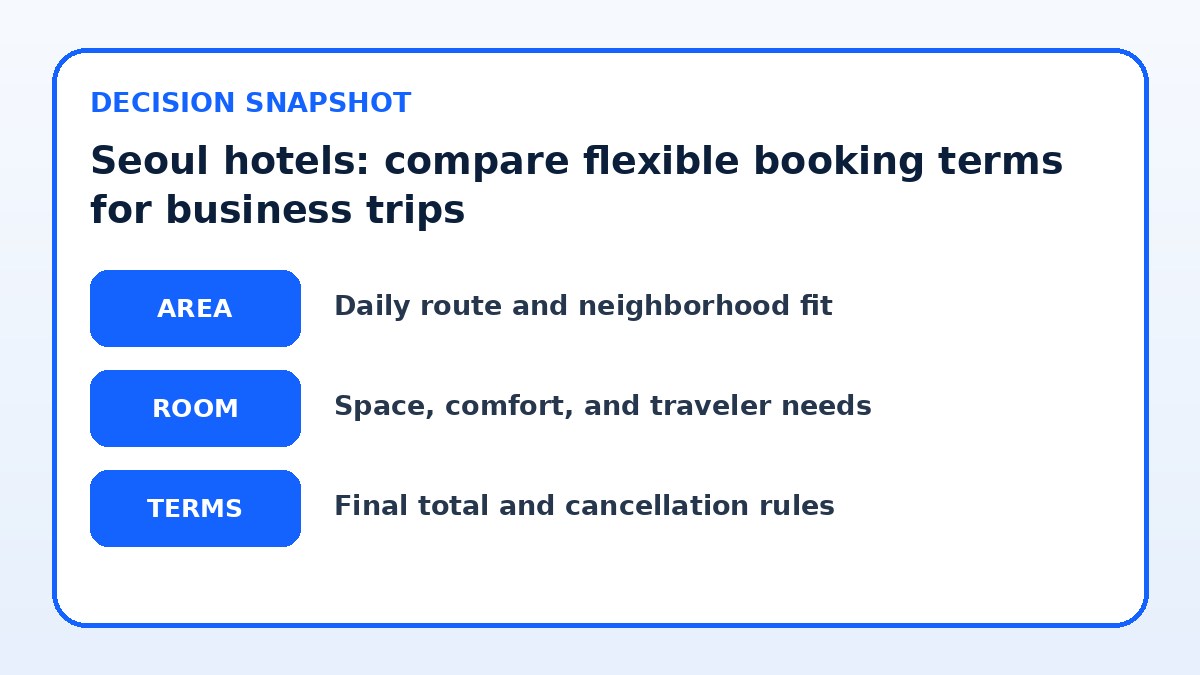
See current options before you compare the details
Availability and final conditions change. Open Trip.com now or keep reading for the practical comparison.
Understand the core types of flexible booking terms
Booking flexibility usually falls into a few practical categories: refundable rates (full refund up to a deadline), changeable-but-not-refundable rates (allow date changes with or without fees), and nonrefundable prepaid rates. Some hotels also offer a hybrid: refundable deposits with penalties for late cancellations, or partial refunds that decline over time. For business travelers, the meaningful difference is not just whether a rate is refundable but how that refund is processed — immediately to the original payment method, as a hotel credit, or as an invoice adjustment. When comparing Seoul hotels, read each rate’s cancellation and modification subparagraphs rather than relying on the headline label.
Another important distinction is where the liability sits: rates that require full prepayment shift the immediate financial risk to the booker, while those that only require a card guarantee maintain flexibility but may hold a security deposit at check-in. Corporate bookings can add complexity if the company policy requires direct billing or third-party payment. Also check whether the hotel allows name swaps or reservation transfers, which can be useful when a colleague takes over a trip. These procedural differences shape whether a flexible rate truly fits your business needs.
How company policy and payment method change the decision
Your employer’s travel policy often determines acceptable room rates, who can approve changes, and which payment methods are allowed. If your company pre-approves only specific corporate rates or centralized billing, you might be constrained to options that are less flexible outside normal change windows. Conversely, if you personally pay and get reimbursed, choosing a fully refundable or easily changeable rate often makes more sense: you can avoid reconciliation headaches and last-minute corporate approvals. Clarify whether your travel manager can make changes on your behalf and whether their permissions apply to the hotel’s booking portal or require direct contact with the property.
Payment type also matters for refunds and authorizations. Prepaid bookings refunded by the hotel may take time to return to the original card and could complicate monthly expense reconciliation. Card guarantees without prepayment typically avoid immediate charges but may trigger an authorization hold that affects available credit. When you compare Seoul hotels, ask how refunds are processed, whether credits can be issued to a corporate account, and which documentation the hotel will produce for expense reports.
| Approach | Best for | Tradeoff to check |
|---|---|---|
| Fully refundable nightly rate | Last-minute travelers and unpredictable meeting schedules | Usually higher nightly price and possible limited corporate discounts |
| Changeable with fee (credit applied) | Moderately flexible plans where date swaps are likely | May involve admin fees and credits rather than cash refunds |
| Prepaid nonrefundable rate | Firm itineraries and cost-conscious corporate policies | Little to no recovery if you must cancel; stricter company approval needed |
| Corporate direct-bill or invoiced booking | Companies needing centralized billing and audit trails | Can limit available flexible perks and require advance setup with the hotel |
Ready to check the option that fits your plan?
Use your exact dates and traveler details so the provider page can show the current total and conditions.

Tradeoffs: price vs. flexibility and how to evaluate value
Flexible rates usually cost more or come with restrictions like stricter cancellation windows; nonrefundable rates often appear cheaper but increase risk if plans change. The practical way to evaluate value is scenario-based: estimate how likely you are to change or cancel, and then weigh the incremental cost of flexibility against the potential loss from a nonrefundable booking. For frequent, short-notice trips, higher flexibility is often worth the premium. For predictable multi-day meetings booked months in advance, semi-flexible or prepaid options can save money without much downside.
Remember that some flexible features are worth more to business travelers than leisure guests—things like late check-out, guaranteed high-speed internet, breakfast inclusion, and free meeting-room credits. When comparing Seoul hotels, factor in whether the rate includes these perks or whether they’re add-ons. A slightly higher refundable rate that includes breakfast and stable Wi-Fi can cost less in total than a lower nonrefundable rate plus daily extras. Always calculate the net cost under realistic scenarios rather than using sticker price alone.
Before you book
- Read the cancellation cutoff time in local Seoul time and save a screenshot of the policy text from the booking page.
- Confirm whether refunds return to the original card, are issued as hotel credit, or adjust a corporate invoice.
- Ask your travel manager which booking channels and rate codes your company accepts before selecting a rate.
- Request written confirmation if you negotiate extended cancellation or waivers with the hotel sales or reservations team.
- Check for incidental deposit or authorization holds and verify the amount and expected release timing.
- Compare the hotel’s direct booking terms with the OTA’s terms and reconcile any inconsistencies before payment.
Practical steps to verify policies and protect your booking
Never assume the headline on a booking site captures the full policy. On the hotel or booking-provider page, check: exact cutoff times for free cancellation (date and local time), whether refunds go back to the original card or are held as hotel credit, who is authorized to make changes, and any nonrefundable deposit amounts. If your company requires invoicing, verify whether the hotel offers a post-stay invoice and what documentation will be provided. If a third-party portal is involved, confirm with the hotel directly which of the portal’s policy statements it enforces.
When your trip is high-risk for change, request written confirmation of special arrangements—email from the hotel or a printout that explicitly states any waived fees, extended cancellation windows, or corporate billing terms. Note that verbal assurances at check-in or on a phone call are harder to enforce later. Lastly, before finalizing, compare the provider’s fine print on a couple of booking sites (including, optionally, Trip.com) and the hotel’s own direct booking page to make sure the same terms are consistently offered and that there are no contradictory clauses.
Frequently asked questions
How much flexibility should I demand for short business trips to Seoul?
For short, high-frequency trips, prioritize easy date changes and full refunds up to a late cutoff because a single disrupted meeting can make a prepaid night expensive. If you travel on behalf of a company that reimburses you, weigh whether having a fully refundable booking avoids administrative delays in expense reconciliation. If your employer uses direct billing, clarify whether they accept flexible refundable rates or only negotiated corporate rates—sometimes corporate discounts come with stricter modification rules. Ultimately, match the level of flexibility to how likely schedule shifts are and who bears the financial risk.
Can I rely on a hotel’s verbal promise to waive cancellation fees?
Verbal promises can be helpful but are risky without written confirmation. Hotels may grant exceptions in good faith, but without an email or a documented amendment to the reservation, front-desk staff or billing teams can interpret policies differently. If a waived fee matters—because your company will dispute it or you need proof for reimbursement—ask the hotel to send an updated booking confirmation that states the agreed waiver or extended deadline. Keep that message with your travel records so you can present it if a fee reappears on your folio or invoice.
Should I book directly with the hotel or through a third-party site when flexibility matters?
Both channels can offer flexible rates, but the wording and enforcement may differ. Booking direct sometimes makes it easier to negotiate corporate billing or get explicit amendments, while third-party sites can aggregate rate types for comparison. If you find a flexible rate on an OTA, verify identical terms on the hotel’s own site and, when necessary, call the hotel to confirm they recognize the OTA’s policy language. If your company requires specific invoicing or approval codes, secure those details before finalizing whether you book direct or through a third-party.
Final planning note
Choosing flexible booking terms for Seoul hotels comes down to matching policy detail to your real-world travel risk: who pays, how often your schedule changes, and how much time you’ll have to cancel or amend. Don’t make decisions on headline labels—dig into the cancellation hours, refund method, and who can change the booking. Use scenario-based math to compare the premium for flexibility against potential losses from a nonrefundable night. Finally, get important concessions in writing and reconcile the hotel’s terms with any corporate travel policy before you pay. That approach keeps costs predictable and reduces last-minute stress on Seoul business trips.
Continue planning
Check current options and final conditions
Use the provider page to confirm live availability, the final total, cancellation terms, and every condition that matters to your trip.
This evergreen planning guide was created with AI-assisted drafting and a structured quality review. It does not display live prices, schedules, availability, visa guidance, or provider rankings. Verify current details before booking. Some links are affiliate links; we may earn a commission at no additional cost to you.