
If you’re carrying extra suitcases or oversized gear, the fastest practical move when searching Abu Dhabi travel deals is to add date flexibility to your search and compare the same route across a few neighboring departure and return days. Shifting outbound or return by two or three days can move you into a fare bucket with more generous baggage allowance, or reduce the need to buy additional checked items. Start by checking fare rules, fare families, and baggage allowance fields on the airline or booking page for each candidate itinerary; when a result doesn’t show baggage details, click through to the airline’s own page to verify. Also compare the same flexible dates for alternative airports and overnight connections — sometimes a different connection pattern includes a longer-transfer carrier that allows more generous baggage as part of its fare class.
See current options before you compare the details
Availability and final conditions change. Open Trip.com now or keep reading for the practical comparison.
Why date flexibility matters more than price tags
Airlines package baggage allowances into specific fare families and classes, and those bundles don’t always change linearly with price. A slightly higher-priced ticket on a different departure date or with a different connection can include a checked allowance that saves you money compared with the cheapest fare that charges per bag. For travelers with extra luggage, the effective cost is the total of base fare plus mandatory bag fees, not the headline fare alone. Flexible-date searching reveals these structural differences: you may find a fare three days later that looks more expensive but actually saves you on baggage fees or avoids restrictive size limits.
When you search flexible dates, treat baggage allowances as a central comparison point rather than an add-on later. Make shortlists of itineraries where the fare family includes at least the number and size of bags you need, and then compare ground costs like transfers and local taxes that could be different on different days. Also be aware of schedule tradeoffs — a more baggage-friendly fare might have longer layovers or less convenient arrival times. Decide whether savings on baggage justify any added time or inconvenience; for many travelers hauling sport equipment, musical instruments, or bulky souvenirs, sacrificing an inconvenient time can be worth avoiding repeated bag fees.
How to run flexible-date searches that surface baggage-friendly fares
Begin with a multi-day calendar view on your preferred booking site and filter for fare family, if the tool supports it. If not, run parallel searches for a three- to seven-day window around your preferred travel dates and record the fare family or fare code for each result. When a booking engine doesn’t list baggage in search results, click through to the airline’s official page and look for the fare rules or baggage allowance table. Write down differences in free checked pieces, per-piece weight limits, and maximum dimensions — those are the decisive details for oversized or heavy luggage.
Compare results across departure and return legs independently: a ticket may include generous allowance one way but not the other, so shifting only one leg can be enough. Also check nearby alternative airports and connecting hubs; a different connection can change the operating carrier on a leg and therefore the baggage rules that apply. Remember to verify what happens for interline itineraries — when multiple carriers operate your trip, the most restrictive baggage allowance or special item rules of the ticketed carrier typically apply, so confirm this before booking.
| Approach | Best for | Tradeoff to check |
|---|---|---|
| Shift outbound date by 1–3 days | Travelers with flexible departure windows who can avoid paid checked bags on the outbound leg. | May miss planned activities at the destination or require a different local arrangement on arrival. |
| Shift return date by 1–3 days | Those who can extend or shorten stay to secure a return with better baggage allowance. | Could result in extra nights’ accommodation costs or alignment issues with onward commitments. |
| Change connection or routing (same date) | Passengers willing to accept longer layovers to access a carrier fare class with better baggage rules. | Longer travel time and higher missed-connection risk if flights are on separate tickets. |
| Mix fare families (one leg upgraded) | Travellers who want to secure baggage allowance on the heavier leg while keeping the other leg cheap. | Combining different fare families can complicate change/refund rules and make contingency handling harder. |
Ready to check the option that fits your plan?
Use your exact dates and traveler details so the provider page can show the current total and conditions.
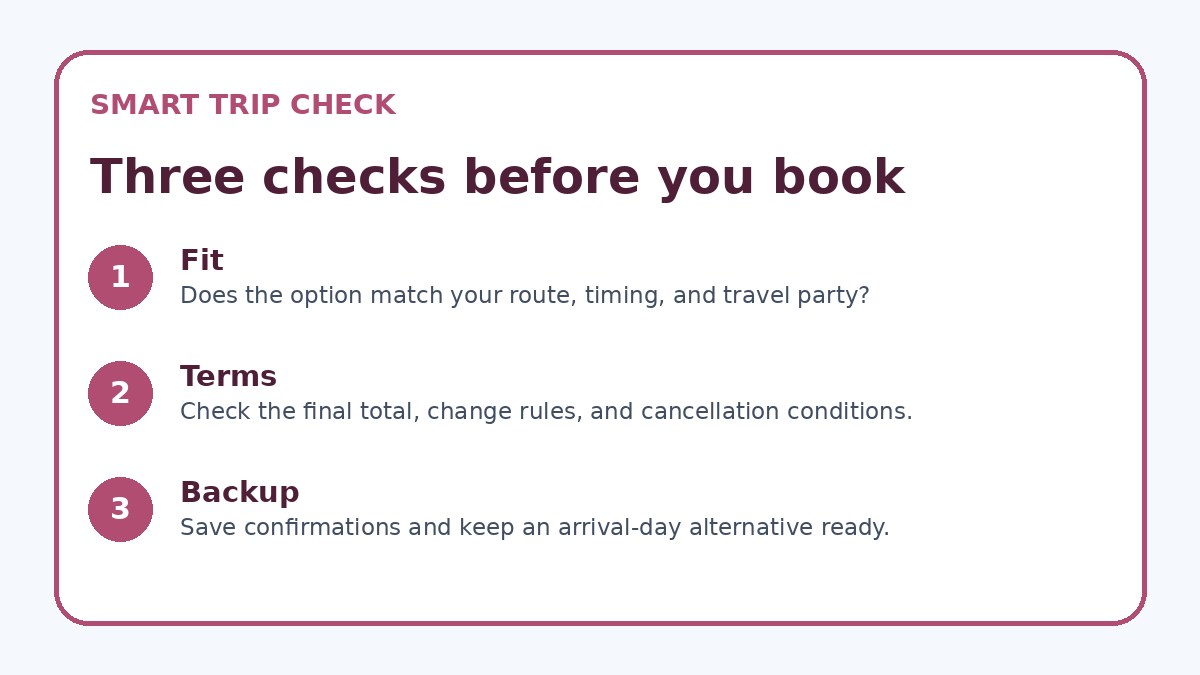
Tradeoffs to weigh when you shift dates for baggage benefits
Shifting dates can reduce baggage costs but can introduce other tradeoffs: you might face longer layovers, miss events, or pay more for accommodation. Travel insurance or flexible hotel reservations can reduce the risk of planning around alternative dates, but those come with their own costs. If your trip is time-sensitive, weigh whether the baggage savings justify changing commitments. For leisure trips with wide date windows, moving a day or two is often the least friction-heavy way to reduce surplus bag charges.
Another tradeoff is the potential for multiple separate bookings. For example, using an alternative carrier with a friendlier baggage rule might require booking two separate tickets for outbound and return or splitting the journey into separately ticketed segments. That can add risk — missed connections are harder to protect — so weigh the reduced baggage costs against added transfer risk and the potential need for travel disruption cover. Always verify on the final booking page whether a fare is fully ticketed through one carrier and whether baggage allowances are combined or enforced per segment.
Before you book
- Search +/- three days around your preferred dates and note fare codes and baggage allowances for each candidate itinerary.
- Click through to the airline’s official fare rules page and photograph or download the baggage allowance and special-item policy.
- Compare total trip cost including required paid bags, transfer fees, and any extra night accommodation implied by date shifts.
- Verify which carrier’s baggage policy applies on multi-carrier itineraries and confirm whether allowances are combined or per segment.
- Check refund and change penalties for the chosen fare family so you know the cost of moving the date later if needed.
- If transporting oversized items, contact the airline in advance to reserve space and confirm dimensions, packaging, and handling requirements.
Practical checks and verification steps before you confirm
Before you pay, use a checklist: confirm the fare code, read the baggage allowance on the airline’s official page, check for size and weight limits for each bag, and confirm how many free pieces are included. If you’re transporting oversized items (sports equipment, instruments), specifically look for special-item policies and fees; they are often listed separately from standard checked baggage. If the booking is interline, contact the operating carriers or the ticketing airline’s service desk to confirm which rules apply. Take screenshots or save the fare rules PDF from the airline page for later reference.
Verify the refund or change policy tied to the fare family as well — a baggage-friendly fare that is nonrefundable or expensive to change might not be worth it if your plans are uncertain. If you change only one leg to improve baggage conditions, check the full itinerary price again because combined penalties or recalculated taxes can alter the final total. Finally, compare availability on a live meta-search like Trip.com to cross-check options and to see current inventory, but always confirm the baggage and fare-rule details on the carrier’s final booking page before you commit.
Frequently asked questions
How much date flexibility should I use when hunting Abu Dhabi travel deals with extra luggage?
Start with a +/- three-day window on both outbound and return legs and expand to +/- seven days if you can. Narrow results by fare family or baggage allowance, not just price, and note any repeating patterns — for example, midweek departures often fall into different fare buckets than weekend flights. If you see a fare with the baggage terms you need, check directly with the airline to confirm before booking because sometimes third-party sites omit special-item details or change rapidly.
Can I rely on a cheaper ticket plus paid bags versus a slightly pricier ticket with included baggage?
It depends on your specific bag count, weight, and dimensions. Always add the exact bag fees to the base fare for a side-by-side comparison, and include potential secondary costs like overweight or oversize surcharges. For multiple bags or bulky items, a pricier fare that includes more checked pieces can be less costly and simpler. Verify the final baggage charges and allowed dimensions on the carrier’s booking page before choosing so you’re not surprised at checkout or at the airport.
What should I confirm for multi-carrier or connecting itineraries to avoid baggage surprises?
Confirm which carrier issues the ticket and review that carrier’s baggage rules, because interline itineraries can default to the most restrictive policy on paper. Ask the ticketing airline whether baggage will be checked through to the final destination or will need re-checking during a connection, which matters for oversized items. If connection flights are on separate tickets, clarify whether each carrier accepts your sizes at the agreed rates and whether you must collect and re-check luggage between legs.
Final planning note
Using flexible dates when researching Abu Dhabi travel deals gives travelers with extra luggage practical leverage: a small date shift often moves you into a fare family with better baggage terms and lowers total trip cost when measured correctly. The key is to treat baggage allowance as a primary comparison metric, verify details on the airline’s official fare page, and balance savings against schedule convenience and transfer risk. Run parallel searches, record fare codes, and confirm interline rules for connections. With these checks and a willingness to move a day or two, you can reduce baggage friction and arrive in Abu Dhabi with fewer surprises at the airport.
Continue planning
Check current options and final conditions
Use the provider page to confirm live availability, the final total, cancellation terms, and every condition that matters to your trip.
This evergreen planning guide was created with AI-assisted drafting and a structured quality review. It does not display live prices, schedules, availability, visa guidance, or provider rankings. Verify current details before booking. Some links are affiliate links; we may earn a commission at no additional cost to you.