If you’re planning a family trip between Vancouver and Seattle, pick the mode that matches how you travel, not just the advertised ride. For many families the decision comes down to balancing door-to-door convenience, luggage and stroller hassle, the ability to move around during the journey, and what happens if plans change. Trains can ease motion for restless kids and offer room to walk; coaches can be direct and wallet-friendly but may feel tight with big luggage; ferries add a scenic interlude and require extra transfers; driving or private transfer gives maximum control but shifts the work to the driver. Read the practical tradeoffs below, then use the comparison rows and checklist to make a decision that fits your family’s pace, gear, and backup tolerance. Verify schedules, boarding rules, baggage allowances, and vehicle restrictions on the provider’s booking page before you finalize.
Terminal fit and door-to-door practicality
Start by mapping where each service’s terminal sits relative to your first and last addresses. Train stations are often downtown and well connected by public transit, which can cut last-mile taxi rides and make walking with a stroller feasible. Coach terminals may be at bus depots or airports; compare how easy it is to load and unload luggage, whether curbside staff help with heavy bags, and whether you’ll need to cross busy streets or haul gear up steps.
Ferries typically leave from dedicated terminals that require time to board and disembark—factor in extra minutes for vehicle or foot passengers and secure handling of infant carriers and strollers. Driving or hiring a private transfer ranks highest for direct door-to-door service but adds responsibility for parking, tolls, and border crossing logistics. For each option, list the exact walk, transit, or taxi connections you’d need at both ends and measure those against your family’s mobility and patience.
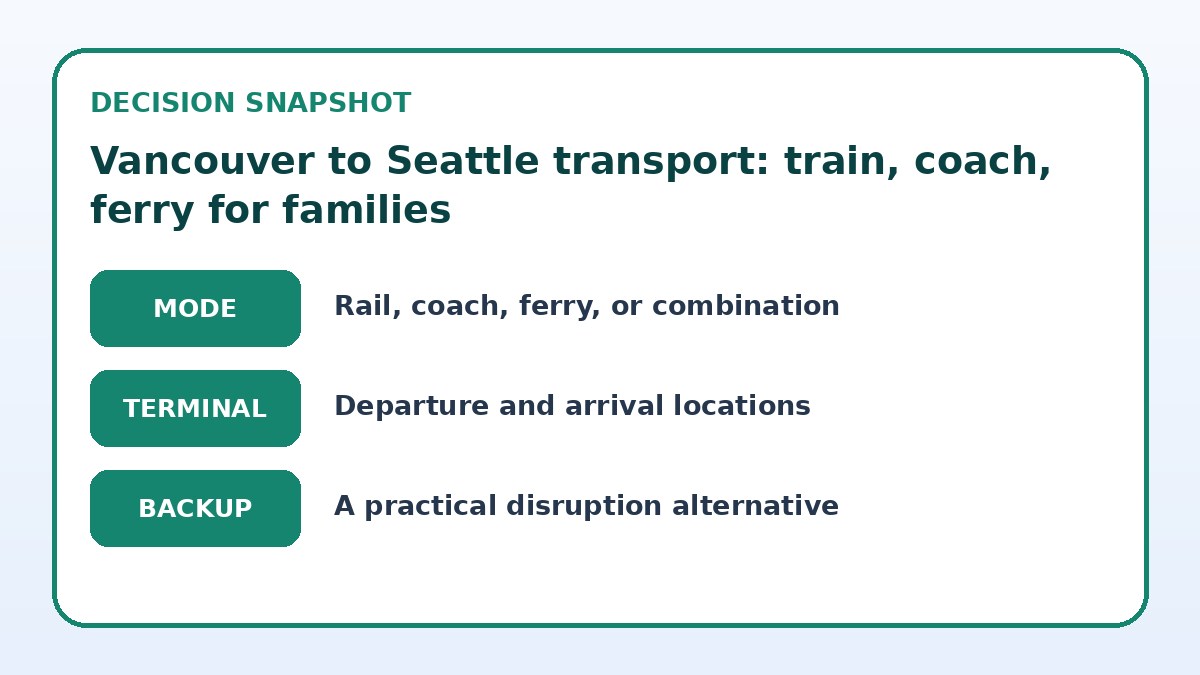
Choose the end-to-end journey plan
| Journey approach | Best for | Friction to check |
|---|---|---|
| Rail-centric plan: train for the main leg, local transit to terminals | Families who want onboard space, predictable departure times, and easy downtown arrival. | Less flexible for last-minute changes and may require lifting luggage on/off platforms or using transit links with gear. |
| Coach-first plan: direct buses with minimal walking and frequent departures | Families needing more departure options and potentially straightforward drop-off locations. | Cabin space and baggage handling can be tight; traffic delays affect travel time and comfort. |
| Ferry-combo plan: drive or transit to ferry terminal then vehicle or walk-on ferry | Families who value a scenic break and want to keep gear in the car during a crossing. | Requires extra transfers and careful timing around boarding windows; walking-on passengers handle all luggage themselves. |
| Drive or private transfer: door-to-door control with flexible timing | Families carrying lots of gear, multiple car seats, or traveling on a tight schedule. | Driver workload, border crossing logistics, parking costs, and potential traffic-related delays fall to you. |
Check live intercity options
Look beyond the ride itself and compare terminals, transfers, luggage, and arrival fit.
Luggage, strollers, car seats and transfer friction
Families traveling with car seats, a stroller, bulky luggage, or sports gear should prioritize minimal handling. Trains usually have open luggage racks and room in vestibules for a stroller, but you’ll still be lifting gear on and off platforms. Coaches may allow underfloor luggage but have limited cabin space; confirm whether a coach operator will help with large items and whether carry-on space is guaranteed for the whole family.
If you plan to use a car seat, decide whether to bring and install your own or rent one at your destination; each adds time to transfers and potential compatibility headaches. Ferries that accept vehicles allow you to keep everything in your car during the crossing, reducing transfer friction—but walking-on ferry passengers must manage all gear themselves. For any operator, check the provider’s booking page for exact baggage dimensions and stroller/car-seat policies before committing.
Timing flexibility and travel-day rhythms
Fixed-schedule services like trains and ferries demand punctual arrivals at terminals; they help families plan nap times and meals around the timetable but give little leeway for last-minute delays. Use schedules to pick a departure that aligns with your children’s sleep and meal patterns to reduce stress on travel day. If you value adjustable departure times, coaches and driving provide more departures and the ability to leave when the kids are ready, though traffic and border delays can still upset the plan.
Also weigh the in-vehicle experience: trains usually permit movement between cars and restroom access without exiting to a platform, which helps with restless children. Coaches and cars confine the family to a single space—bring compact activity kits and snacks. Ferries offer deck time and scenery that can refresh a long trip, but boarding windows and vehicle loading rules add fixed steps to your itinerary. On every option, build buffer time for border processing and restroom breaks.
Compare the practical alternatives
Use the final page to confirm what is actually offered on your dates and save a workable fallback.
Intercity travel checklist
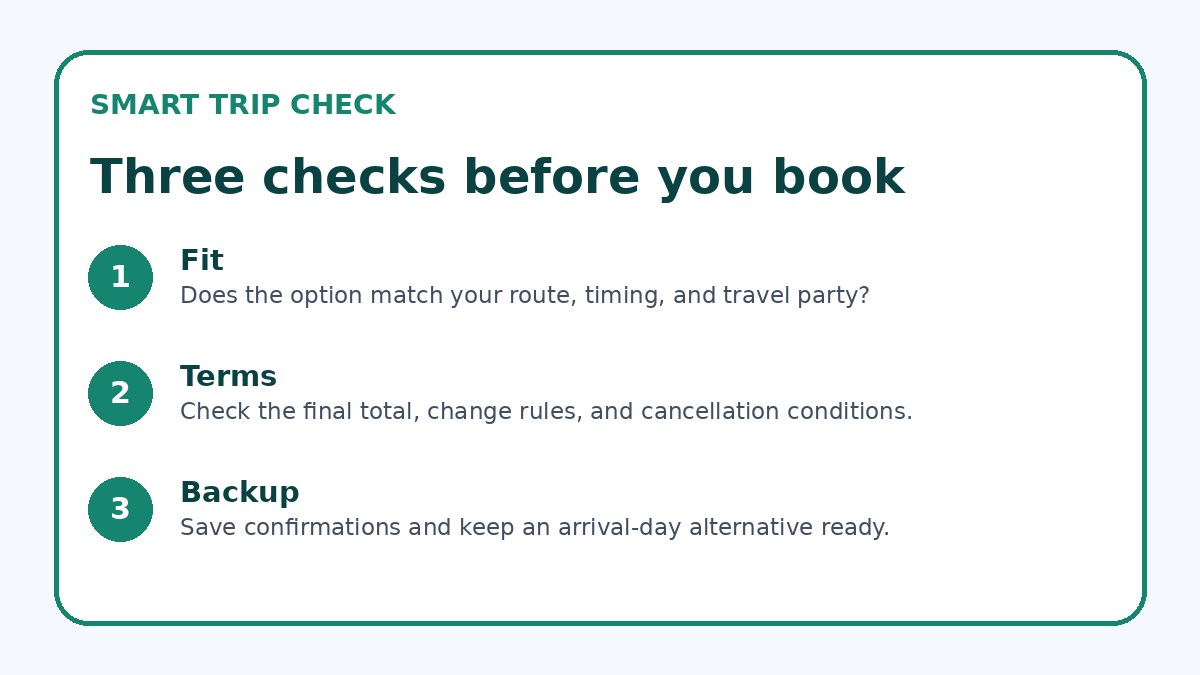
- Map exact door-to-door times: estimate minutes from your lodging to departure terminal and from arrival terminal to your destination.
- Verify baggage, stroller, and car-seat policies on the operator’s official booking page before purchasing tickets.
- Check the operator’s change and cancellation terms and note the next two alternative departures in case of disruption.
- Plan meals and naps around departure times and pack compact, familiar snacks and entertainment for each child.
- Prepare printed or screenshot copies of all confirmations and ID needed for border crossings and operator checks.
- Pack a small emergency kit with chargers, spare clothing for children, essential medicines, and a basic first-aid supply.
Disruption backup: how to plan for delays or cancellations
Create a simple contingency plan before booking: identify the next two departures on your chosen mode, note nearby terminals for alternative routes, and confirm refund or change policies on the provider’s site. For families, a backup that avoids repeating long checkpoints (like border crossings) is especially valuable—if a train is cancelled, can you switch to a coach without re-clearing customs? Document the provider’s change window and any fees so you know your options if a leg is delayed.
Carry a compact 'travel emergency kit' with chargers, snacks, contact numbers, paper copies of booking confirmations, and a small basic first-aid kit. If traveling with young children, include a spare outfit and familiar toys to ease sudden waits. Finally, if you book through a third-party aggregator such as Trip.com, check the operator’s final booking page afterward to verify baggage allowances, boarding times, and vehicle restrictions; third-party sites can change availability between search and final confirmation.
Rail & Intercity Transport questions travelers ask
Can I take a car seat or stroller on trains, coaches, and ferries between Vancouver and Seattle?
Most operators allow strollers and typically permit car seats if you’re traveling with a vehicle or installing them on a seat, but exact rules differ. Trains often have space for folded strollers and open luggage areas, while coaches may require you to store larger items in underfloor compartments. Ferries that accept vehicles let you keep a car seat in your car during the crossing; walk-on ferry passengers must manage their own gear. Always check the specific operator’s booking page for permitted dimensions, carriage instructions, and whether advance notice is required.
How should families handle border crossing formalities when choosing between modes?
Border procedures are a part of the total journey time and can vary by entry point and mode. Determine where customs and immigration will occur for your chosen route—some services process both directions at the terminal, others require stops en route. Prepare passports and any required documentation in advance, keep them accessible during transfers, and build extra time into schedules for screening. If you need verifiable details on border processing for a service, consult the operator’s final booking page and official border agency guidance rather than relying on third-party summaries.
If my chosen leg is cancelled, which backup approach is least disruptive for families?
The least disruptive backup depends on your priorities. If minimizing transfers matters most, a private transfer or driving alternative keeps everything in one vehicle. If you value flexible departure options, coaches often have more frequent services for switching plans. Trains and ferries can be easier to plan around if you already have nearby alternate departures documented. Before travel, identify specific alternate departures and confirm whether switching requires new border checks or extra tickets. Keep refunds and change policies handy so you can act quickly with minimal stress for kids.
Final decision note
Choosing between train, coach, ferry, or a private transfer for Vancouver to Seattle transport comes down to the family tradeoffs you value: fewer transfers versus flexible timing, more onboard room versus responsibility for gear, and scenic breaks versus additional boarding steps. Start by mapping door-to-door time and the exact transfers each option demands. Verify baggage and car-seat rules on providers’ official booking pages and note alternative departures before you finalize. With a clear checklist, a small emergency kit, and at least one realistic backup plan, you’ll be able to pick the option that keeps kids comfortable and travel-day stress manageable.
Continue planning
Check current options and final conditions
Use the provider page to confirm live availability, the final total, cancellation terms, and every condition that matters to your trip.
This evergreen planning guide was created with AI-assisted drafting and a structured quality review. It does not display live prices, schedules, availability, visa guidance, or provider rankings. Verify current details before booking. Some links are affiliate links; we may earn a commission at no additional cost to you.