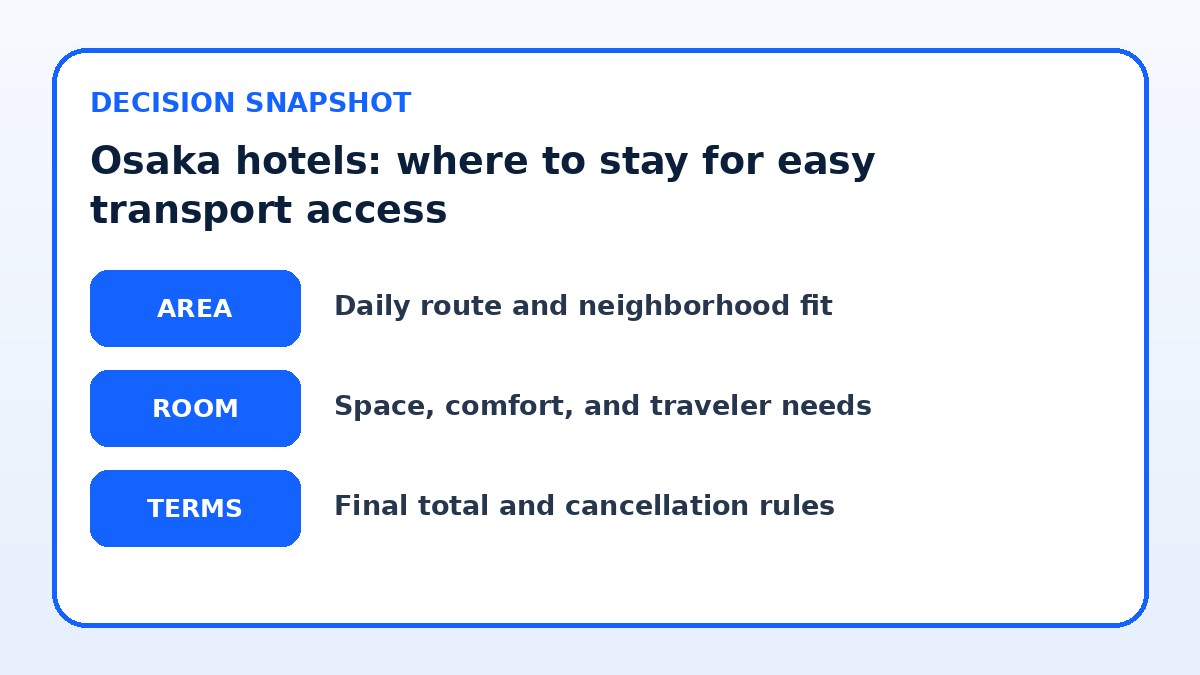
Decide your Osaka stay first by which transport connections you will use most. For a first visit that means identifying whether you need fast access to Kansai International Airport or prefer walking distance to major rail hubs for day trips and city sightseeing. Pick an area that shortens the daily journeys you expect to make — commuting to shows, markets, or a business meeting becomes less stressful when your hotel sits on a convenient subway or JR line. This guide gives a clear stay-area recommendation up front, then explains tradeoffs across neighborhoods, how to think about room size and party needs, and the key booking terms to verify before you finalize. By the end you'll be able to choose one or two neighborhoods to open live hotel inventory and compare rates and cancellation policies.

Check live stays in the areas that fit
Use your dates and party size to compare current rooms after you narrow the neighborhood fit.
Neighborhood fit: match your itinerary to station types
Start by mapping your likely itinerary against the three main transport types in Osaka: JR regional lines, the subway network, and private railways that link to nearby cities. If you expect to take several day trips to Kyoto, Nara, or Kobe, give strong weight to hotels near major JR stations (Osaka Station / Umeda area or Tennoji / Shin-Osaka if you expect Shinkansen transfers). If your time will be spent inside Osaka — museums, Dotonbori, shopping arcades, and nightlife — a central subway hub like Namba or Umeda reduces transfers and walking between attractions.
Don’t overlook private rail stations that serve Kansai Airport and suburban lines; staying near Namba or Shin-Osaka can cut airport-to-hotel legs. Also consider how often you’ll be carrying luggage. A single transfer on a level platform is far easier than multiple stair climbs; check whether the nearest station has elevators or escalators, and confirm that on the hotel or operator’s page before booking. The goal is to pick a neighborhood that lines up naturally with how you plan to move around the city.
Choose an area-selection strategy
| Area approach | Best for | Tradeoff to check |
|---|---|---|
| Stay beside a major JR hub (Umeda/Osaka Station) | Day-trip travelers using JR lines and long-distance trains | Station area can be busy with smaller rooms and higher foot traffic |
| Stay around Namba / Shinsaibashi | First-timers wanting nightlife, food, and subway connections | Can be noisier at night and has many alleys that complicate arrival with luggage |
| Stay near Shin-Osaka | Travelers needing easy Shinkansen transfers to other cities | Fewer evening entertainment and dining choices within immediate walking distance |
| Stay in Tennoji / Tennoji Park area | Visitors combining cultural sites, a calmer base, and decent JR/subway links | Slightly longer journeys to some central nightlife or shopping districts |
Daily-route friction: what adds time and hassle
Look past distance on a map and think in door-to-door time. A hotel 800 meters from a station on flat sidewalks may be a ten-minute walk; the same straight-line distance uphill, through a district with narrow streets, or with stairs becomes a heavier, slower transfer. Consider luggage, the timing of first and last trains for your schedule, and how many transfers each common trip will require. Frequent short transfers compound: a 12-minute train plus a 12-minute walk and a 12-minute transfer wait can make a short trip half an hour longer than expected.
Pay attention to where station exits deposit you. Some large stations have multiple exits that can leave you several minutes away from your hotel if you choose the wrong one. Read hotel descriptions about the recommended exit and confirm it on transit maps. If you’ll be arriving late or with heavy bags, a hotel on the same block as the station platform entrance reduces friction. Small conveniences — luggage storage, late check-in, or a porter — can matter a lot if you value speed and minimal effort between transit and the room.
Now compare like with like
Keep the same dates, guests, room needs, and cancellation preferences while you compare the final choices.
Room and party needs: space, beds, and accessibility
Deciding the area is only half the choice — you also need the right room layout for your party. Budget city hotels near major stations often have compact rooms; families or travelers who prefer extra living space should expect to trade immediate station proximity for larger rooms a short transit ride away. Consider whether a twin or triple room, a connected family room, or an apartment-style stay better suits you. Verify bed configurations and whether the hotel can add rollaway beds on their booking page rather than assuming availability.
Accessibility needs change which exits and routes work for you. If anyone in your party uses a wheelchair or has mobility challenges, prioritize hotels explicitly stating step-free routes and elevator access between the street, station platforms, and the hotel entrance. Confirm on the hotel’s final booking page which room types are accessible, where the nearest elevator is, and whether staff assistance is offered on arrival. When in doubt, call the property to clarify before booking to avoid surprises at check-in.
Hotel booking check before payment
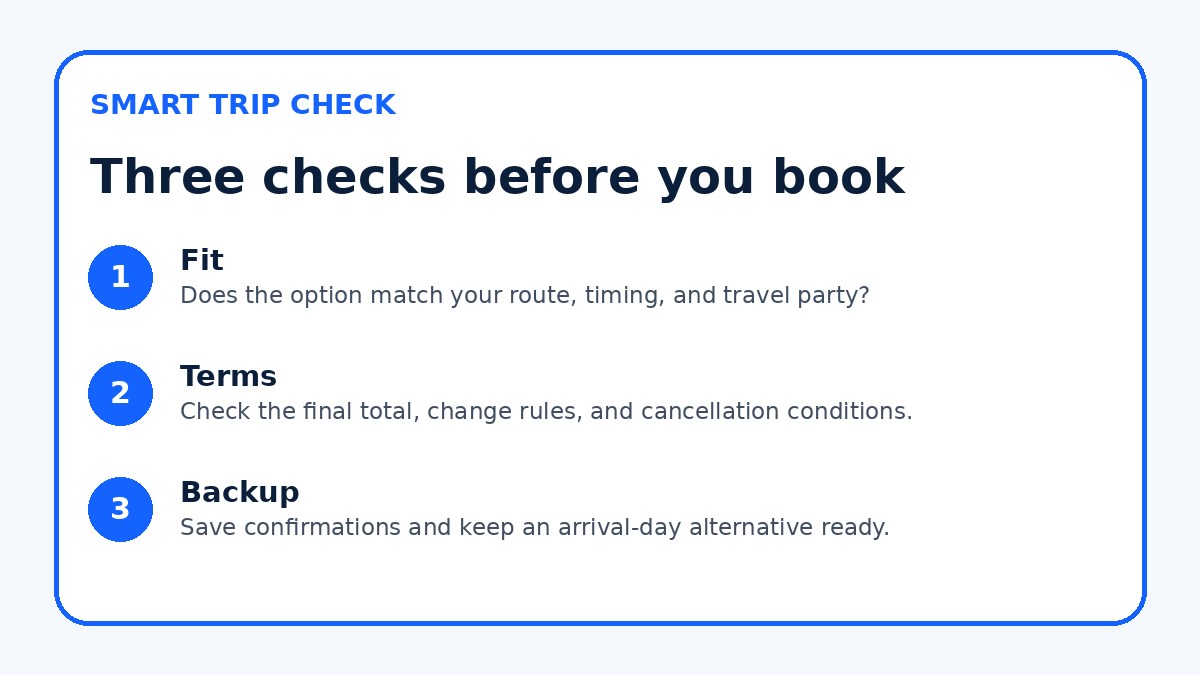
- Identify the single station or line you will use most (airport link, JR, or subway) and prioritize hotels near that link.
- On the hotel page, confirm the recommended station exit and compare it to the official transit map to plan your arrival walk.
- Check whether the hotel or station provides elevators or ramps if you have heavy luggage or mobility needs.
- Compare room types for bed configuration and size; request photos or clarification from the hotel before booking if needed.
- Read the booking terms for cancellation, check-in/out times, and whether the rate includes taxes or breakfast.
- If arrival is late, confirm late check-in procedures and whether staff are available to assist with luggage when you arrive.
Final booking terms: what to verify before you reserve
Before you book, verify the cancellation and change terms on the hotel's page and note any nonrefundable rules. For first-time visitors whose plans may shift, look for flexible cancellation windows and clear check-in/out times that suit your arrival or departure schedule. Also confirm whether the quoted rate includes city taxes, breakfast, Wi‑Fi, and if there are mandatory resort or service fees. If the booking platform allows, check recent guest photos and read reviews about reported access problems, but treat specifics like schedules or facilities as something to verify with the hotel directly.
When comparing listings, check how the hotel describes access: names of nearby stations, recommended exits, and approximate walking time. Use official station maps and the hotel's directions to plan your arrival route from Kansai Airport or Shin-Osaka if you use the Shinkansen. If you need to compare live availability or multiple properties quickly, you may look at Trip.com as one place to view current inventory, but always confirm final rates, room rules, and other specifics on the hotel's official booking page before committing.
Hotel Guide questions travelers ask
Which Osaka neighborhood is most convenient for first-time visitors who want sightseeing and food?
For a first-time visitor focused on sightseeing and food, Namba and Shinsaibashi place you in the middle of dining, shopping, and entertainment with multiple subway and private rail connections. These areas put iconic streets and markets within walking distance, reducing the need for transfers. However, if you expect many day trips by JR lines you might prefer a hotel near Osaka/ Umeda station instead. Before you book, compare the hotel’s stated station exit and evening noise policy on the booking page to make sure it matches your comfort and schedule.
Is it better to stay near Osaka Station or Shin-Osaka for a short trip including a day trip to Kyoto?
If your short trip includes a day trip to Kyoto, both areas work but for different reasons: Osaka Station (Umeda) offers more local subway and shopping options and easy JR transfers for regional trains, while Shin-Osaka is where Shinkansen services stop and may be faster if you value minimal transfer time to Kyoto. Consider where you’ll spend evenings — if you want dining and nightlife back in Osaka each night, staying near Osaka Station reduces additional local transfers after returning from Kyoto. Verify train types and transfer requirements before deciding, as schedules and service patterns can change.
How much walking time from a station is reasonable when choosing an Osaka hotel?
For first-time visitors with luggage, aim for a hotel within a five- to ten-minute walk from your primary station. Shorter walks keep arrival and departure simple, especially after long travel days. If that’s not available, check the path for steps, narrow streets, and the recommended station exit; a slightly longer but step-free route may be faster and easier than a shorter route with stairs. Always confirm walking directions on the property’s booking details and use street-level maps to visualize the final approach before you reserve.
Final decision note
Pick your Osaka neighborhood by the transport link you'll rely on most and then refine choices by room needs and accessibility. For first-timers this reduces daily friction more than chasing central-sounding areas without considering transfers. Use the checklist to verify station exits, elevator access, room layouts, and cancellation rules before you open live inventory. When you have one or two neighborhoods shortlisted, compare properties side-by-side by walking distance to the right station, room size, and booking terms. If you want a single place to view many options quickly, Trip.com can show current availability, but always confirm important details on the hotel’s final booking page to avoid surprises.
Continue planning
Check current options and final conditions
Use the provider page to confirm live availability, the final total, cancellation terms, and every condition that matters to your trip.
This evergreen planning guide was created with AI-assisted drafting and a structured quality review. It does not display live prices, schedules, availability, visa guidance, or provider rankings. Verify current details before booking. Some links are affiliate links; we may earn a commission at no additional cost to you.