
If you’re traveling from Tokyo to Fukuoka with extra luggage, the practical choice is usually Haneda Airport—if it fits your schedule and airline. Haneda is closer to central Tokyo, often has shorter transfer times, and typically makes ground transfers with heavy bags easier. But Haneda won’t always be the best option: flight availability, fare class baggage allowances, loyalty benefits, and late-night schedules can push you toward Narita or change whether a connecting itinerary is practical. This guide gives a plain answer up front, then walks through the tradeoffs that matter most to people hauling bulky suitcases, sports gear, or multiple pieces of checked baggage. Read on to learn which airport will likely save you time, effort, and unexpected transfer hassle, what to verify on the carrier’s booking page, and quick steps to reduce stress when traveling with extra luggage on Tokyo to Fukuoka flights.
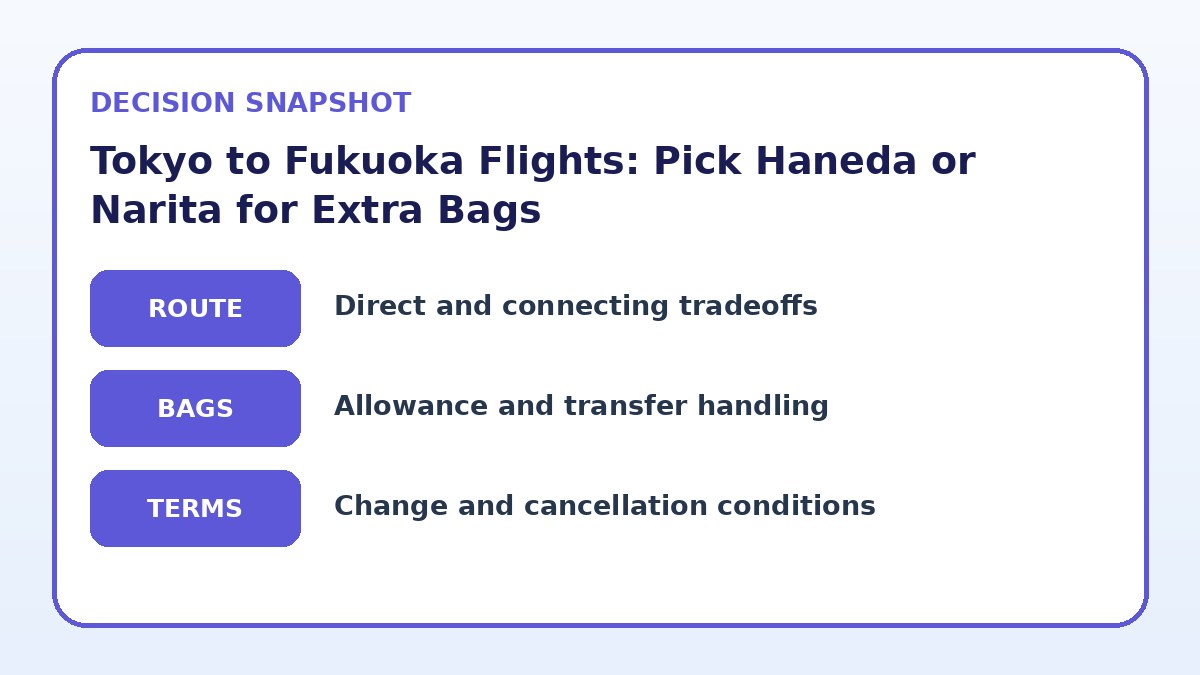
See current options before you compare the details
Availability and final conditions change. Open Trip.com now or keep reading for the practical comparison.
Why airport location matters most for extra luggage
Distance from your stay or transit hub directly affects how much effort and cost you’ll spend moving heavy suitcases. Haneda sits substantially closer to central Tokyo than Narita, which often means shorter taxi rides, cheaper door-to-door trips, and less time wrestling bags across platforms. For travelers with oversized items or multiple checked pieces, fewer transfers and shorter public-transport segments reduce fatigue and risk of damage.
That said, location is one factor among several. If a cheap fare from Narita includes two checked bags while a Haneda option charges per piece, the apparent savings from a closer airport can evaporate. Also consider timing: if you’re traveling very early or late, one airport may have limited ground transport or fewer staff to help with oversized luggage, so always check night transfer options before deciding.
Baggage rules and fare classes: the invisible cost
Airlines set baggage allowances by fare class and route, and those allowances are the single most important variable for travelers with extra luggage. Before you commit to Haneda or Narita, look at the specific airline’s checked-bag policy on the booking page: number of pieces, weight limits, and oversize/overweight surcharges. Those fees can be significantly higher than a slightly longer taxi or train, so calculate the total cost rather than focusing on base fare alone.
If your journey might include a connection, check whether the carrier will transfer checked bags automatically or if you must reclaim and re-check them at the Tokyo airport. If re-checking is required, factor in minimum connection times and the hassle of moving bags through immigration or between terminals. The booking page and carrier’s baggage policy are the authoritative sources; if details are unclear, contact the airline before booking.
| Approach | Best for | Tradeoff to check |
|---|---|---|
| Use Haneda for shorter transfers | Travelers based in central Tokyo or with very heavy/oversize bags | May have higher fares or stricter baggage fees depending on airline and fare class |
| Use Narita for cheaper long-distance access | Travelers coming from eastern Tokyo or those finding better baggage allowances on Narita fares | Longer transfer times and more handling for multiple bags |
| Choose based on airline baggage policy | Anyone whose extra luggage costs could exceed transfer savings | Requires time to compare rules on the booking page and may limit airport choice |
| Prioritize direct flights when possible | Travelers wanting minimal handling and fewer re-checks | Direct schedules may be less convenient or slightly more expensive |
Ready to check the option that fits your plan?
Use your exact dates and traveler details so the provider page can show the current total and conditions.

Transfers, trains, and taxis: practical transfer choices
Haneda’s proximity to central Tokyo gives you more convenient transfer options when traveling with extra luggage: shorter taxi rides, direct monorail or train lines with elevators, and more frequent services. Taxis can be the most straightforward — they minimize handling and keep groups together — but confirm taxi luggage limits, especially for very large items. If convenience is a priority, add the taxi or private transfer cost into your total travel budget when comparing airports.
Narita often has cheaper long-distance fares and some dedicated airport buses, but the longer transfer time and additional handling on trains may increase stress when you have many or heavy bags. If you’re traveling from farther east of Tokyo, or staying near the Narita Express line, Narita may still be the practical option. Always map the door-to-door journey and test whether elevators, escalators, and luggage space are available on the specific trains or buses you’ll take.
Before you book
- Check the airline’s final booking page for exact checked-bag allowances, weight limits, and oversize or overweight fees before choosing an airport.
- Map your door-to-door transfer: estimate taxi, train, or bus costs and total time from your lodging to each Tokyo airport.
- If you have a connection, confirm whether the airline tags bags through to Fukuoka or requires you to reclaim and re-check them at Tokyo.
- Measure and photograph oversized items; verify whether taxis or trains permit those dimensions and whether additional handling services are available at the terminal.
- Budget extra time for transfers and possible re-checking; add at least 60–90 minutes buffer when moving heavy luggage between terminals or transport modes.
- If unsure, contact the airline or booking agent directly to confirm baggage policies and whether special assistance or oversized-item handling is available.
When connections and schedules change the math
Not every Tokyo to Fukuoka itinerary is direct — compare direct and connecting flights carefully. Direct flights simplify baggage handling: checked bags are typically carried through without you intervening. If only a connecting itinerary is available from one airport, compute the minimum connection time you need with extra luggage and whether you’re comfortable reclaiming and re-checking items if required.
Schedules matter more for luggage-heavy travelers because a missed connection means dragging heavy bags through an airport or waiting for customer service. If your schedule is tight, prioritize flights and airports with realistic connection windows and robust ground transport. When in doubt, choose the option that gives you more buffer time and fewer transfers rather than the absolute fastest itinerary on paper.
Frequently asked questions
Is Haneda always the better choice for travelers with a lot of baggage?
Not always. Haneda’s advantage is shorter transfers from central Tokyo and generally easier ground logistics, which helps when managing many or heavy bags. However, the final decision depends on the airline’s baggage rules for your specific fare and whether you have a direct flight. If a Narita departure includes more checked baggage or waives heavy-item fees that Haneda’s fares don’t, the longer transfer could still be cheaper or simpler overall. Always compare the carrier’s baggage policy and total door-to-door time before booking.
How much time should I allow when transferring between Tokyo airports with heavy luggage?
Allow substantial buffer when transferring between Haneda and Narita or when changing terminals: plan for transit time plus handling, ticketing, and security. For heavy or oversized luggage, add extra minutes for elevator access, baggage carts, and possible queueing. A conservative approach is to build in at least two to three hours for airport-to-airport transfers within Tokyo if you must move between airports and re-check bags. If you’re using a single airport and the airline tags bags through, much less buffer is needed.
What practical steps reduce stress when flying Tokyo to Fukuoka with extra bags?
Minimize handling by booking a direct flight or an itinerary where the airline checks bags through to Fukuoka. Use a single, sturdy checked bag instead of many small pieces when possible, and label everything clearly. Pre-book assistance or oversized-item handling with the airline if you have sports equipment or unusually large items. Factor taxi or private-transfer costs into the decision, and verify elevator availability on transit routes. Finally, save the airline’s baggage policy and customer-service phone number in your booking record for quick reference at the airport.
Final planning note
For most travelers hauling extra luggage on the Tokyo to Fukuoka route, Haneda will be the most practical departure if it fits your schedule — shorter transfers and simpler logistics reduce handling and stress. Yet the final choice should rest on a small checklist: compare the airline’s baggage allowances on the final booking page, total door-to-door time including transfer costs, and whether your itinerary requires reclaiming and re-checking bags. If Narita’s fares include more free baggage or your origin point sits closer to Narita, the longer transfer can still be the smarter option. Verify carrier baggage rules, estimate transfer costs, and, when in doubt, prioritize fewer handoffs over marginal time savings.
Continue planning
Check current options and final conditions
Use the provider page to confirm live availability, the final total, cancellation terms, and every condition that matters to your trip.
This evergreen planning guide was created with AI-assisted drafting and a structured quality review. It does not display live prices, schedules, availability, visa guidance, or provider rankings. Verify current details before booking. Some links are affiliate links; we may earn a commission at no additional cost to you.