Practical answer first: for most first-time visitors the smoothest approach is to pick a single main intercity mode (train or coach) that leaves from a central Sydney terminal you can reach easily, book a terminal-to-door transfer or light taxi at both ends, and build 30–60 minutes of buffer for luggage and connection friction. That minimizes walking between stations and reduces risk when you arrive in Canberra with unfamiliar local connections. If you prefer driving or a mixed strategy (train plus local bus), plan door-to-door segments and check how much luggage you must move between modes. Use this article to weigh terminal fit, luggage friction, timing flexibility and a simple disruption backup so you can choose the route that fits your priorities and confidence level.
Choosing rail, coach, driving, or a mixture
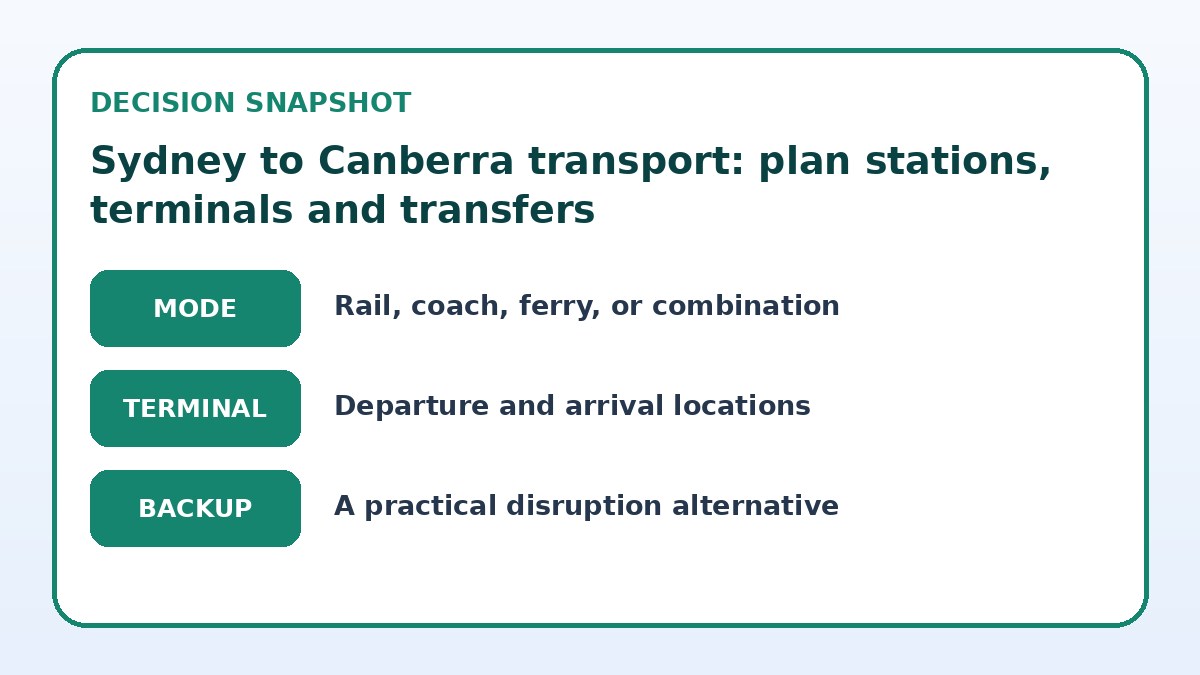
Start by matching mode strengths to your priorities. Trains are often more comfortable and easier to stand up in for longer distances, while coaches can offer more direct city-to-city links and drop-off points closer to Canberra neighbourhoods. Driving gives the maximum door-to-door control but brings parking and fatigue considerations. A mixed plan — for example, a train to a nearby hub then a rental car for the last leg — can combine benefits but increases luggage handling and transfer steps.
To choose, list non-negotiables: minimal transfers, least walking with luggage, or greatest schedule flexibility. If you prize a single seamless transfer, a coach that terminates near your Canberra accommodation may win. If you prefer a predictable timetable and a more spacious seat for work or naps, the train may be preferable, provided the departure terminal is easy to reach from where you’re staying in Sydney.
Choose the end-to-end journey plan
| Journey approach | Best for | Friction to check |
|---|---|---|
| Single-mode train (no transfers) | Travelers prioritizing seat comfort and predictable timetables | May require longer walk or separate local transfer at one or both ends |
| Direct coach that drops close to accommodation | Visitors wanting minimal station walking and simpler door-to-door routing | Less onboard space and fewer amenities than trains; check luggage handling rules |
| Drive or rental car door-to-door | Those who value full control over timing and doorstep delivery | Responsibility for driving, fuel and parking; longer trips can be tiring |
| Mixed mode (train plus local car/bus) | Travelers balancing comfort on the long leg with flexibility in the final mile | More transfers and luggage handling steps increase disruption risk |
Check live intercity options
Look beyond the ride itself and compare terminals, transfers, luggage, and arrival fit.
Terminal fit and station-to-station transfers
Terminal fit means how well the departure and arrival points match your door-to-door plan. In Sydney, central terminals vary in public transport connections and taxi/rideshare access; in Canberra, arrival points may be on the edge of the city requiring a local bus or short onward taxi. Study maps and public-transport links from your lodging to the terminal, and confirm how far the station entrance is from bus stops or taxi ranks. Where terminals are far apart you’ll need to add transfer time or consider a single-mode option that avoids cross-terminal transfers.
If your journey requires switching stations in Sydney (for example, coming from a suburban rail line into a separate long-distance terminal) or changing stops in Canberra, plan a clear transfer method. Decide if you will use public transport, a scheduled shuttle, or a private transfer. For every planned transfer, write down expected walking times, luggage handling steps, and the contact details for taxi/rideshare pickup zones so you aren’t searching for directions when tired or under time pressure.
Luggage and transfer friction: practical steps
Luggage is often the hidden friction that turns a simple intercity ride into a stressful sequence. Consider the number, size and mobility of your bags. If you travel with large suitcases, prefer options that allow easy drop-off of luggage at the carriage or coach hold and avoid plans with long walking links or repeated up-and-down stairs. If you have mobility needs or heavy bags, pre-book assistance where offered and choose terminals with step-free access and short transfer distances to taxis or buses.
Pack a small ‘day’ bag with essentials so you don’t need to access your main suitcase during transfers. Keep important documents, a phone charger, and medication in that bag. When booking onward transfers, check exactly where drivers wait at each terminal and whether they can help with loading. If using a rideshare, confirm pick-up points on the app before you arrive; if taking a scheduled shuttle, print or screenshot the timetable and meeting instructions.
Compare the practical alternatives
Use the final page to confirm what is actually offered on your dates and save a workable fallback.
Intercity travel checklist
- Map the exact terminal addresses in Sydney and Canberra and measure transfer walking distances using a mapping app.
- Decide how many pieces of luggage you’ll carry and choose a mode/transfer that minimizes repeated lifting.
- Book or reserve a taxi, rideshare, or scheduled shuttle for arrival and departure to guarantee a short, known transfer.
- Block at least 30–60 minutes as buffer time for transfers depending on how many station changes you must make.
- Save screenshots of pick-up points, driver instructions and timetable pages to use if cellular data is poor.
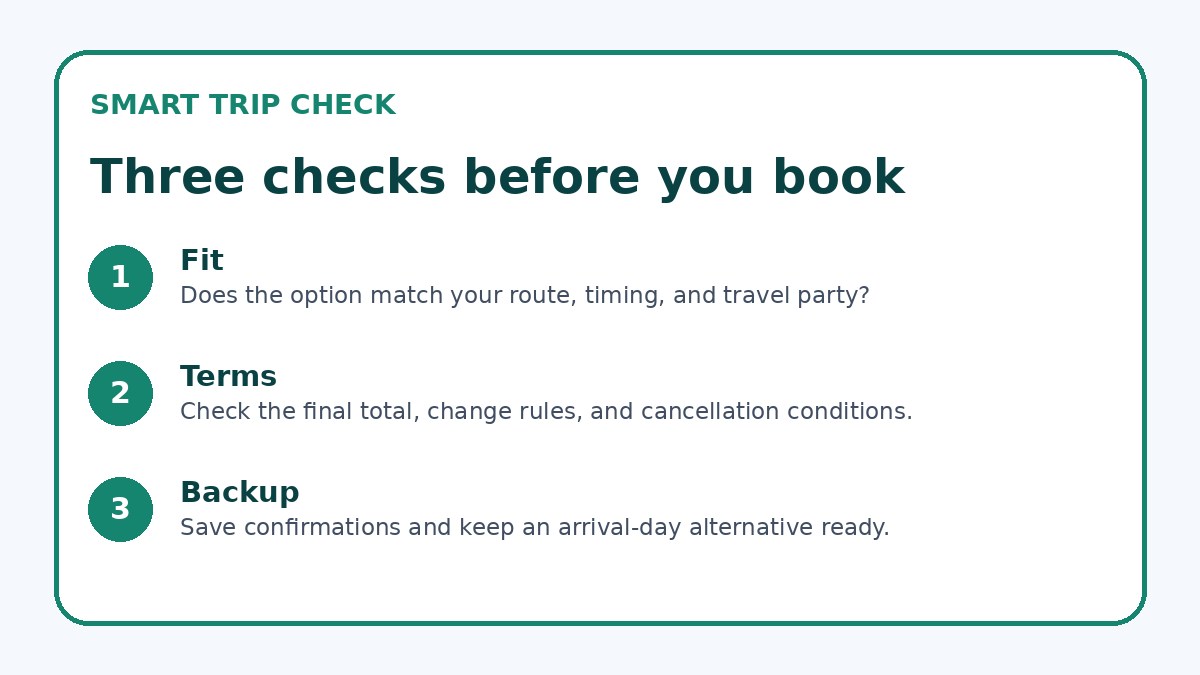
- Identify and note one realistic backup option (later service, taxi or rental) and confirm change/cancellation terms.
Timing flexibility and a simple disruption backup
Create time buffers at both ends of your intercity leg. Build at least 30–60 minutes depending on how many transfers you face and how much luggage you carry. Allow extra time if you must change terminals in Sydney or if your arrival in Canberra requires a local bus with limited frequency. If your schedule is tight around check-in or meetings, aim for an earlier arrival slot so small delays won’t derail plans.
For a disruption backup, choose one clear, realistic fallback and make it quick to implement: a later coach/train that runs frequently, a pre-identified taxi/rideshare option, or a short car rental. Before you travel, note cancellation or change conditions and the phone numbers or apps you’ll need. Keep an eye on service alerts the day before and the morning of travel; if you see a problem, switch to your backup while you still have options rather than waiting until your onward connection is missed.
Rail & Intercity Transport questions travelers ask
How do I decide if I should pick a coach or train from Sydney to Canberra?
Choose based on what matters most: if you want fewer station-to-station hassles and a drop-off closer to Canberra neighbourhoods, a coach can be more convenient. If you prefer onboard space, a smoother ride for working or sleeping, and clearer timetables, a train may suit you better. Compare where each mode departs in Sydney and where it arrives in Canberra relative to your accommodation. Verify on the provider’s booking page where vehicles stop, luggage rules, and what transfer options (taxi or shuttle) are available at those terminals.
What should I verify on the operator page before booking a connecting transfer?
Confirm the departure and arrival terminal names and exact addresses, stated luggage allowances, the location of taxi or rideshare pickup zones, and any assistance services you might need. Check cancellation or change conditions for both the intercity leg and any separately booked transfers. If the provider lists a meeting point or shuttle service, save screenshots or print the instructions because these details can change and are the final authoritative source for pick-up procedures.
If my intercity service is delayed, how quickly can I switch to my backup plan?
Act early: as soon as you see a delay that threatens your onward connection, contact your backup provider or the booking platform and secure the next available option. If your backup is a later train or coach, check availability and book immediately; if it’s a taxi or rideshare, request one and confirm estimated arrival. Keep cancellation/change rules in mind for any pre-booked items and prioritize backup choices that are easy to arrange last minute, such as on-demand taxis or frequent coach services.
Final decision note
Getting from Sydney to Canberra with minimal stress is mostly about planning the end-to-end journey, not just the long-distance leg. Pick the mode that matches your priorities — comfort, fewer transfers, or door-to-door control — then align terminals and transfers so you don’t add unnecessary walking or luggage handling. Build time buffers and pick a realistic, easy-to-activate backup. Before you finalize any booking, verify terminal addresses, luggage rules, pickup locations and change/cancellation terms on the provider’s booking page. If you want a quick comparison of current schedules while you decide, Trip.com can be used to view real-time availability, but always rely on the operator’s final details for pick-up and drop-off instructions.
Continue planning
Check current options and final conditions
Use the provider page to confirm live availability, the final total, cancellation terms, and every condition that matters to your trip.
This evergreen planning guide was created with AI-assisted drafting and a structured quality review. It does not display live prices, schedules, availability, visa guidance, or provider rankings. Verify current details before booking. Some links are affiliate links; we may earn a commission at no additional cost to you.