If you’re bringing extra luggage to Sydney, choose the stay area first—then the room. Picking central Circular Quay or Barangaroo trims daily transit but can shrink rooms and increase stairs or narrow lifts; choosing a quieter suburb like Neutral Bay or Newtown gives space and lower room-clutter stress but adds time and transfers each day. The practical decision: shortlist two area types (city-centre convenience vs. spacious outer suburbs) then filter hotels for luggage-friendly features—ground-floor or low-floor rooms, elevators with wide doors, luggage storage, and clear arrival instructions. This approach keeps your booking focused on real needs: how you’ll move on arrival, where you’ll go each day, and whether the hotel’s layout makes dragging multiple suitcases painful. Below you’ll find neighborhood fits, how daily-route friction plays out in Sydney, room and party needs guidance, and exact booking terms to verify before you click reserve.
Check live stays in the areas that fit
Use your dates and party size to compare current rooms after you narrow the neighborhood fit.
Neighborhood fit: city core vs. suburbs
Decide whether your priority is minimizing transit time or having a room with breathing space. Staying in the city core—Circular Quay, Darling Harbour, Barangaroo, or the CBD—puts most tourist attractions and business addresses within a short walk or a single transport leg. That convenience can be invaluable if you’re on a short trip, have scheduled meetings, or prefer to return quickly between outings to reorganize luggage or freshen up. The tradeoff is that central hotels often have smaller rooms or older buildings with narrow lifts and stairs, which increases handling effort during check-in and check-out.
Choosing an inner suburb or waterside neighborhood such as Surry Hills, Neutral Bay, Newtown, or Balmain typically yields larger rooms, quieter streets, and easier parking or loading zones for taxis and private transfers. These areas are attractive if you have bulky luggage, longer stays, or a travel group that needs space to spread out. The downside is potentially longer daily commutes—ferries, buses, or trains—and more connections. Map your must-visit points and estimate travel legs: if you’ll cross the city several times a day, the central option may still be worth the smaller room.
Choose an area-selection strategy
| Area approach | Best for | Tradeoff to check |
|---|---|---|
| City centre (Circular Quay, CBD, Barangaroo) | Travelers prioritizing minimal daily transit and quick returns to the hotel. | Smaller rooms, narrow lifts, and potential extra handling during arrival. |
| Inner suburbs (Surry Hills, Newtown) | Those wanting larger rooms, local cafes, and quieter streets with easier parking. | Longer commutes to major attractions and possible extra transport legs. |
| Waterside suburbs (Neutral Bay, Balmain) | Guests seeking roomy accommodations and ferry access for scenic commutes. | Ferries can require additional walking and transfers with luggage. |
| Near major transport hubs (Central Station, Wynyard) | Passengers prioritizing direct airport/train links and multi-leg onward travel. | Busy streets, crowds, and buildings with limited luggage-handling space. |
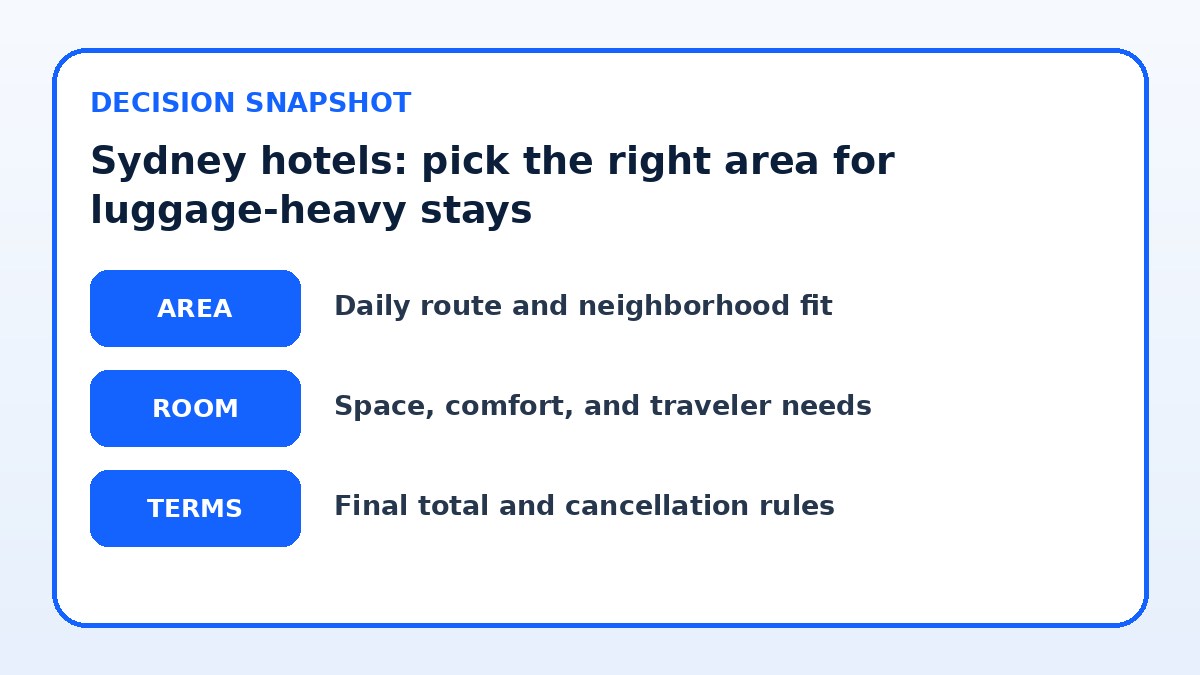
Daily-route friction: arrival, transfers, and in-town moves
Think through the whole arrival-to-first-night path. From the airport you’ll choose between taxi/ride-share, private transfer, or train. If luggage and quick access matter, a hotel with a clear pickup point, a level entrance, and an elevator big enough for multiple suitcases will save time and stress. For train or ferry arrivals, inspect station maps for step-free access and the number of stairs between platform and street; multiple small ramps or narrow pedestrian bridges multiply friction. On arrival day, a two-leg transfer with short walking distances is usually manageable; a multi-leg route with stairs is not.
Once you’re in town, plan how often you’ll need to move your bags. If you will day-trip to the Blue Mountains or nearby regions, consider leaving bulky luggage at the hotel in short-term storage—confirm the hotel’s storage policy and hours. For itineraries that cross the city repeatedly, estimate door-to-door time and count the number of luggage lifts and platform changes. Short walking distances with luggage trolleys and firm pavements make central stays feel lighter; poorly maintained sidewalks, long pedestrian tunnels, or stairs make even short distances a chore.
Now compare like with like
Keep the same dates, guests, room needs, and cancellation preferences while you compare the final choices.
Room and party needs: layout, lifts, and extras
When you shortlist hotels, prioritize room layout and building logistics that matter with extra luggage. Request or search for room types that explicitly state larger floor area, connecting suites, or family rooms that allow you to stash bags out of the way. If booking a smaller room, ask if the hotel can provide luggage racks or a fold-out bed to create floor space. Also check whether bathrooms open into the main area or a separate corridor; that layout affects how easy it is to maneuver suitcases without blocking walkways.
Don’t underestimate elevator dimensions and hallway width. Many older Sydney buildings have compact lifts—measurements matter if you have framed art, long instrument cases, or oversize suitcases. Ask the property to confirm lift size and the weight capacity if you’re bringing unusually heavy items. If you travel with a group, consider two-adjacent rooms or a suite; this reduces repetitions of luggage handling and gives someone a staging room to organize before heading out. Always verify whether the property charges for storing luggage before check-in or after check-out and the security arrangements for stored items.

Hotel booking check before payment
- Map your top three daily destinations and estimate door-to-door travel legs from each candidate neighborhood.
- Ask each shortlisted hotel for elevator dimensions, step-free access details, and whether there is a level entrance.
- Confirm the hotel’s luggage storage policy, hours of access, limits on items, and any associated fees.
- Request written pickup/drop-off instructions for taxis or rideshares and whether a bell service is available on arrival.
- If traveling with fragile or oversized items, ask the property about handling procedures and any required advance notice.
- Compare cancellation and modification terms and verify if name changes or late check-ins will be accommodated without penalty.
Booking terms to verify before you commit
Before you finalize a reservation, confirm practical, changeable details on the hotel’s booking page. Look for explicit information on check-in and check-out times, whether late arrivals are accommodated, and any instructions for drop-off zones or loading docks. Because building layouts and local loading rules change, ask the property to describe the car access—whether it’s a short drive, a pedestrianized street to the entrance, or a restricted zone—and whether a bell service is available on arrival. If using a rideshare, confirm where drivers can legally wait and whether there are one-way systems nearby.
Also verify luggage-specific policies: whether the hotel offers free or paid luggage storage, the maximum number of stored items, insurance or liability disclaimers, and pickup/drop-off hours. If moving between hotels in Sydney, ask both properties whether they will accept a transfer of bags and whether they will hold them between stays without continuous reservations. Finally, check cancellation and change policies relative to your travel uncertainty and whether the booking page lists any special requirements for oversized or fragile items so you can plan transport accordingly.
Hotel Guide questions travelers ask
Should I prioritize a central location or a bigger room if I have a lot of luggage?
If your itinerary involves multiple short stops, meetings, or quick returns, prioritize a central location—fewer transfers typically mean less physical strain. If you’re staying longer in one place, working from the room, or need space to unpack and store equipment, prioritize a larger room in a suburb with easy taxi access. A useful middle ground is to pick a central neighborhood but reserve a suite or a larger room type that explicitly lists floor area, or confirm luggage-friendly features like ground-floor rooms or large elevators before booking.
How can I check elevator and entry dimensions before I travel?
Ask the hotel directly for elevator width, depth, and door opening measurements, and whether the main entrance has steps or a ramp. If the hotel cannot provide measurements, request photos or a short video of the typical arrival route from the curb to the reception desk and of the elevator interior. For older buildings, confirm whether manual assistance is offered at arrival and whether bell staff can meet vehicles at the kerbside to reduce repeated lifts.
Is it safe to store expensive equipment at a Sydney hotel between check-out and return?
Many hotels offer luggage and valet storage, but policies, levels of security, and liability vary. Before leaving valuable or fragile items, obtain written confirmation of the hotel’s liability terms, whether items are kept in a locked room, and if insurance or a signed release is required. Consider using your own lockable case, photographing items for records, and avoiding leaving high-value items if the hotel’s policy is unclear. When in doubt, arrange for professional courier or specialized storage services and verify their insurance cover.
Final decision note
Start by choosing the stay area that matches how you’ll use Sydney: central for short itineraries and rapid returns, suburbs for larger rooms and relaxed arrivals. Once you have two or three neighborhoods, narrow hotels by logistics—elevator size, step-free access, clear drop-off instructions, and luggage storage terms. Don’t finalize until the property confirms these specifics on their booking page or by message: elevator dimensions, pickup locations, storage liability, and check-in flexibility. A deliberate shortlisting step lets you compare realistic tradeoffs and book a room that keeps the city accessible without turning each arrival or departure into a heavy chore. For live availability and to cross-check listings, you can compare current options on Trip.com as one reference point.
Continue planning
Check current options and final conditions
Use the provider page to confirm live availability, the final total, cancellation terms, and every condition that matters to your trip.
This evergreen planning guide was created with AI-assisted drafting and a structured quality review. It does not display live prices, schedules, availability, visa guidance, or provider rankings. Verify current details before booking. Some links are affiliate links; we may earn a commission at no additional cost to you.