If you're travelling solo in Sydney, the practical answer depends on your priorities: stick to public transport for inner-city convenience, cost predictability, and avoiding parking hassles; rent a car if your itinerary includes multiple coastal drives, national parks, or flexible day trips beyond the train and bus network. Solo travellers who value simplicity and low navigation stress usually favour trains, buses, ferries, and rideshares. Those who prefer scenic freedom and off-grid exploring often choose a car. This article explains the tradeoffs—time, cost, flexibility, safety, and convenience—so you can match the mode to the trip you want. It also gives decision criteria and a checklist of the exact things to verify before booking a car or committing to public-transport passes in Sydney.
See current options before you compare the details
Availability and final conditions change. Open Trip.com now or keep reading for the practical comparison.
Practical strengths of Sydney public transport
Public transport in Sydney covers the CBD and major suburbs with frequent trains and buses linking to ferries for harbour and coastal travel. For a solo traveller staying in or near the central areas—such as the CBD, Surry Hills, Newtown, or North Sydney—trains and ferries let you reach attractions, museums and nightlife without driving, parking or navigating complex one-way streets. Public transport also reduces the mental load of urban driving: no need to find parking, deal with toll systems, or worry about local parking restrictions when you move between neighbourhoods.
Using public transport makes budgeting simpler for short stays because you can buy a reloadable transit card or day passes (verify current pass types and fares on the provider's site). It also pairs smoothly with rideshares or local buses for late-night journeys and short hops from stations. For single-day ferry trips or harbour sightseeing, ferries provide scenic value without the stress of harbour-side parking. Check timetables and service notices when planning early starts or trips on public holidays; verify any special services or planned engineering works on the transport operator's official pages.
When a solo traveller should consider renting a car
A hire car is most useful if your solo itinerary includes destinations poorly served by trains or buses—think national parks, remote beaches, or multi-stop coastal routes. Driving gives you flexible start times, the ability to carry gear (surfboards, hiking equipment), and access to lookouts or trails where public transport doesn't reach. For photographers, coastal hikers, or anyone who wants to string together several off-peak stops in a day, a car can save time and make logistics straightforward compared with coordinating multiple transfer points and limited bus schedules.
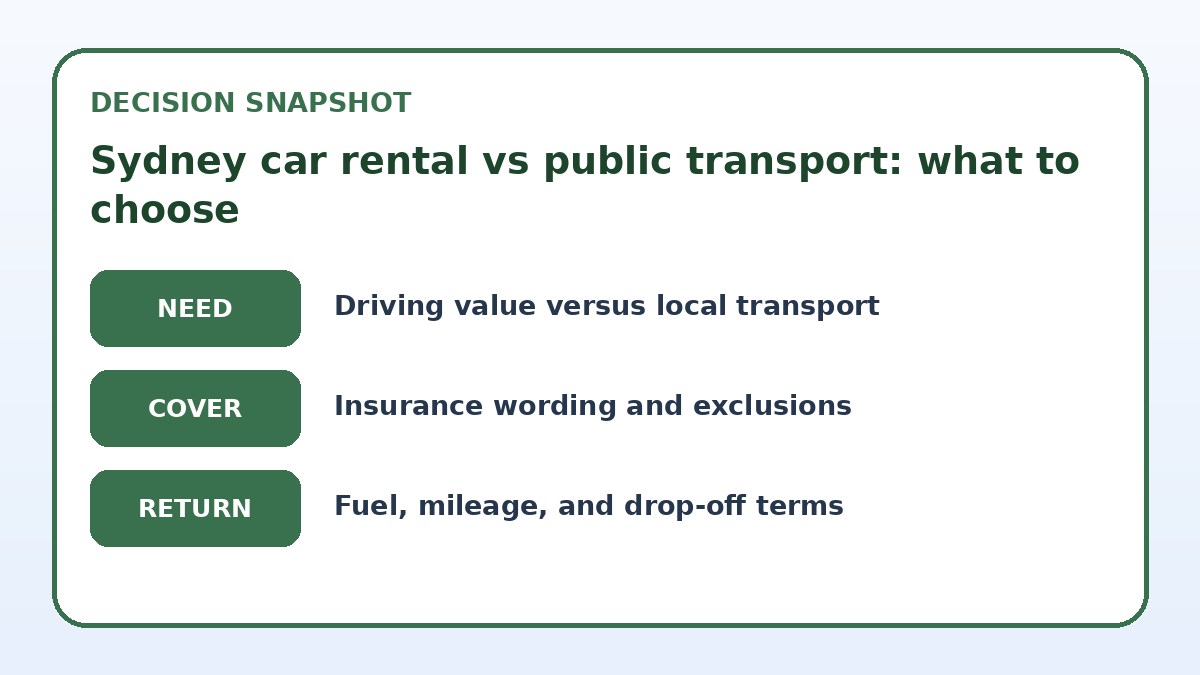
Renting a car also changes safety and comfort calculations for late-night or early-morning travel in areas with limited transit. However, driving in Sydney brings tradeoffs: parking availability in busy precincts, unfamiliar traffic patterns, congested commute windows, tolls on some roads and bridges, and the need to verify insurance coverage, license requirements, and fuel policies. Before you book, confirm exact rental terms on the provider's final booking page—insurance excess, fuel rules, mileage limits and any one-way drop fees can materially change whether a rental makes sense for your trip.
| Approach | Best for | Tradeoff to check |
|---|---|---|
| Public transport and rideshares | City-focused itineraries, low planning overhead, avoiding parking and tolls | Less flexibility for remote day trips and early starts; you depend on schedules and connections |
| Full-time car rental | Multi-stop coastal routes, national parks and carrying gear or photography equipment | Higher solo cost, parking hassles, tolls and responsibility for navigation |
| Hybrid: public transport plus short-term rental | City stay with one or two planned day drives outside transit zones | Requires planning rental pickup/drop-off logistics and may incur extra fees |
| Public transport with selective rideshares | Late-night safety, short transfers from stations, cost control without full rental | Can become expensive if used frequently for long suburban trips |
Ready to check the option that fits your plan?
Use your exact dates and traveler details so the provider page can show the current total and conditions.
How to weigh time, cost and convenience for your plan
Start by mapping your daily itinerary: mark where you'll sleep, the attractions you won't miss, and any day trips beyond the urban core. Estimate door-to-door times using public transport journey planners and compare them with realistic driving times while accounting for traffic congestion during peak hours. Include extra minutes for parking, walking from car parks to sights, and finding fuel stops. For short city-focused trips, public transport often wins on total time spent; for multi-stop rural days or flexible schedules, a car may save time overall despite traffic.
Cost comparisons need to include more than the headline rental rate. For a fair assessment, factor in parking fees in central areas, tolls you might incur on express roads, fuel consumption for planned distances, and any mandatory insurance or credit-card hold amounts. If budget is tight, compare the cumulative cost of transit passes and occasional rideshares against a conservative estimate of total rental costs. Remember that solo travellers have no one to split rental or parking fees with, so per-person costs for a car will be higher than for a pair or group.
Before you book
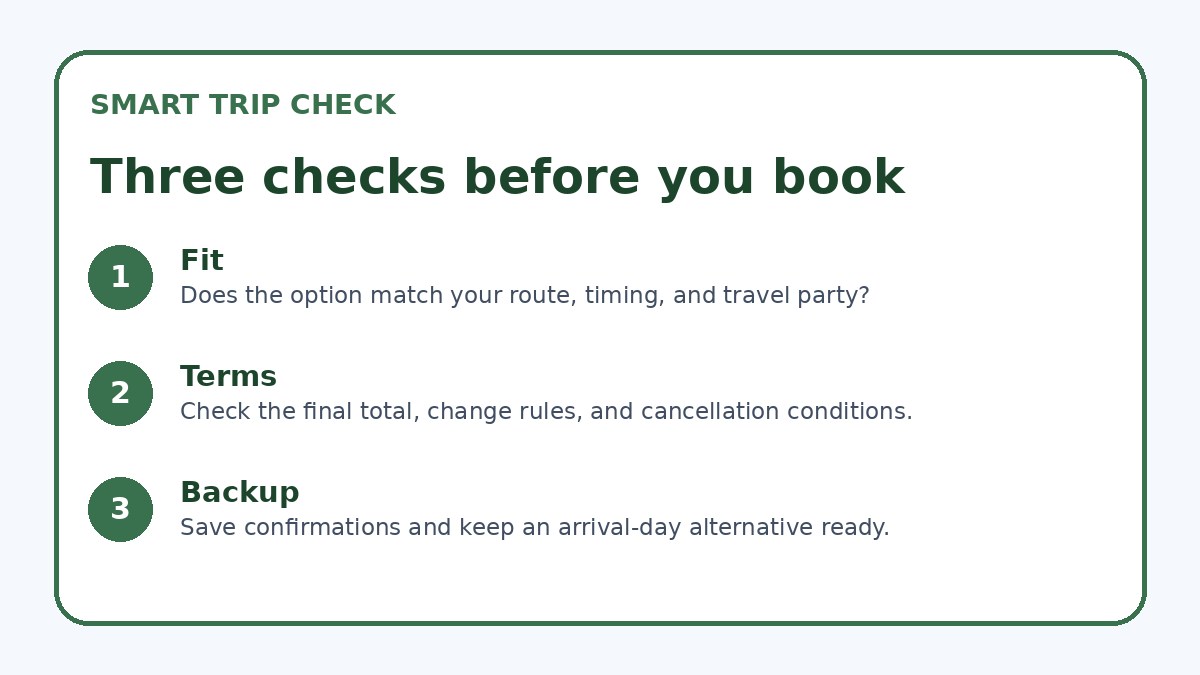
- Map your daily route and mark destinations public transport serves directly before choosing a car rental.
- If renting, verify insurance excess, roadside assistance and whether your own card or insurer covers the vehicle.
- Check parking options and likely fees near your accommodation and main attractions before committing to a car.
- Confirm fuel policy, mileage limits and any one-way or airport surcharge on the rental company's final booking page.
- Look up current train, ferry and bus timetables for key travel days and check for planned engineering works.
- Decide pick-up/drop-off logistics: compare costs and convenience of renting at the airport versus a central city location.
Safety, comfort and convenience considerations for solo travellers
Solo travellers should consider personal safety and comfort: public transport has the advantage of predictable routes, populated stations, and frequent services, which can reduce isolation during late journeys. Ferries and trains often stop at clearly marked hubs with amenities nearby. If you expect to be out late or travel in less populated suburban areas, plan transfers in advance and identify reliable ride options for the final leg. Carry a charged phone, share your live location with someone trusted, and know the local non-emergency contact numbers for peace of mind.
Driving brings control over privacy, luggage storage and timing, but it also places full responsibility for navigation, parking and vehicle security on you. When renting, inspect the vehicle and document any existing damage with photos, confirm roadside assistance coverage and note emergency procedures. If you are not fully comfortable driving in unfamiliar cities or on busy highways, consider hybrid approaches: rent a car for only a few days to reach remote spots and rely on public transport while staying in the city.
Frequently asked questions
Can I rely on public transport alone to see Sydney's main sights as a solo traveller?
Yes—many of Sydney's iconic attractions (the Opera House precinct, central museums, Darling Harbour, Bondi via frequent bus routes and ferry connections) are accessible by public transport. For harbour views, ferries add scenic value and connect several popular spots. However, if your 'must-see' list includes remote beaches, the Blue Mountains, or national parks, those destinations are less convenient by transit and might need a long multi-leg journey or organised tour. For any day trips that push beyond the network, compare the total travel time and convenience with a rental before deciding.
What should a solo traveller know about parking and tolls if they rent a car in Sydney?
Parking availability and cost vary widely: central precincts charge for street and garage parking and some suburbs limit free parking. Many expressways and bridges use electronic tolling systems—check whether the rental includes a toll device or if tolls are billed to the renter afterwards. Also confirm the rental company's approach to toll charges and any administrative fees; these details appear on the provider's final booking page and can change. Factor parking and tolls into your budget because they can quickly exceed expectations during peak tourism periods.
Is it safer for a solo traveller to use public transport rather than driving at night?
Public transport in central Sydney operates late into the evening on major corridors, and populated stations make most journeys feel secure. For very late-night travel or trips into quiet suburbs, organise a pre-booked rideshare or taxi for the final leg rather than waiting at isolated stops. If driving at night, ensure you know where you can park safely, avoid unfamiliar poorly lit streets, and keep your vehicle doors locked. Whether by transit or car, share your itinerary and live location with someone you trust when travelling alone.
Final planning note
Choosing between Sydney car rental and public transport as a solo traveller comes down to your itinerary and tolerance for driving responsibilities. If your trip is concentrated in the CBD and inner suburbs, public transport keeps things simple, predictable and often faster for point‑to‑point movement. If your priority is exploring coastal drives, national parks or multiple off-network stops in a single day, a rental gives unmatched flexibility—provided you factor in parking, tolls and insurance. For many solo travellers a hybrid approach works best: rely on trains and ferries while in the city, then rent for a couple of days to reach remote highlights. Before you book, map routes, total the likely costs, and verify rental terms or transit passes on the provider's booking pages (you can also compare availability on Trip.com if you want a quick cross-check).
Continue planning
Check current options and final conditions
Use the provider page to confirm live availability, the final total, cancellation terms, and every condition that matters to your trip.
This evergreen planning guide was created with AI-assisted drafting and a structured quality review. It does not display live prices, schedules, availability, visa guidance, or provider rankings. Verify current details before booking. Some links are affiliate links; we may earn a commission at no additional cost to you.