If you’re flying from Seoul to Osaka with more than carry-on or an awkward oversized bag, get the important checks done before you book. Start by confirming baggage allowances, surcharges, and how those rules change across fare classes and connecting itineraries. Next, compare departure and arrival airports in both cities and factor in transfer costs—extra luggage changes the ground-transport equation. Look at seat and aircraft choices if checked-bag space or hold size matters, and always verify provider baggage policy on the airline’s final booking page. This checklist-focused article gives the practical checks you need first, then explains tradeoffs so you can choose the option that balances cost, convenience, and risk for your specific luggage needs.
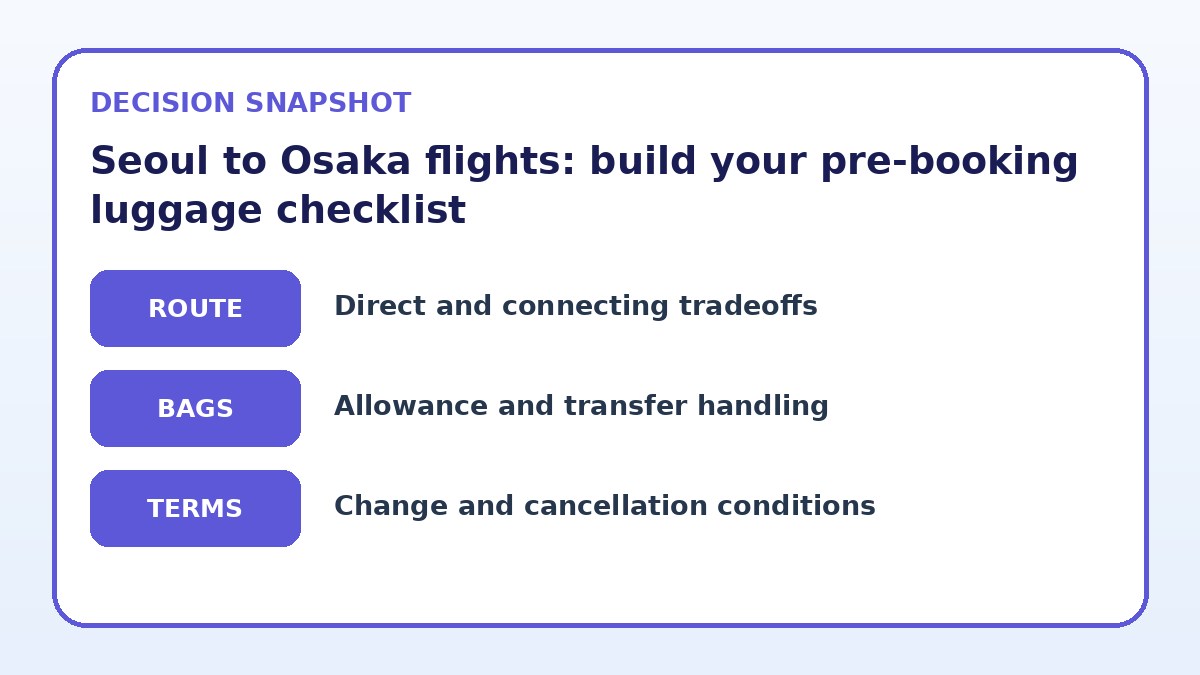
See current options before you compare the details
Availability and final conditions change. Open Trip.com now or keep reading for the practical comparison.
Confirm baggage rules and surcharges before choosing a fare
Baggage allowances are the first decision filter for travelers with extra luggage. Airlines often bundle one checked bag into higher fare classes while basic or budget fares may include none; carry-on size and weight limits vary too. Look for explicit per-piece limits, weight-based allowances, and whether the airline charges for oversize or overweight items. When comparing fares, open the airline’s final booking page or baggage policy PDF to confirm exact fees, permitted dimensions, and how many kilograms or pieces are included. Remember that third-party booking sites can list different baggage terms—use them for initial comparison but verify on the carrier’s official page before purchasing.
Special items—sports gear, musical instruments, golf clubs, or fragile goods—frequently follow different rules and may need advance booking or special labels. If you have multiple pieces or non-standard shapes, check if the carrier requires an oversized baggage booking or has per-item maximums. Some airlines allow prepayment discounts for extra baggage; others only accept payment at the airport, often at higher rates. Note also how changes or cancellations affect baggage purchases: if you change flights, pre-purchased baggage may not transfer automatically. Always document the baggage allowance text or screenshot the final booking page where the fee and allowance are shown.
Choose airports and transfers with extra luggage in mind
Seoul has two main airports serving international flights; Osaka is served by multiple airports too. For travelers with extra luggage, the distance between airport terminals, availability of baggage trolleys, and the cost and ease of ground transfers matter as much as the ticket price. Factor in how you will get between airport and city center with heavy bags: trains with stairs, long connection walks, or multiple transfers can make lower fares impractical. If you must change airports in either city, plan additional transfer time and costs; a cheap flight into a farther airport can be a false economy once you include taxi or shuttle expenses.
When comparing arrival airports in Osaka, consider onward plans: will you be heading to central Osaka, Kyoto, or further afield? A closer airport could save transfer time and money and reduce the hassle of dragging luggage through public transit. Check whether the airports offer porter services, luggage delivery, or lockers if you want to leave some bags temporarily. Also confirm terminal layouts and whether international arrivals require lengthy immigration or baggage claim procedures that add unpredictability to onward connections—long queues mean more time managing heavy bags.
| Approach | Best for | Tradeoff to check |
|---|---|---|
| Direct flight | Minimizing bag handling and risk of misrouting | Often higher fare or limited schedule choices |
| Single-ticket connection with same carrier | Automatic through-check of bags and simpler claims | May still require longer layovers and limited carrier options |
| Separate-ticket connection | Potential savings or specific schedule fits | You’ll likely need to collect and recheck bags; added risk and time |
| Ship bulky items in advance | Avoiding airline oversize/overweight fees and airport hassle | Higher upfront logistics, lead time, and courier costs |
Ready to check the option that fits your plan?
Use your exact dates and traveler details so the provider page can show the current total and conditions.
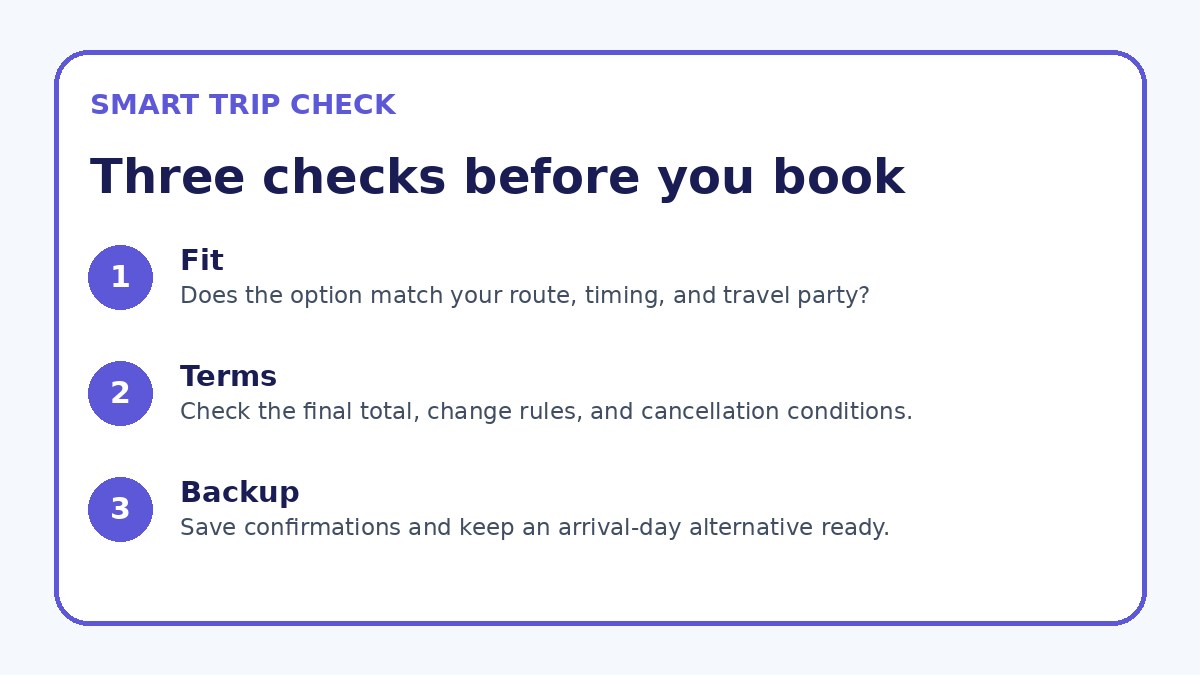
Decide between direct and connecting options for luggage reliability
Direct flights minimize handling and the risk of misrouted bags, which makes them attractive when you’re traveling with extra or valuable items. However, direct flights may be more expensive or depart from less convenient terminals. Connecting flights can offer savings or better schedules but introduce transfer risks: will your bags be through-checked, or will you need to collect and recheck them? If the itinerary involves separate tickets or carriers without interline agreements, plan to collect baggage and clear immigration before rechecking. That can add significant time and complexity when you’re carrying excess items.
When comparing connections, confirm on the airline or booking page whether checked luggage is automatically transferred and whether minimum connection times recommended by the carrier are realistic for you with heavy bags. If the connection is tight, choose longer layovers or book a single-ticket itinerary with a single carrier or alliance to reduce the chance of baggage separation. Also weigh the inconvenience of a longer layover against possible savings: sometimes paying a modest fee for a direct flight is worth the assurance your luggage stays with you and arrives on time.
Before you book
- Confirm the baggage allowance, fees, and maximum dimensions for your exact fare class on the airline’s official baggage policy or final booking page.
- Weigh and measure every bag at home and decide whether to redistribute contents to avoid overweight charges per piece.
- If your itinerary includes a connection, verify whether checked bags are through-checked or require recheck—confirm this on the booking confirmation and airline policy.
- Compare airport arrival and departure options in Seoul and Osaka for transfer time, luggage trolleys availability, and door-to-door transport costs.
- Arrange coverage for valuable or fragile items: note carrier liability limits, consider declared-value or insurance, and photograph contents before departure.
- If oversized or special items apply, reserve special baggage handling in advance (sports equipment, musical instruments) and confirm pickup/drop-off procedures at both airports.
Prepare documentation, packing strategy, and arrival logistics
Before booking, list what you’re packing and categorize items by weight, fragility, and value. This helps decide whether to split items across multiple bags to avoid overweight charges or to ship some goods in advance. For valuable or fragile items, check insurance options and whether the airline’s liability limits meet your needs. Prepare clear labeling and a contents list for each bag; some travelers photograph contents and weigh bags at home to avoid surprises at check-in. If you plan to ship items separately, research international courier options and door-to-door timing as part of your arrival plan.
Also verify customs rules and any documentation required for specific goods when entering Japan; while rules change, you should confirm any restricted or taxable items on official government pages. At arrival, plan a smooth transfer from plane to ground transport—remember that oversized bags may need special handling or longer retrieval time at baggage claim. Scout porter services or luggage storage at the airport if you need temporary relief before moving on. Finally, add buffer time to your itinerary for breakdowns like reweighing, repacking, or paying excess baggage fees so your trip starts without stress.
Frequently asked questions
How do I know if my checked bag will be transferred automatically on a connecting Seoul–Osaka itinerary?
Whether checked bags transfer automatically depends on the ticketing and carrier agreements. On a single-ticket itinerary issued by one airline or by partnered carriers within the same alliance, bags are commonly through-checked to the final destination—but you must confirm this on your booking confirmation and the airline’s baggage rules. For separate tickets or for carriers that don’t have interline agreements, you will probably need to collect your bag at the first arrival airport, clear immigration, and recheck it for the onward flight. Always check the booking details and, when in doubt, contact the airline to request written confirmation of baggage transfer procedures.
Should I pay for extra baggage online or at the airport for Seoul to Osaka flights?
Prepaying extra baggage online is often cheaper and lets you lock in allowance before travel, but policies vary by carrier. The safest approach is to check the airline’s booking page for the extra-baggage purchase options and any listed price difference between online and airport rates. If you can’t prepay or have last-minute changes, be prepared for higher fees at check-in. Also verify whether online purchases are refundable or transferable if you change flights. Document the transaction confirmation so you can present it at check-in to avoid disputes.
What ground-transport options should I factor in for bulky luggage arriving in Osaka?
Factor in taxis, private transfers, airport shuttles, and rail options when arriving in Osaka with bulky bags. Trains may be cheaper and faster but can be crowded and include stairs or long walks between platforms, which complicates handling oversized suitcases. Taxis or private airport transfers reduce handling and door-to-door time but cost more; consider splitting costs if traveling with others. Also check whether your arrival airport offers luggage trolleys, porter services, or luggage delivery and storage—these services can ease the transfer but may add extra fees. Verify service availability and pricing on the airport’s official pages before you travel.
Final planning note
For travelers with extra luggage, the right Seoul to Osaka flight choice begins with precise verification: baggage allowances and fees, whether bags transfer on connections, and which airport options minimize ground hassle. Build your decision around those concrete checks rather than headline fares—small differences in baggage policy or airport transfer costs can change the best option. Use the checklist to confirm details on airline booking pages and airport websites, and allow buffer time for repacking or paying fees at check-in. If you need a rapid comparison of current schedules and options, you can check a flight search site such as Trip.com, but always confirm baggage terms directly with the airline before you finalize payment.
Continue planning
Check current options and final conditions
Use the provider page to confirm live availability, the final total, cancellation terms, and every condition that matters to your trip.
This evergreen planning guide was created with AI-assisted drafting and a structured quality review. It does not display live prices, schedules, availability, visa guidance, or provider rankings. Verify current details before booking. Some links are affiliate links; we may earn a commission at no additional cost to you.