
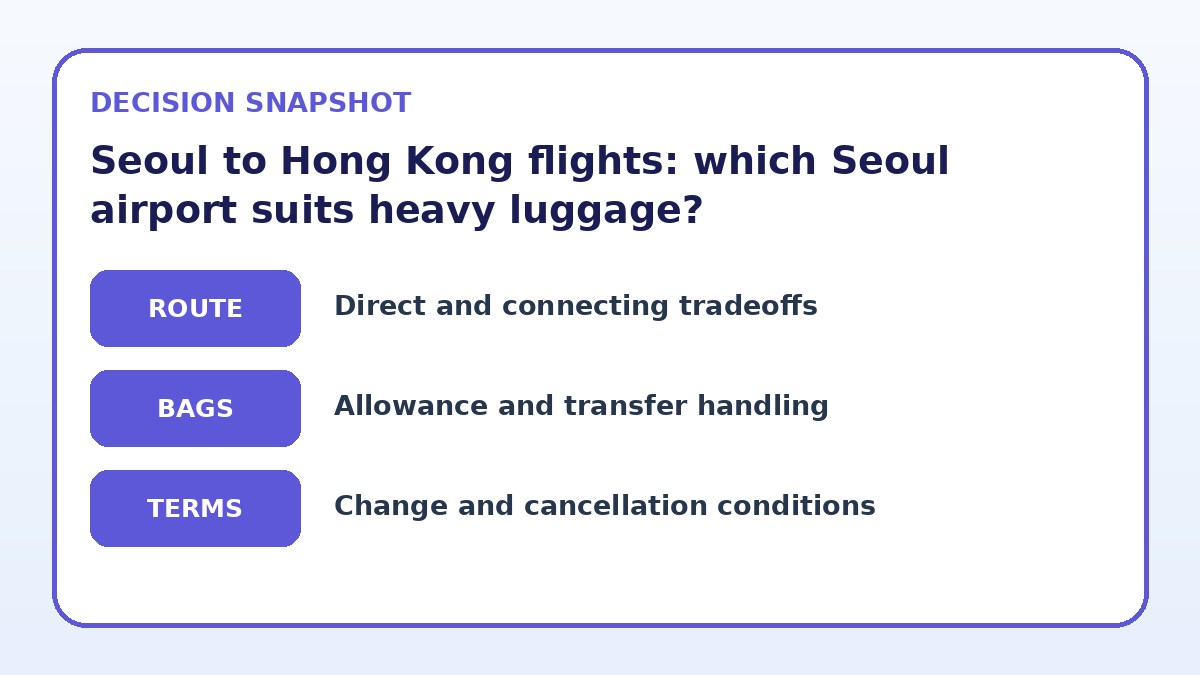
Practical answer first: if managing extra luggage is your top priority, prefer departures from the airport that gives you clearer checked-baggage rules, straightforward oversized/overweight handling, and easier ground logistics — often the larger international airport in Seoul. That reduces surprises at check-in and simplifies transfers to your gate or onward transport. Now the tradeoffs: a larger airport may mean longer lines, more walking, and potentially higher taxi or transfer costs; a smaller airport can be quicker to clear but may have stricter or less transparent baggage policies and fewer flight choices. Below I explain the criteria you should weigh, how to check baggage allowances before you book, and practical tips for packing, transfers, and handling oversize items during Seoul to Hong Kong flights.
See current options before you compare the details
Availability and final conditions change. Open Trip.com now or keep reading for the practical comparison.
How airport choice affects baggage handling and fees
Airlines set baggage allowances and oversize or overweight fees; the airport mainly affects how practical it is to get from curb to check-in and to handle bulky items. A larger international hub typically has dedicated counters, wider check-in areas, and carts or porters available, which makes handling multiple or heavy suitcases easier. However, those conveniences do not change the airline’s rules about how many pieces are included in your fare or the fee amounts for overweight or oversize items. Always treat the carrier’s published allowance as decisive, then use the airport’s facilities to make complying with that policy easier.
Smaller or secondary airports can be quicker to navigate and may have shorter security lines, but they sometimes lack dedicated special-luggage desks or have fewer staff familiar with nonstandard items. If your bags include sports equipment, musical instruments, or unusually large boxes, check whether the departure airport offers cargo desks or a central lost-and-found area that handles oversized items; those facilities vary by airport. In short: pick the airport that balances clear airline baggage policy with the ground-side services you’ll need to move heavy or oversized luggage smoothly.
Comparing direct flights vs connections for extra luggage
When you can fly direct, you usually avoid re-checking baggage and the risk of missed connections disrupting oversized-item handling. Direct Seoul to Hong Kong flights let you tag bags through to the destination on a single itinerary when both legs are on the same ticket, reducing the number of times staff must transfer or inspect heavy items. But direct options may be limited at certain airports or time windows, and they may have stricter aircraft weight limits on particular flights—so confirm whether the specific flight can accept overweight or oversize pieces before you finalize your booking.
If a connection is necessary, the most important checks are whether both legs are on a single ticket and whether the transfer airport requires baggage re-claim. Transfers increase the handling steps and therefore the chance for delays, extra fees, or manual re-checking of oversized items. If you must connect, plan longer transfer windows to allow time for baggage procedures, and verify with both carriers how they process checked items, especially if one carrier is a low-cost operator that often treats baggage differently than full-service airlines.
| Approach | Best for | Tradeoff to check |
|---|---|---|
| Depart from the larger international airport with full services | Travelers needing more staff, trolleys, and dedicated counters for oversized items | Potentially longer queues, more walking between terminals, and higher transfer costs |
| Depart from a smaller or secondary airport | Those who prioritize faster check-in and shorter security lines for lighter transfers | May lack special-luggage desks or consistent handling for oversized baggage |
| Book a direct flight (same-ticket) where available | Reducing the number of times baggage is handled and minimizing re-check risk | Possible limited schedule options and stricter aircraft-specific weight limits |
| Choose a connecting itinerary with long transfer windows | Travelers who must use specific carriers or lower-cost segments but carry many items | Extra handling steps, higher chance of re-checking, and longer total travel time |
Ready to check the option that fits your plan?
Use your exact dates and traveler details so the provider page can show the current total and conditions.
Ground logistics: getting to and from the Seoul airport with heavy bags
Think beyond check-in: how you arrive at the Seoul airport and how you’ll leave Hong Kong determine how manageable heavy baggage feels. Taxis, ride-shares, and private transfers vary in trunk space; if you have multiple large suitcases or sports gear, book a larger vehicle or reserve a van in advance. Public transport can be efficient, but stairs, crowded trains, and limited elevator access at stations complicate moving heavy bags. Factor door-to-door travel time plus time for check-in, security, and the possibility of extra screening for oversized items.
At the departure airport itself, look for services that ease movement: luggage trolleys, porter services, curbside check-in options, and fast-track lanes for families or mobility needs. These services can reduce the physical strain and time spent queueing. If the airport provides online check-in and pre-paid baggage options, use them to save time at the counter, but still confirm at the airline desk whether your pieces meet weight and size rules to avoid last-minute repacking.
Before you book
- On the airline’s final booking page, confirm allowed number of checked pieces, per-piece weight, and maximum dimensions before you pay.
- If you have an oversized item, call the airline baggage desk to confirm acceptance, required documentation, and any cargo-handover steps.
- Reserve a larger taxi, van, or airport transfer in advance if you have multiple large suitcases or awkward items.
- Pack a day bag with essentials and a compact set of clothes in case checked luggage is delayed or rerouted.
- Buy or rent sturdy luggage straps and a protective case for fragile or expensive items and photograph contents before travel.
- Check departure and arrival airport services (trolleys, porters, curbside check-in) and note their operating hours in case of early or late flights.
Practical booking steps and what to verify before you pay
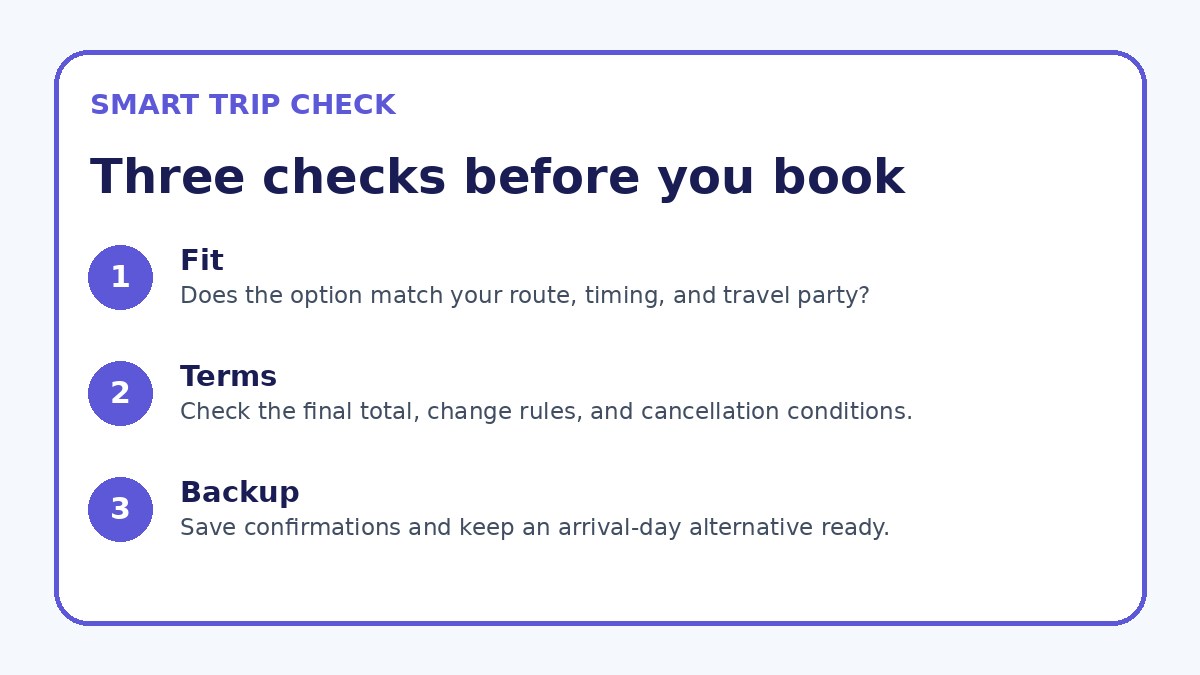
Before booking Seoul to Hong Kong flights, compare the total door-to-door plan, not just the headline fare. On the airline’s final booking page confirm the exact included baggage allowance, per-piece weight limits, maximum dimensions, and clear statements about oversized or sports equipment. If fees are listed, treat them as indicative and double-check by phone if the itinerary includes unusual items. If you see different policies between carriers or ticketing options, call the airline to confirm how your specific route and fare class applies to heavy or oversized bags.
Also check the airport’s site or customer service for real ground-side details: availability of trolleys, porter desks, curbside check-in, and any luggage storage or cargo desk hours you might need. If you plan transfers in Seoul before departure or in Hong Kong on arrival, verify whether you’ll need to re-check bags. Finally, consider travel insurance that covers delayed or damaged baggage, and keep photos and receipts for any item you consider valuable or difficult to replace.
Frequently asked questions
Can I avoid overweight fees by splitting items between bags at the airport?
Possibly, but not reliably. Airlines charge per piece or by weight depending on the fare and carrier rules shown on the booking page. If you split contents across more checked bags to keep each under the per-piece weight limit, you may avoid overweight fees but could incur extra per-piece fees if your fare only includes a certain number of free pieces. Airport staff may also inspect repacked items and apply fees based on the airline’s policy. Always verify allowed pieces and the carrier’s per-piece versus per-kilogram rules before attempting this approach.
Should I use courier or cargo services instead of airline checked baggage for bulky items?
Courier or cargo can be a good option for very heavy, bulky, or valuable items because they often handle oversized shipments and provide door-to-door options. However, they add handling steps and cost and require different timing: cargo shipments may take longer to arrive and need separate customs clearance. If you choose courier or cargo, compare lead times and documentation requirements, and confirm that both origin and destination customs processes are understood. For many travelers, checked baggage remains simpler for regular suitcases, while cargo suits equipment or shipments that exceed airlines’ limits.
How far in advance should I arrive at the Seoul airport with extra luggage?
Arrive earlier than the standard recommendation to allow extra time for check-in, oversized-item handling, and security screening. While the exact lead time depends on the airport and airline, plan additional time for queuing at special-luggage desks, potential form-filling, or on-the-spot inspections. If you need cargo desk assistance or a porter, factor in extra minutes to locate those services. Check the airline and airport guidance on arrival time for passengers with excess or irregular baggage, and call if you’re unsure—this can prevent last-minute stress and rushed repacking.
Final planning note
Choosing the most practical Seoul departure airport for Seoul to Hong Kong flights when you have extra luggage is about matching airline baggage rules with airport ground services and your ground-transport plan. Start with the carrier’s published allowances on the final booking page, then pick the airport whose facilities—trolleys, special-luggage counters, porters, and straightforward curb access—reduce friction. If you must connect, build generous transfer time and confirm whether bags will be re-checked. Finally, prepare physically and document your items: secure cases, reserve room in transfers, and keep essential items in your carry-on. If you want to compare current schedules and availability, sites like Trip.com can show options, but always verify baggage specifics directly with the airline before you pay.
Continue planning
Check current options and final conditions
Use the provider page to confirm live availability, the final total, cancellation terms, and every condition that matters to your trip.
This evergreen planning guide was created with AI-assisted drafting and a structured quality review. It does not display live prices, schedules, availability, visa guidance, or provider rankings. Verify current details before booking. Some links are affiliate links; we may earn a commission at no additional cost to you.