
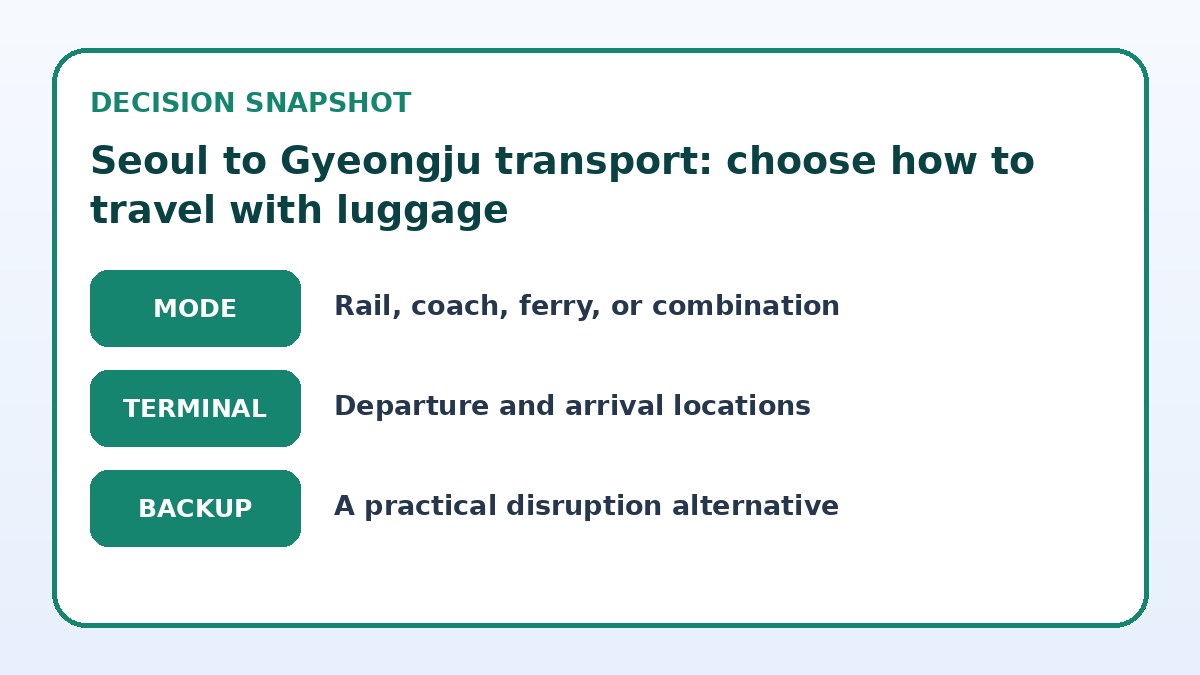
If you’re a solo traveler leaving Seoul for Gyeongju and carrying luggage, your practical first decision is whether to prioritize speed, convenience, or cost. For most solo travelers with medium-to-large bags, the best approaches are high-speed train plus simple transfers, intercity express buses with luggage space, or a private transfer if you need door-to-door service. Pack strategically so your bag fits overhead or under-seat spaces, and plan transfers at stations with elevators or escalators. This article quickly tells you the most luggage-friendly options, then explains tradeoffs—how much handling you’ll do, where to store bags temporarily, and what to verify on booking pages (train seat types, baggage rules, bus hold limits, and transfer accessibility). Use the practical checklist and comparison table to pick the approach that matches your comfort level and the specific luggage you’ll bring.
Choosing between train, bus, and private transfer
High-speed and conventional trains between Seoul and Gyeongju offer the smoothest rides and reduce exposure to traffic delays, but luggage handling varies. Trains typically allow you to bring a carry-on and a larger bag; however, available luggage racks and luggage zones differ by train type and carriage. When booking, check whether reserved seats have generous overhead racks or dedicated luggage spaces and whether there are longer gaps or steps at stations that complicate boarding with heavy suitcases.
Buses can be the most luggage-friendly in terms of underfloor storage capacity and usually require only one lift of the bag into the hold at boarding. That convenience comes with a tradeoff: you might have to handle the bag at both ends and during any stops. Private transfers or taxis remove most handling for the solo traveler, but they require clear pickup instructions and confirmation of trunk space. For each option, verify baggage rules and pickup/meeting details on the provider’s final booking page; Trip.com can be used to compare current availability, but always read the operator’s terms.
How to pack and move your bags for station and platform layouts
Packing to match the route environment cuts friction. Use a carry-on with smooth wheels, a comfortable shoulder strap or backpack straps, and a balanced load so you can lift it onto overhead racks or into bus holds without assistance. Place frequently needed items in an external pocket or daypack so you won’t need to open your main bag during short transfers. If your bag is heavy, put heavier items close to the wheels or back panel to make lifting less awkward when stepping onto platforms or into vehicles.
Scout station layouts in advance so you know where elevators, escalators, and stairs are; many stations list accessibility maps online. If you will be switching modes—train to taxi, bus to guesthouse—identify the nearest elevators or station exits. Consider using luggage straps, a compact trolley, or a backpack cover to protect your bag on busy platforms and during walk transfers. If an elevator is not available, evaluate whether you can manage a single lift or need assistance; plan for assistance at ticket counters if available and described by the provider.
| Approach | Best for | Tradeoff to check |
|---|---|---|
| High-speed train (reserved seats) | Travelers wanting speed and a stable ride with manageable luggage | Limited dedicated luggage space and possible steps at some stations |
| Intercity express bus | Large or bulky bags needing underfloor storage | Longer journey times and potential traffic delay exposure |
| Private transfer or taxi | Door-to-door convenience and minimal handling | Higher out-of-pocket cost and reliance on precise pickup details |
| Split travel (train + local taxi) | Balancing speed with lighter last-mile handling | Requires coordination at transfer points and additional transfers |
Managing luggage during transfers and at your Gyeongju accommodation
Plan transfers so you minimize the number of times you have to lift heavy suitcases. Allow buffer time between connections to retrieve and stow luggage without rushing. If you arrive at a station with lockers or left-luggage services and you plan to sightsee before checking in, confirm the locker size and operating hours. Many hotels and guesthouses offer luggage storage before check-in or after checkout, but confirm the hours, any fees, and whether staff will move bags between properties if you change accommodation.
When booking accommodation, prioritize places with ground-floor access, elevators, or staff help if you carry more than one bag. Read property descriptions and guest reviews for comments about stairs and narrow corridors so you won’t be surprised on arrival. If your accommodation is away from the station, calculate the last-mile options: a short taxi ride might be worth the small extra cost to avoid dragging bags on public transport or long walks on uneven streets.
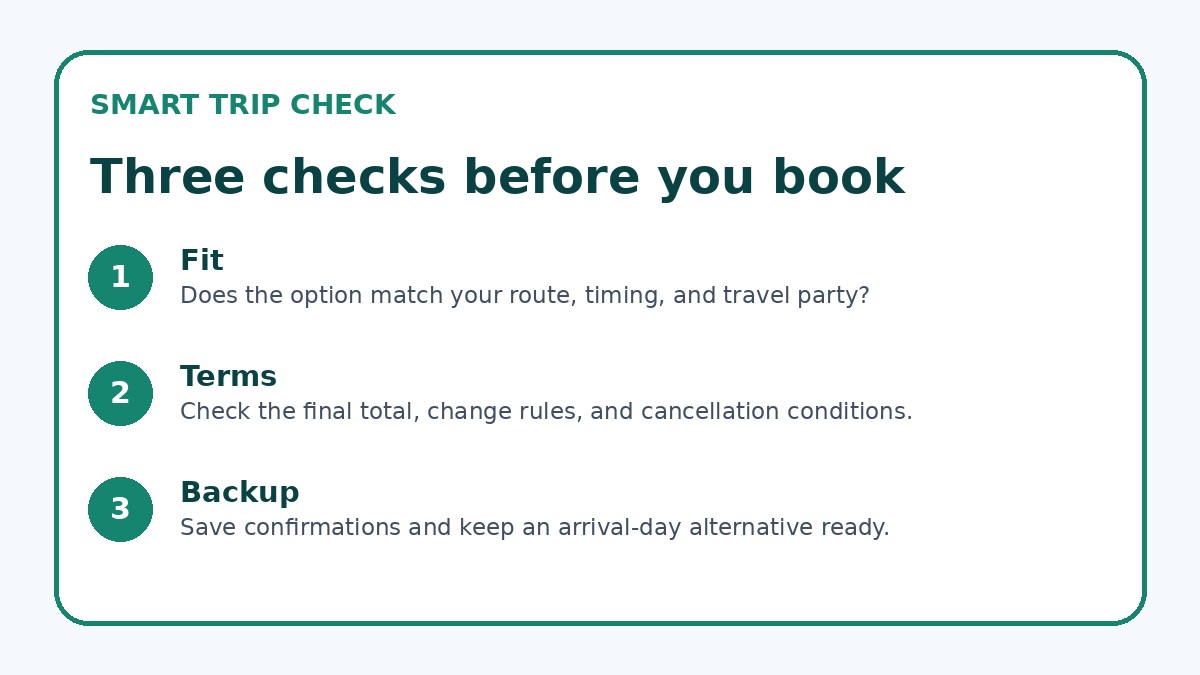
Before you book
- Measure and weigh your luggage to confirm it fits the carrier’s published allowances before booking.
- Book reserved train seats or bus tickets that note luggage rules, and save the provider’s baggage policy screenshot or page link.
- Locate elevators, escalators, and station exits on a map to plan the least-stairs route between platforms and station exits.
- Pack a compact daypack with essentials and valuables to avoid opening your main suitcase during transfers.
- Confirm pickup details, meeting points, and trunk capacity when arranging a private transfer and exchange mobile contact numbers.
- Ask your accommodation in advance about early luggage drop-off, stairs, elevators, and whether staff can help with heavy bags.
What to verify on booking pages and at the station
Before you complete any booking, confirm these provider-specific details: permitted luggage dimensions and weight, whether you need a seat reservation to bring oversized bags on trains, availability of wheelchair or elevator access at stations, and the exact meeting point for private transfers. Providers change rules and seat options; find the baggage policy section and read it thoroughly. For buses, check hold access rules—some services require you to tag and label hold luggage at the counter and retrieve it at a specified baggage area.
At the station, check the departure board for platform changes and allow extra time for ticketing or baggage checks. If you’re uncertain, ask staff at the counter about elevators, accessible routes, and luggage trolleys. Keep booking confirmations and any luggage claim tags in an external pocket. If using an online aggregator like Trip.com to compare options, use the operator’s final page to verify rules rather than relying solely on the aggregator’s summary.
Frequently asked questions
Can I bring large suitcases on trains between Seoul and Gyeongju?
Trains generally allow passengers to bring luggage, but space, rack sizes, and policies differ by train type and operator. Some high-speed and intercity trains have designated luggage areas or overhead racks, while larger suitcases may need to be stowed in less accessible zones. Before you book, check the operator’s baggage policy on their official booking page for permitted dimensions, whether you must reserve a specific seat for oversized items, and any requirements for labeling. If the policy is unclear, contact customer service to confirm how your specific bag will be managed.
Is it safer to use lockers or keep luggage with me in Gyeongju?
Lockers and left-luggage services let you sightsee unencumbered, but they have size limits and operating hours you must confirm in advance. Keeping your luggage with you reduces the risk of misplacement but increases the physical burden while you move between sites and accommodations. If your bag is large and your accommodation allows early drop-off, that is often the most convenient option. Always check the locker dimensions or the storage service’s rules and retain any claim tickets issued at drop-off.
How do I plan last-mile transfers from Gyeongju station to a distant guesthouse?
First, identify whether your accommodation offers pickup; if not, note nearby taxi stands and local bus routes. For heavy or multiple bags, a taxi or pre-booked private transfer is usually the simplest way to avoid stairs and multiple carries. If you prefer public transport, plan a route that minimizes transfers and look for stations with elevators. Confirm the exact drop-off point with your host and estimate walking distances with luggage. When booking a taxi or transfer, verify trunk space and agree on a meeting point to avoid waiting with your bags in busy areas.
Final planning note
For solo travelers going from Seoul to Gyeongju with luggage, the right choice depends on how much you want to carry, how comfortable you are with transfers, and whether you prioritize speed or convenience. High-speed trains are fast and smooth but require checking luggage policies; buses handle bulky suitcases better but can be slower; private transfers reduce handling at a higher cost. Prepare by measuring your bags, scouting station layouts, and confirming baggage rules on the operator’s booking page. Use the checklist to reduce surprises and choose the approach that matches your luggage size, mobility, and stress tolerance so your journey to Gyeongju starts calmly and stays that way.
Continue planning
Check current options and final conditions
Use the provider page to confirm live availability, the final total, cancellation terms, and every condition that matters to your trip.
This evergreen planning guide was created with AI-assisted drafting and a structured quality review. It does not display live prices, schedules, availability, visa guidance, or provider rankings. Verify current details before booking. Some links are affiliate links; we may earn a commission at no additional cost to you.