If you’re traveling from Seoul to Da Nang with more than a carry-on, your pre-booking work will shape both cost and stress levels. The practical answer: before you click Book, gather your exact travel dates, passenger names and passport details, total checked-bag weight and dimensions, and your acceptable tradeoffs for price versus schedule. With that information you can compare ticket fares that include checked baggage against lower base fares plus add-ons, weigh direct versus connecting itineraries for luggage transfer risk, and confirm connection minimums and recheck rules. This article gives a concise, prioritized checklist and a framework to choose the flight strategy that suits your luggage needs. Use it to prepare the facts you’ll need to verify on airline booking pages and third-party sites like Trip.com, and to avoid surprises at check-in or during a connection in another city.
See live routes for your exact travel day
Compare direct and connecting choices with the same baggage and traveler details.
Routing: direct versus connecting flights for extra luggage
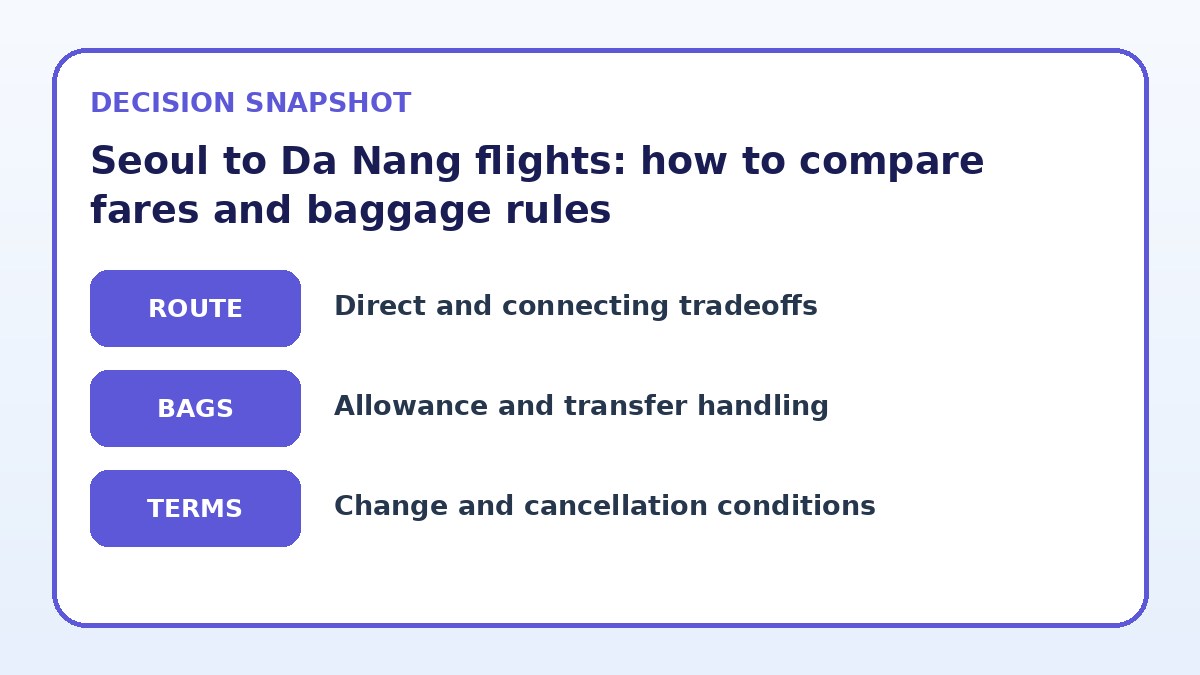
Direct flights reduce the number of times baggage must be loaded and unloaded, which lowers the chance of mishandling and missed transfers. For travelers with oversized or extra suitcases, a nonstop itinerary simplifies logistics: you only check baggage once at departure and collect it at the destination. If nonstop options exist for Seoul to Da Nang on your dates, list them first and compare their baggage allowances and schedule fit. If nonstops are unavailable or prohibitively expensive, study connecting routes carefully; the number of connections and length of each layover become critical when you have extra bags.
When evaluating connecting itineraries, pay attention to whether the transfer is on the same ticket or requires separate tickets. Same-ticket connections usually allow through-checked baggage and some protection if a connection is missed due to delay. With separate tickets you may need to collect and re-check luggage, pass immigration, and re-clear security—operations that demand extra time and can incur additional baggage fees. Prepare to verify transfer rules with the airline(s) during booking and consider buying a longer connection to reduce stress if you’re managing bulky or multiple checked items.
Baggage rules and connection risk: what to check on booking pages
Airlines use different fare families with varying included baggage allowances, weight limits, and per-piece rules. Before booking, note both the included allowance and the cost of additional pieces or overweight charges. Check whether the fare lists weight-per-piece or total weight allowances, and whether dimensions matter for oversize surcharges. On airline and OTA booking pages, expand fare details and the baggage policy link—do not rely on summary text alone. Also verify the policy for infants, sports gear or instruments, which often require advance purchase and different handling.
For connections, find explicit language about through-checking luggage and whether you must collect bags for immigration or transfer. If you will transit through a country with border control, the booking page should state whether transfer passengers re-clear customs; if it doesn’t, contact the airline. Confirm minimum connection times published for the airport, but be conservative—add cushion for collecting and re-checking larger bags. When in doubt, ask the airline to confirm in writing or screenshot the baggage handling statement on the booking page so you have it at check-in.
Compare flight-selection strategies
| Flight strategy | Best for | Risk to check |
|---|---|---|
| Book a higher-fare ticket that includes baggage | Travelers who want one-price simplicity and lower risk at check-in | Paying more upfront for included pieces rather than shopping for cheaper base fares |
| Buy a low base fare and add baggage a la carte | Price-sensitive travelers who can predict exact baggage needs | Savings may vanish if baggage costs or change fees are higher than expected |
| Choose a connecting itinerary to save money | Those willing to manage longer connections and possible re-checks | Increased risk of missed connections and extra handling of luggage |
| Purchase same-day flexible or refundable fare | Travelers who value change flexibility due to uncertain plans | Higher ticket cost in exchange for easy changes and refund options |
Recheck the complete itinerary
Confirm airports, connection handling, baggage, and change conditions before deciding.
Schedule fit and practical timing with extra baggage
Extra luggage adds time to every step: check-in, security screening, potential baggage drop inspections, and baggage reclaim. When choosing flight times, allow extra time at your departure airport in Seoul for overweight or special-item processing—early morning or late-night counters may be understaffed. If you must take a connecting flight, choose longer layovers that still fit your tolerance; a longer, single layover is often preferable to multiple short transfers when handling bulky bags. Also consider airport logistics: departing from a congested terminal can lengthen queue times for both check-in and security.
If your schedule is tight, prioritize flights with generous connection windows and predictable operations rather than marginally cheaper options with tight turns. Take into account transport time to and from airports on both ends—if you’re traveling to or from Da Nang city center with heavy suitcases, an earlier arrival or later departure could be much easier. Build flexibility into your travel plan: choose fares that allow changes for a reasonable fee so you can swap to a less stressful itinerary if baggage issues arise or flights shift.
Flight details to verify
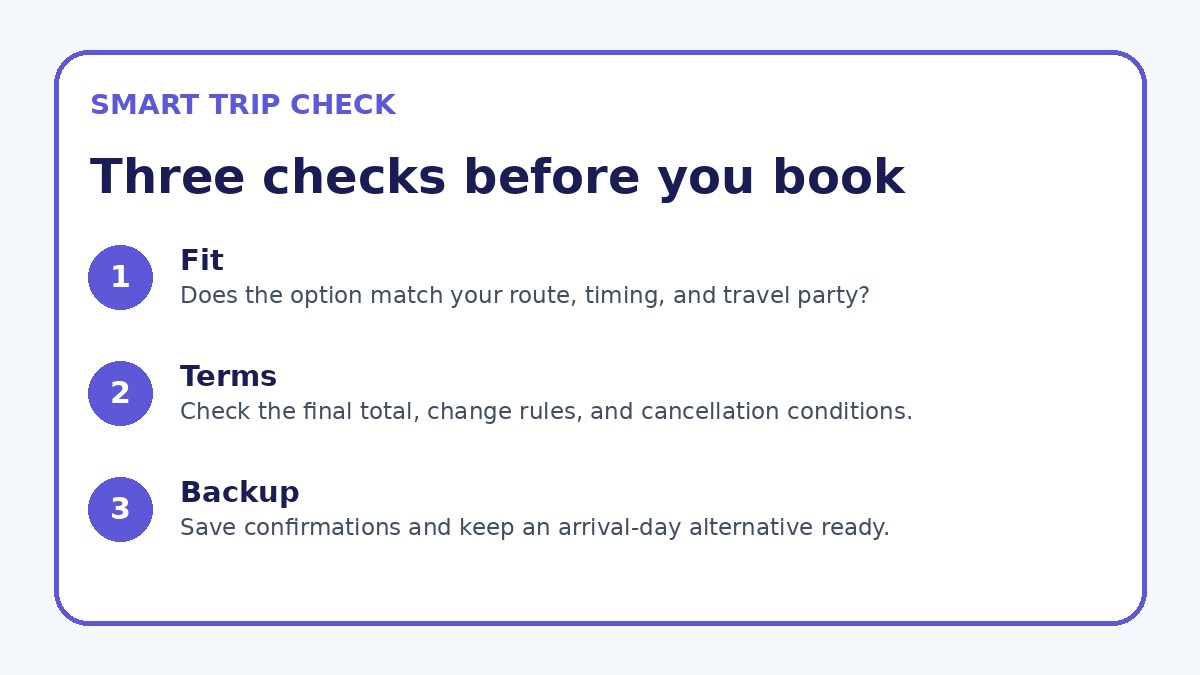
- Confirm exact travel dates, full traveler names as on passports, passport numbers and nationalities before checking fares.
- Measure and weigh every bag including soft duffels—record dimensions and total weight to compare to airline limits.
- Open fare details on each booking page and screenshot the baggage allowance, overweight charges and change/cancellation rules.
- Decide whether you require a same-ticket connection; if not, add cushion time for bag collection and re-checking at transfers.
- Calculate total cost per itinerary: base fare plus all baggage fees, seat fees, change fees and likely ground transport with heavy bags.
- If booking through an OTA, confirm on the airline’s final booking page that baggage allowances and fare conditions match before payment.
Fare conditions and protections to verify before paying
Fare rules determine your ability to change dates, get refunds, and add baggage after purchase. Before booking, read the change and cancellation policy for the specific fare class shown on the booking page—not just the airline’s generic policy. Key items to verify: whether a change fee applies, whether taxes or fare differences still apply, and if the fare is refundable or strictly nonrefundable. If you expect baggage needs to change, confirm the cost and process to add or upgrade baggage allowance after purchase.
Also check what the airline promises for irregular operations—rebook protection, compensation or hotel accommodation if a missed connection caused by the carrier forces an overnight stay. If you book separate tickets for connecting legs, verify whether any protection exists at all. Keep a screenshot or PDF of the fare conditions and baggage policy as displayed at purchase; this is the reference you’ll need if an agent later disputes what was promised. Finally, consider trip insurance for baggage delay or loss specifically tailored to cover checked items rather than relying on basic travel insurance alone.
Flight Guide questions travelers ask
Should I always choose a direct flight from Seoul to Da Nang if I have extra luggage?
Direct flights generally reduce baggage handling and the chance of missed transfers, which is helpful when you have many or bulky bags. However, direct service can be more expensive or misaligned with your schedule. Compare the fare difference against the value of reduced transfer risk and time savings. If a connecting itinerary saves a lot, check whether the connection is same-ticket and whether the airline will through-check bags; if it will, the risk is lower. Ultimately, balance cost, luggage complexity and how comfortable you are with tight connections.
What specific baggage details should I verify on the airline booking page?
Look for the exact number of included checked pieces, weight limits per piece or per passenger, dimensions allowed and fees for overweight or oversize items. Also check rules for special items like sports equipment and musical instruments. Verify whether the fare states baggage is included or if it must be purchased separately, and confirm whether any promotional or mileage benefits alter the allowance. If the booking page language is unclear, contact the airline and save the response or a screenshot of the policy shown at the time of purchase.
If I book two separate tickets for my Seoul–Da Nang trip, how does that affect my luggage?
With separate tickets you are usually treated as a new passenger for the second flight, so your checked bags often will not be through-checked to the final destination. That means you may need to collect luggage, pass immigration, and re-check it for the onward flight—adding time and potential extra fees. Separate tickets also reduce protection if a delay on the first leg causes you to miss the second; the second carrier typically has no obligation to rebook you. If choosing separate tickets, build in long transfer time and verify baggage handling requirements for each airline.
Final decision note
Booking Seoul to Da Nang flights with extra luggage is mostly about preparation: know your exact bag sizes and weights, gather traveler details before price-checking, and read fare and baggage rules on the airline’s booking page. Decide whether you value a simple all-in fare, a cheaper base fare with added baggage fees, or the schedule reliability of direct options. For connections, prioritize same-ticket routing and generous layovers to minimize re-checking and missed-transfer risk. Keep screenshots of fare conditions and baggage policies at the time of purchase, and consider flexible fares or specific baggage insurance if your plans or baggage are uncertain. These steps will reduce surprises and help you choose the option that matches your budget and tolerance for logistical hassle.
Continue planning
Check current options and final conditions
Use the provider page to confirm live availability, the final total, cancellation terms, and every condition that matters to your trip.
This evergreen planning guide was created with AI-assisted drafting and a structured quality review. It does not display live prices, schedules, availability, visa guidance, or provider rankings. Verify current details before booking. Some links are affiliate links; we may earn a commission at no additional cost to you.