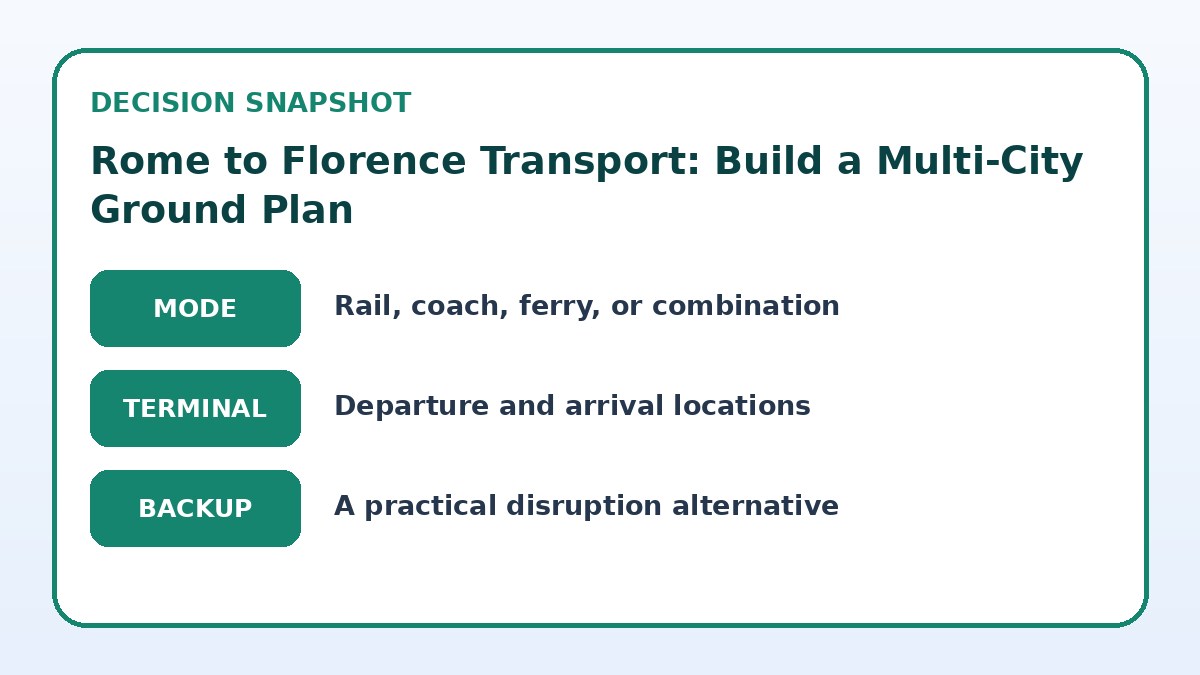
Practical answer first: for most first-time visitors, prioritize an intercity train as the core of a Rome to Florence ground plan, then layer in local transfers and a short backup option. Trains normally place you in central stations, reduce city-to-airport transfers, and minimize driving in Italy’s historic cores; coaches are cheaper but add terminal friction; driving gives flexibility for countryside stops yet increases parking and navigation hassles. Build your multi-city plan by mapping door-to-door time and transfer complexity rather than focusing only on on-rail or on-road travel time. Identify where you’ll start in Rome, which station or garage you’ll arrive at in Florence, how you’ll move luggage between nodes, and a simple disruption backup — for example an earlier or later train, a scheduled coach alternative, or a planned taxi corridor. Keep verification steps: check the operator’s final booking page for exact boarding terminal, luggage policies, seat reservations, and ticket-change rules.
Choosing between rail, coach, and driving
Begin by listing what you value most: minimal transfers, lowest walking with luggage, on-the-road flexibility, or saving a bit of money. Trains often win on transfer simplicity because major stations are centrally located and connect to public transit, while coaches may operate from peripheral terminals requiring extra taxi or metro rides. Driving gives freedom to visit smaller towns en route, but adds parking searches and navigation through restricted traffic zones. Think of the trip as a chain: your hotel door, the transfer to the terminal, the main leg, and the arrival transfer—each link can dominate the real travel time.
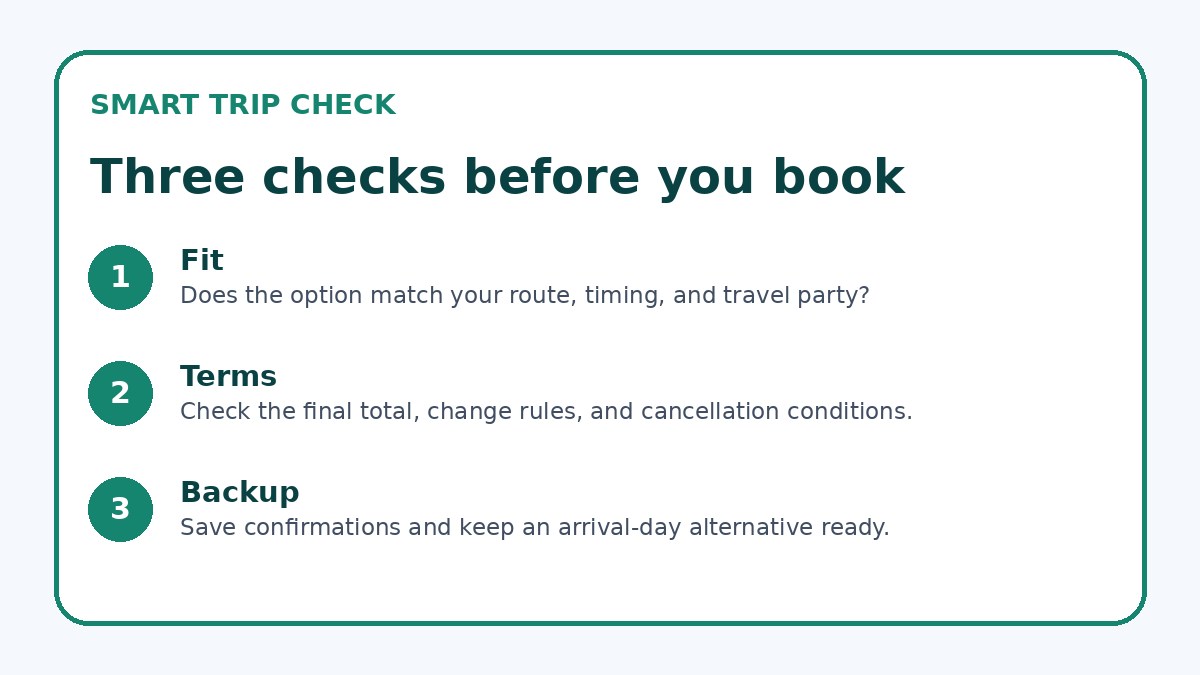
Compare the practical on-paper tradeoffs rather than theoretical speeds. If you have heavy luggage, are traveling during rush hours, or arrive late at night, a single train that puts you near your Florence accommodation can beat a slightly faster but more fragmented option. Conversely, if you plan multiple stops in Tuscany, a car may be sensible for door-to-door convenience despite urban parking friction. For every option, note the terminal addresses, nearest tram or taxi rank, and whether seat reservation is required; verify those details on the provider’s final booking page before purchasing tickets.
Choose the end-to-end journey plan
| Journey approach | Best for | Friction to check |
|---|---|---|
| Focus on direct intercity train as your backbone | Travelers who want minimal transfers and central arrival points | Less flexibility for countryside stops and dependence on train schedules |
| Choose coach-first planning with local transfers | Budget-minded travelers willing to trade transfer ease for lower fares | Peripheral terminals often mean extra taxi or metro time with luggage |
| Build a driving-based multi-stop route | Visitors planning multiple rural stops or independent timing | Parking, ZTL zones, and urban navigation can add significant door-to-door time |
| Hybrid plan: train for main leg, car or coach for side trips | Those who need central arrival plus flexible day trips in Tuscany | Requires careful coordination of car hire or coach schedules and pickup/drop locations |
Check live intercity options
Look beyond the ride itself and compare terminals, transfers, luggage, and arrival fit.
Terminal fit and luggage/transfer friction
Terminal fit is a practical, often overlooked decision criterion. Rome’s city has several major rail and coach hubs—each has different entrance points, taxi ranks, and luggage elevator availability—while Florence’s main station is compact and closer to central hotels. If your Rome stay is nearer to a smaller station or an airport, include the extra transfer time and any mode changes in your plan. For coaches that use out-of-center terminals, ask how you’ll get from that terminal to a taxi stand or metro and whether luggage porters are available at the arrival point.
Luggage matters. Count bags, note carry-on versus checked-size, and decide whether you can manage stairs or long corridors. If you must change platforms or transfer between coach and train, add a buffer for moving luggage and buying new tickets if required. Where possible, choose a single-seat, reserved option on trains to avoid platform-ticket stress; when checking providers’ pages, confirm baggage allowances and whether you need to print or show mobile tickets to staff at boarding points.
Timing flexibility and building a realistic schedule
Build a two-tiered schedule: your preferred departure and one or two backups, spaced at least an hour apart to allow for delays or longer-than-expected transfers. Consider the time of day for arriving in Florence—late arrivals can mean limited public transit and higher taxi fares, so plan either an earlier arrival or confirm late-night transfer options. Also account for check-in windows at hotels; arriving very early may require a luggage drop plan. When comparing alternatives, compute total door-to-door windows rather than only comparing advertised journey durations.
Be realistic about tolerances. If you have a tight museum booking or onward connection, choose an option with comfortable time buffers and simpler transfers. Coaches and some slower trains may be cheaper but less frequent; if you miss one, the next available service could create a long wait. When you narrow candidates, inspect the final booking pages for change and cancellation terms; these rules determine how flexible your plan will be if you need to shift to a backup.
Compare the practical alternatives
Use the final page to confirm what is actually offered on your dates and save a workable fallback.
Intercity travel checklist
- Map door-to-door times for your chosen option, including hotel exit, terminal transit, main leg, and arrival transfer to your Florence accommodation.
- Verify departure and arrival terminal addresses on the operator’s final booking page and note the nearest taxi rank or public-transport stop.
- Confirm baggage allowances and whether seat reservations or printed/mobile tickets are required before completing the purchase.
- Identify two realistic backup services (earlier/later train or coach) and note how to reach their terminals from your hotel.
- If driving, pre-book parking or a drop-off point in Florence and check for restricted traffic zones to avoid fines.
- Save contact details for your chosen operator and a local taxi or transfer service so you can rebook quickly if needed.
Disruption backups and verifying details before you buy
A useful backup is a named, practical alternative you can access quickly: an earlier or later train you can realistically reach, a reputable coach route with a nearby terminal, or a taxi corridor with an estimated fare range checked on the provider’s page. Don’t rely on vague promises—know the next three services and how to reach their terminals from your hotel. If you rent a car, plan a parking spot at your Florence arrival or a drop-off point plus a short taxi ride to your hotel so unexpected closures don’t strand you.
Before booking, verify these items on the provider’s final booking page: exact departure and arrival terminals, baggage limits and fees, seat reservation requirements, ticket change or refund rules, and whether mobile boarding is accepted. If you want to compare live availability or see aggregated options quickly, Trip.com can be used to view current choices, but always confirm the terminal and luggage specifics directly with the operator before finalizing.
Rail & Intercity Transport questions travelers ask
Should I book a train or coach ticket in advance for Rome to Florence transport?
Booking in advance gives you the most options for seat choice and better control over schedule fits, especially during busy travel periods. However, the need to prebook depends on your flexibility and risk tolerance: if you prefer schedule certainty and minimal platform stress with luggage, reserve train seats early. If your plans are fluid and you’ll accept occasional waits, you can often buy coach or some regional train tickets closer to departure. Always check the provider’s final booking page for reservation rules and whether tickets are refundable or changeable.
How much time should I allow for transfers and luggage when planning my itinerary?
Allow more time than online journey durations imply: add at least 30–60 minutes for urban transfers, luggage handling, and finding the correct platform or coach bay. If you’re moving between Rome airports and city terminals, or if you must transfer from a peripheral coach station to a central train station, increase the buffer. For early-morning or late-night travel, add extra margin because public-transport frequency may drop. Plan deliberately so you won’t miss reserved seats or scheduled hotel check-in windows.
If I rent a car, what practical checks should I do before leaving Rome?
Confirm the rental company’s pickup location and hours, the exact insurance and mileage terms on the rental agreement, and whether the car is allowed into Florence’s limited traffic zones; verify how tolls and parking are handled. Plan your first and final day routes with realistic urban driving time, and book parking or a hotel drop-off in Florence in advance. Also check fuel policy and any one-way drop fees on the rental page before you finalize the booking so there are no surprises at pickup or drop-off.
Final decision note
Building a practical Rome to Florence transport plan means treating the trip as a door-to-door chain: hotel exit, transfer to terminal, the main leg, and arrival logistics. For most first-time visitors, an intercity train centered plan reduces transfers and places you close to Florence’s historic core, but coaches and driving each have legitimate uses depending on priorities like budget or rural flexibility. Focus your comparisons on terminal fit, luggage handling, timing buffers, and a concrete disruption backup you can enact quickly. Verify terminal addresses, baggage rules, and seat reservation requirements on the operator’s final booking page before you buy. Keep two plausible backups and a short list of contacts so you can adapt without losing your day.
Continue planning
Check current options and final conditions
Use the provider page to confirm live availability, the final total, cancellation terms, and every condition that matters to your trip.
This evergreen planning guide was created with AI-assisted drafting and a structured quality review. It does not display live prices, schedules, availability, visa guidance, or provider rankings. Verify current details before booking. Some links are affiliate links; we may earn a commission at no additional cost to you.