Practical answer first: for most families travelling between Seoul and Busan, prioritize convenience when you need steady timing and simpler transfers, and prioritize schedule flexibility when you want more options for delays, sightseeing, or evening plans. If your group includes small children, a senior, or heavy luggage, lean toward options that minimize connections and reduce ground handoffs. If your trip has loose timing or you’re maximizing cost and routing choices, allow extra transfer time and consider connections that give more departure windows. This guide helps you weigh those tradeoffs — flight vs train swaps, direct versus connecting flights where offered, airport-to-city transfer ease, and how to verify provider details before you book. Where provider details matter, check the airline’s final booking page and the airport or train operator site for boarding time rules, baggage policies, and transfer procedures. Trip.com can be a useful place to compare current availability, but always confirm specifics on the carrier’s site before finalizing a family itinerary.
Deciding between convenience and flexibility
Convenience means fewer touchpoints: a short drive to the airport, a direct flight or a single transfer with easy connections, and a simple arrival transfer to your Busan accommodation. Families who prefer convenience often trade off a smaller selection of departure times and possibly higher fares for the practical benefits: less time managing luggage, easier nap and meal schedules, and fewer opportunities for missed connections. If you or your children have health considerations or you’re travelling with a lot of gear, convenience reduces the chance of stressful interruptions that can derail the day.
Flexibility widens your scheduling choices and can expose lower fares or preferable routing. It is useful when your itinerary has buffer days, when you want late arrivals to explore evenings in Busan, or when you plan to combine the flight with a rail segment or regional stopover. Flexible options typically require extra planning: longer total travel time allowances, contingency plans for missed connections, and clarity on rebooking rules. For families that can absorb unpredictability or that prioritize cost or itinerary variety, flexibility can be the smarter overall decision.
How to compare total travel time and hassle
Start by mapping the full door-to-door timeline. For each flight option, estimate time to depart from your lodging in Seoul to reach the departure airport, the recommended check-in or boarding time for your fare class, the flight or connection duration, and the ground transfer time on arrival in Busan. Don’t forget to add buffer time for security lines and for collecting any checked baggage. Families should err on the side of larger buffers: children’s routines and restroom breaks take time, and unexpected delays are common.
Compare similar estimates for multi-modal routes: sometimes a shorter airborne time still results in longer door-to-door travel if the airport is far from central Busan or if connections are tight. Also consider how many times you’ll need to handle luggage and whether transfers are easy to navigate with a stroller or a toddler in tow. If the final booking page lists minimum connection times, baggage transfer guarantees, or assistance services, verify those details directly with the provider before committing.
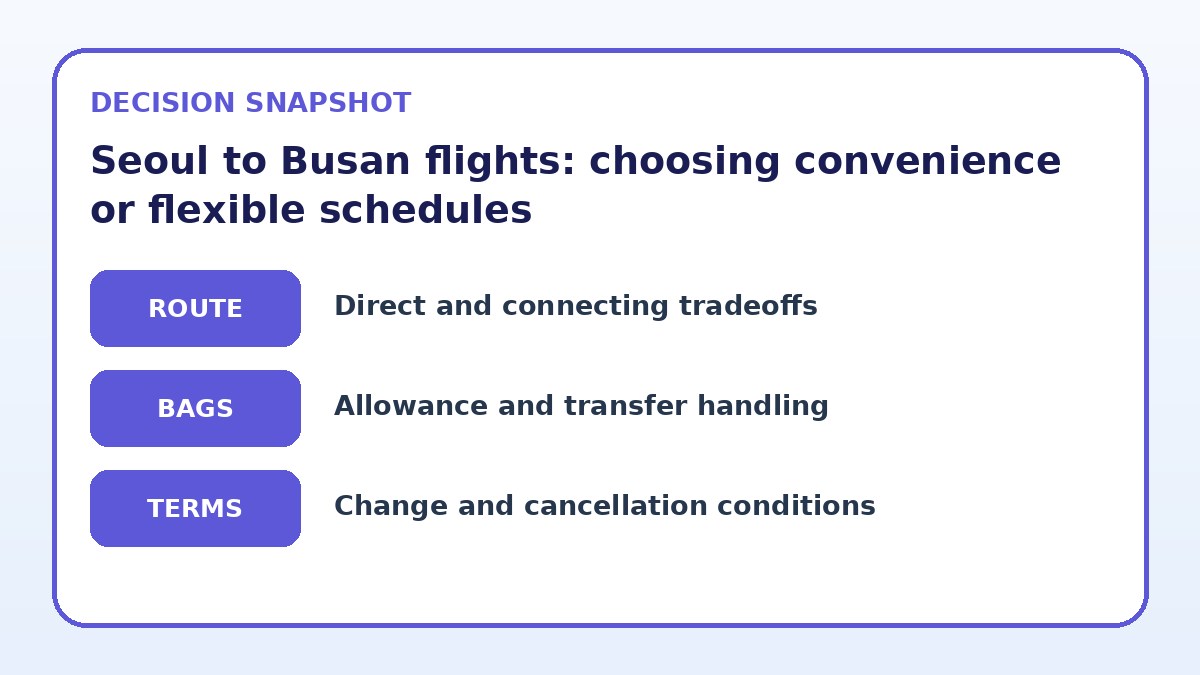
| Approach | Best for | Tradeoff to check |
|---|---|---|
| Prioritize convenience (direct routing, minimal transfers) | Families with young children, seniors, or heavy luggage | Fewer departure windows and possibly higher fares; less flexibility for last-minute scheduling changes |
| Prioritize schedule flexibility (more departure times, connections) | Families with open schedules or those seeking lower-cost routing options | Longer total travel time and extra risk of missed connections or more complex transfers |
| Balance by choosing early departures with short connection buffers | Families wanting lower risk without paying for the most convenient options | Requires careful timing and may still be sensitive to delays; verify minimum connection times |
| Mix modes (flight plus regional train or bus) | Families who want city-center arrivals or sightseeing en route | More planning and luggage handling; must compare door-to-door time rather than just flight duration |
Comfort, seats and onboard needs for families
When flying with children, seat selection and cabin experience matter. Decide whether you need adjacent seats, bassinet options for infants, or extra legroom to manage a squirming child. Some fares and booking channels allow pre-assigned seats while others may charge for preferred seats—check the airline’s final booking page for seat maps, infant policies, and whether bulkhead or family seating can be reserved in advance. Bring familiar comfort items in carry-on bags, and plan for in-flight snacks and entertainment to reduce stress on longer legs or during delays.
Also evaluate the practicalities of carrying gear: stroller check policies, car-seat acceptance, and whether a checked bag will be transferred automatically on connecting itineraries. For connecting flights, confirm whether you’ll need to re-clear security or re-check baggage during transfer; those steps add significant time and complexity for families. If a provider advertises family assistance or fast-track security options, confirm availability and any extra fees on the provider’s booking page.
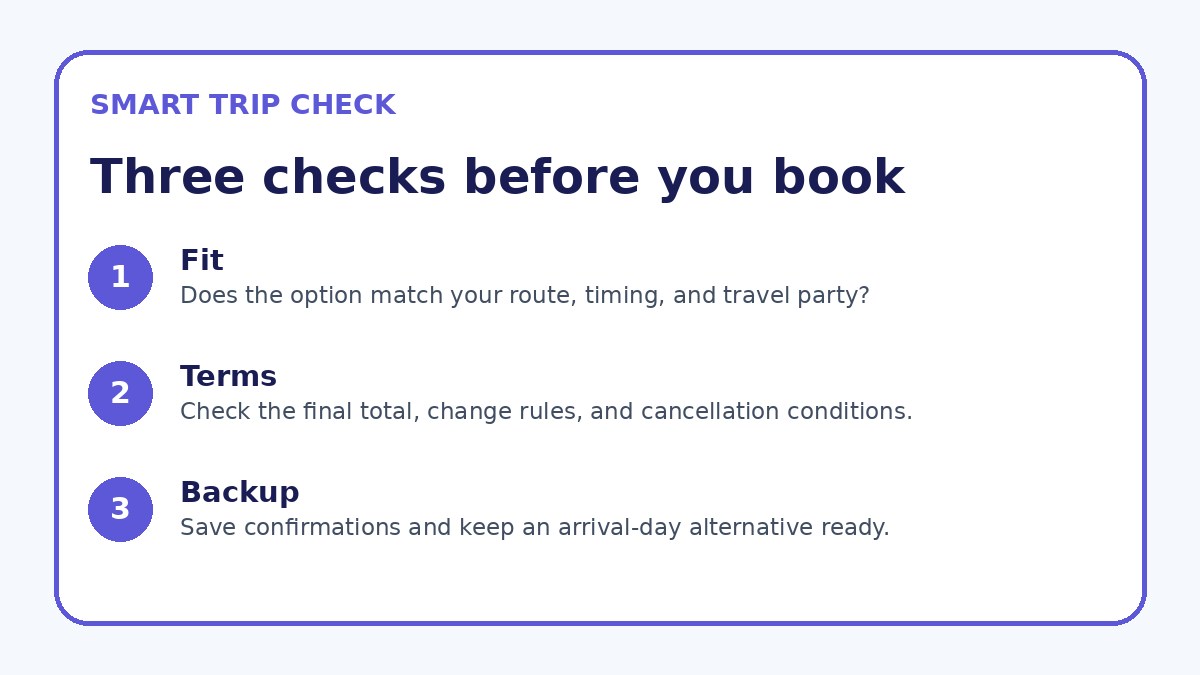
Before you book
- Note your absolute latest acceptable arrival time in Busan and filter options that meet it.
- Confirm seat assignment rules and reserve adjacent seats for your family before final payment.
- Check the airline’s baggage allowance, stroller and car-seat policies on the carrier’s booking page.
- Add at least 60–90 minutes buffer per connection when travelling with children, then adjust higher if using different terminals.
- Compare total door-to-door time for each option, including travel to and from airports or stations and local transfer time in Busan.
- Save booking confirmation and note change/cancellation terms so you can rebook quickly if plans shift.
Booking strategy and what to verify before purchase
Before booking, list your non-negotiables: maximum acceptable total travel time, number of transfers, and whether arrival time in Busan must be before a certain hour. Use those criteria to filter options rather than chasing the cheapest fare alone. If comparing a direct versus connecting flight, calculate the full disruption cost—including taxi or transit fares replaced by longer transfers—and consider whether an earlier or later departure reduces the risk for missed connections.
When you’re ready to buy, verify several provider specifics: exact baggage allowance and charges, seat assignment rules, how changes and cancellations are handled for family bookings, and whether any airport or airline assistance is available for children or mobility needs. If you find options on aggregator sites such as Trip.com, use them for initial comparison but confirm final fare conditions on the airline or operator’s official booking page. Keep screenshots or a note of confirmation codes, and review the carrier’s boarding cut-off and check-in requirements to avoid surprises on travel day.
Frequently asked questions
Are direct flights always better for families traveling Seoul to Busan?
Direct flights reduce the number of times you handle luggage and the risk of missing a connection—advantages that matter for families with young children or seniors. However direct options can have fewer departure times and sometimes require longer ground transfers to reach a central point in Busan depending on which airport you use. Weigh the convenience of fewer touchpoints against how the door-to-door travel time fits your family’s schedule. Always verify transfer options from the arrival airport to your specific Busan neighborhood on the carrier or airport website before booking.
How much connection time should a family plan for between flights?
Plan more buffer than solo travelers: a practical rule is to add at least 60–90 minutes extra per connection for families, especially when using different terminals or if you must re-check baggage. This accounts for restroom breaks, diaper changes, feeding, and moving strollers. If the connection requires immigration or airport transfers, add further time. Check the airline’s minimum connection times and any guidance on family transfers on the carrier’s booking page; those specifics determine whether a proposed connection is realistic for your group.
What should I verify on the airline’s booking page before finalizing a family booking?
Confirm seat selection options and fees, baggage allowances and any charges for checked items, policies for infants and child seating, and rules for rebooking or refunds. Also check boarding cut-off times and whether family assistance or priority boarding is offered. If your itinerary includes a connection, verify whether baggage is through-checked to your final destination or must be re-collected. These provider-specific details change frequently, so always reconfirm them directly on the airline’s or operator’s final booking page before payment.
Final planning note
Balancing schedule flexibility and convenience for Seoul to Busan flights comes down to three family-specific questions: how rigid is your timetable, how much handling can your group tolerate, and how much extra buffer time do you want between connections? Families who need straightforward logistics and minimal transfers should favor convenience, while those with flexible plans can benefit from the wider choice and potential savings that come with flexible routing. Whatever you choose, calculate door-to-door time, confirm seat and baggage rules on the carrier’s booking page, and keep contingency plans for delays. A clear checklist and realistic buffers turn an otherwise stressful travel day into a manageable family journey.
Continue planning
Check current options and final conditions
Use the provider page to confirm live availability, the final total, cancellation terms, and every condition that matters to your trip.
This evergreen planning guide was created with AI-assisted drafting and a structured quality review. It does not display live prices, schedules, availability, visa guidance, or provider rankings. Verify current details before booking. Some links are affiliate links; we may earn a commission at no additional cost to you.