
If your family needs to travel from Paris to Rome with a long connection—whether because there’s no direct option for your dates, you prefer a break between flights, or you’re combining trips—plan the connection to reduce stress and preserve energy. Start by deciding whether a single long layover or two shorter segments works best for your children’s ages, sleep schedules, and tolerance for airport time. Prioritize departure and arrival times that match low-energy windows (early afternoon or early evening for many families), and favor airports with straightforward transfer procedures and child-friendly facilities. Finally, build margin into your itinerary: allow realistic minimum connection times, verify transfer terminals in advance, and prepare carry-on entertainment and comfort supplies. The rest of this guide explains tradeoffs, how to compare options, and the practical checks to complete before you book.
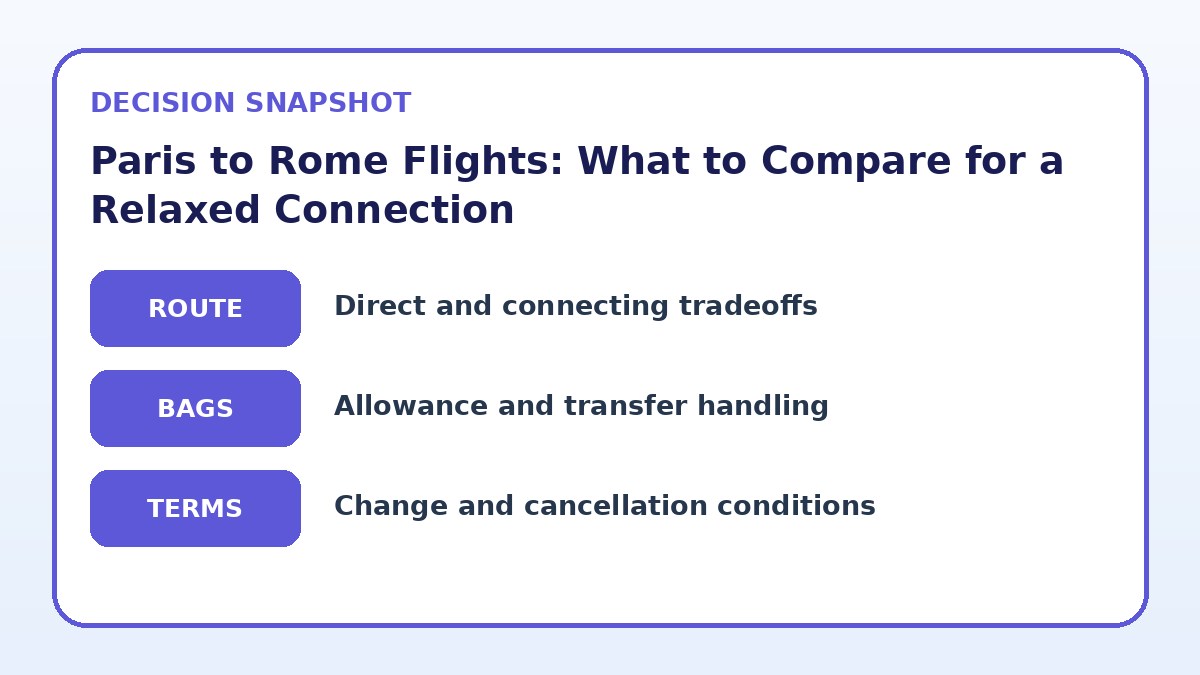
See current options before you compare the details
Availability and final conditions change. Open Trip.com now or keep reading for the practical comparison.
Deciding between direct, one-stop, or two-leg itineraries
Most families first ask whether to pick a direct flight or accept a connection. If a nonstop Paris to Rome flight exists for your dates, it usually saves time and reduces handling: fewer takeoffs and landings, less chance of missed connections, and simpler luggage procedures. However, nonstops may depart at inconvenient times or be fully booked on family-friendly seats. If you choose a one-stop option, look for connections that limit overall door-to-door time and avoid overnight transfers that force children to stay awake in terminals.
Two-leg itineraries can be useful when you want a daytime break in another city or must combine schedules to match a tight plan, but they bring tradeoffs. Additional segments increase the chance of delays, add extra security or passport checks, and multiply the number of times you must manage children, carry-ons, and gate changes. Evaluate how each additional transfer affects sleep, meals, and diapering or restroom breaks for younger children. Consider whether a longer but single layover with a comfortable lounge or transit hotel is less disruptive than multiple short hops.
Timing, sleep, and managing jet-lag-like fatigue
Even short European flights can feel long to families when connections involve waiting. Schedule flights to align with the family’s natural sleep and nap cycles when possible: mid-afternoon departures suit toddlers who nap then, while older children may cope with early evening flights that let them sleep on board. When a connection requires a long wait, choose an airport with play areas, family restrooms, and quiet spaces so children can move, burn energy, and relax instead of being confined to seats for hours.
Avoid very early or very late connections unless absolutely necessary—these typically complicate ground transport and check-in. If an overnight layover is unavoidable, consider booking a nearby family-friendly hotel inside or adjacent to the airport to shorten transfer time and preserve a proper sleep environment. Bring lightweight familiar sleep aids like a favourite blanket, travel pillow, or white-noise app to help kids fall asleep quickly in a seat or hotel room.
| Approach | Best for | Tradeoff to check |
|---|---|---|
| Direct (nonstop) flight | Families prioritizing speed and minimal handling | May offer limited departure times and fewer seat options for larger groups |
| Single long layover | Families who want a predictable rest period between flights | Requires time in an airport; choice of terminal facilities greatly affects comfort |
| Two shorter connections | Travelers splitting travel into smaller chunks or visiting another city en route | Increases chance of delays, multiple security checks, and more physical transfers |
| Overnight stop with nearby hotel | Families needing proper sleep and a reset before the next flight | Adds ground transport time and the extra cost of a night’s accommodation |
Ready to check the option that fits your plan?
Use your exact dates and traveler details so the provider page can show the current total and conditions.
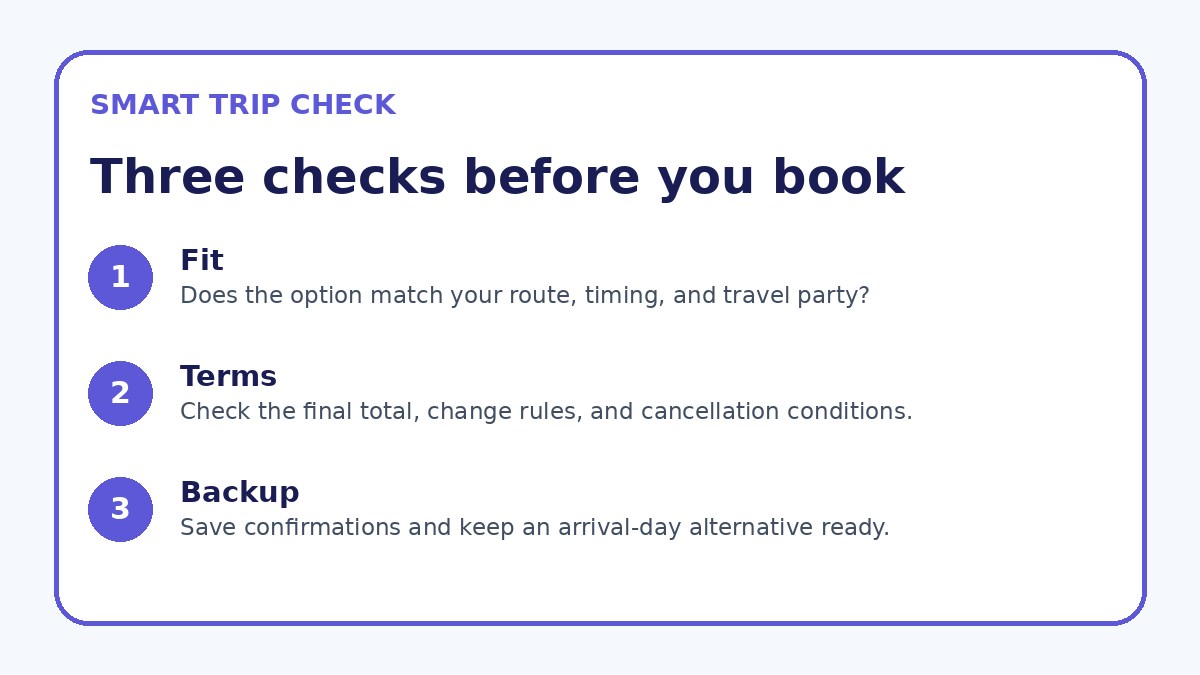
Transfer logistics: terminals, passport control, and handling luggage
Before booking, map the transfer process at the connecting airport: determine whether you remain in the same terminal, need a shuttle, or must clear passport control and recheck bags. Transfer complexity affects minimum connection time and the physical challenge for parents managing children and luggage. Where possible, pick itineraries that keep connections within the same terminal or use airlines that offer through-checked baggage and single boarding passes so you won’t need to collect and re-drop suitcases between flights.
When you're forced to change terminals, check whether the airport provides elevators, moving walkways, and step-free routes suitable for strollers. For transfers involving passport control, factor in lines—peak times can add significant delays. If you’re traveling with pushchairs or car seats, verify whether gate-checking is available and whether you’ll need to collapse and carry these items through busy corridors. Always confirm these provider-specific details on the airline’s or airport’s final booking pages.
Before you book
- Confirm whether bags will be through-checked and whether you need to collect and recheck luggage during the transfer.
- Verify transfer terminal details and minimum connection times on the airline and airport pages before you finalize the booking.
- Reserve seats together as early as possible and request bulkhead or aisle seats if your children need extra movement space.
- Pack a clearly labeled family carry-on with snacks, spare clothes, medicines, chargers, and quick-cleaning supplies.
- Identify restroom and family room locations at the connecting airport using the airport map or mobile app.
- If an overnight stop is planned, prebook a hotel near the terminal and check shuttle schedules and child-friendly amenities.
Comfort and entertainment: packing and in-air strategies
Pack a dedicated family carry-on that prioritizes comfort and quick access: snacks that travel well, refillable water bottles, a basic first-aid kit, wipes and spare clothes, chargers and power banks, and a selection of quiet toys and books. Use layered clothing so everyone can adapt to changing temperatures on the ground and on the plane. For young children, a lightweight inflatable travel booster or a familiar small pillow can make seat time less fussy; ensure any special equipment meets airline guidelines and check gate staff policies.
For entertainment, rotate activities to prevent boredom: a mix of screen time, new small toys, activity books, and simple games works better than one long device session. Download shows, audiobooks, and apps for offline use, and bring child-sized headphones. During layovers, prioritize physical activity—let kids run in designated play areas or walk terminal loops—to help them nap on the next flight. Keep expectations realistic: frequent breaks, patience, and small treats will go much further than rigid timelines.
Frequently asked questions
How much layover time should I plan with young children?
Plan more cushion than you think you need—young children slow down throughput. For same-terminal international connections, allow at least 90–120 minutes to account for deplaning, restroom and diaper changes, snacks, and walking to the next gate. If you must change terminals, clear passport control, or recheck luggage, increase that buffer to 2.5–4 hours depending on the airport layout and peak-hour congestion. Always check the airline’s recommended minimum connection time and build additional margin for peace of mind.
Is it worth buying lounge access for family layovers?
A lounge can be a good value for long layovers because it provides quieter seating, food, restrooms, and sometimes a family room—useful when kids need a calm place to recharge. Consider the cost relative to the length of the layover and your children’s needs: for a three-plus hour wait, lounges often pay for themselves in comfort and reduced stress. If you choose a lounge, check on the provider’s child policy and any age limits, and confirm access rules on the booking page before purchasing.
What practical gear should I bring for transfers and short connections?
Bring a lightweight, compact stroller that gate-checks easily, a soft-sided bag for quick access to essentials, and child-worn items like a small backpack with a favorite toy. Include a refillable water bottle, sealed snacks, wet wipes, spare underwear and a change of clothes for at least one child, and portable chargers. If you have car seats or boosters, confirm airline policies for gate-checking or cabin stowage and consider a protective bag for checked transit. Verify any size or carry rules on airline pages before travel.
Final planning note
Planning a comfortable Paris to Rome connection for families means balancing speed, convenience, and the practical needs of children. Decide early whether you prefer the simplicity of a direct flight, the predictability of a single long layover, or the flexibility of breaking the trip into segments. Prioritize transfer logistics—same-terminal routes, through-checked baggage, and reasonable connection times—and prepare a family carry-on packed for comfort and entertainment. Check the airline and airport pages for provider-specific transfer procedures, seat-assignment rules, and lounge access before you book. With a little advance mapping and realistic timing, you’ll turn a long connection into manageable travel for the whole family.
Continue planning
Check current options and final conditions
Use the provider page to confirm live availability, the final total, cancellation terms, and every condition that matters to your trip.
This evergreen planning guide was created with AI-assisted drafting and a structured quality review. It does not display live prices, schedules, availability, visa guidance, or provider rankings. Verify current details before booking. Some links are affiliate links; we may earn a commission at no additional cost to you.