Short answer: for most solo travelers staying in central Osaka and visiting city sights, public transport is usually the simpler, safer choice; consider renting a car only if your itinerary prioritizes rural day trips, late-night flexibility, or carrying bulky gear. Your decision depends on where you plan to sleep, how far you’ll stray from the city center, and how comfortable you are with toll roads, narrow streets, and parking rules. Read on for the tradeoffs—costs, convenience, and stress levels—plus a comparison table and a practical checklist to use when you compare Osaka car rental options with train, subway, and bus networks. If you want to check live availability and booking terms, compare providers on Trip.com or directly on rental company and transit operator pages and verify final fees, fuel policies, and insurance details there.
See current options before you compare the details
Availability and final conditions change. Open Trip.com now or keep reading for the practical comparison.
When public transport is the smarter pick
If your solo trip centers on central neighborhoods such as Namba, Umeda, or Tennoji, public transport typically saves time and reduces stress. Osaka’s subway and JR lines connect major attractions, shopping districts, and many hotels with frequent service. Trains are often faster than driving during peak hours because they avoid congestion and the city’s intricate one-way roads and limited parking. Public transport also eliminates the need to search for parking spaces or decode local parking regulations late at night.
Choose public transport if you prefer predictable travel times, lower administrative overhead, and minimal additional costs to manage during your stay. For short-distance hops and typical sightseeing agendas—museums, markets, city viewpoints, and evening neighborhoods—walking combined with trains and trams is efficient. Also consider luggage: if you travel light or plan to use coin lockers and station luggage services, you can move around quickly without the worry of parking or city traffic.
When renting a car in Osaka makes sense
A rental car becomes appealing if your plans include day trips beyond the metropolitan area—coastal towns, rural shrines, mountain viewpoints, or multi-site routes that would be slow or expensive by rail. Solo travelers carrying photography equipment, camping gear, or bulky purchases may find a car more convenient than juggling transfers. Cars also provide late-night mobility where trains stop running or to reach remote lodgings not served by regular buses.
That said, driving in Osaka requires comfort with local road patterns, toll expressways, and parking logistics. Expect to spend time learning signage and planning routes to avoid narrow residential streets. Before booking, compare travel time versus train options for each leg: sometimes a rail-plus-local-taxi combination is faster and less costly than a car. If you decide to rent, check what the rental includes—GPS language options, toll card systems, and whether the vehicle is manual or automatic—on the provider’s final booking page.
| Approach | Best for | Tradeoff to check |
|---|---|---|
| Public transport (trains, subways, buses) | Solo travelers staying centrally and visiting urban attractions | Less late-night flexibility and limited direct access to rural sites |
| Rental car for day trips | Those planning multiple rural outings or carrying bulky gear | Added navigation, parking, tolls, and administrative details |
| Mixed approach (transit plus occasional car hire) | Travelers who want city ease with selective rural freedom | Requires careful scheduling and possibly multiple bookings |
| Taxi or rideshare for specific legs | Short nocturnal trips or last-mile connections from stations | Can be costly over many journeys compared with public transport |
Ready to check the option that fits your plan?
Use your exact dates and traveler details so the provider page can show the current total and conditions.
Comparing costs, convenience, and risk
Cost comparison depends on your itinerary. Public transport removes parking fees and many hidden driving costs like tolls and congestion-related fuel use, but multiple long-distance rail tickets or private transfers can add up if you’re leaving the city often. Factor in the time cost too: trains usually offer shorter city transfers, while cars can be more time-efficient for complex rural loops that would otherwise require multiple connections.
Convenience covers more than money. With a car, you control departure times and stops—but you also assume risk: accidents, fines for parking or traffic infractions, and complexities in cross-border driving rules if you plan regional travel. Public transport reduces those risks but may constrain schedules and comfort during rush hours. Evaluate your tolerance for driving in unfamiliar conditions and for potential language barriers when dealing with ticket machines, parking operators, or toll services.
Before you book
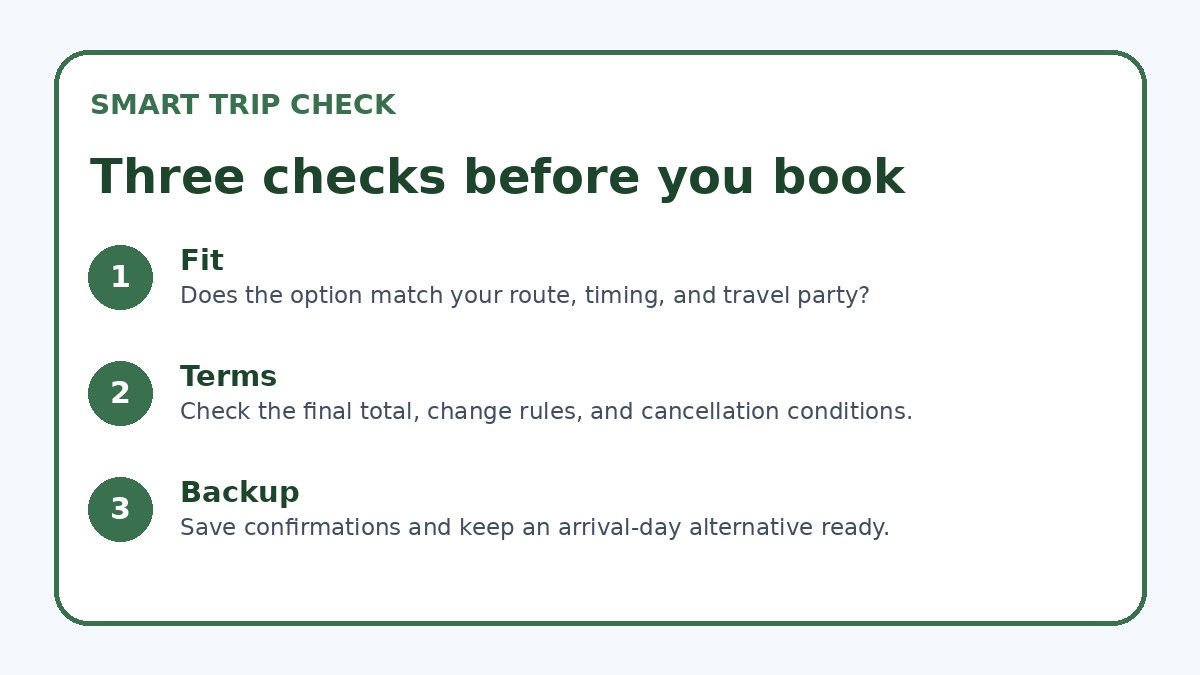
- Map every daily destination and mark whether each is within fast rail/subway access.
- Decide if luggage, gear, or mobility needs make carrying or parking a car necessary.
- If renting, confirm accepted driving permits, insurance levels, and deposit rules on the provider’s final booking page.
- Look up parking availability at your accommodation and key stops; note typical parking restrictions.
- Compare total door-to-door travel time between driving and public transport for two representative days.
- If combining options, reserve a car for the specific day(s) you need it to avoid unnecessary rental days.
How to decide before you book
Start by mapping every place you realistically expect to visit and note whether those spots are inside the metro rail network. Add estimated arrival and departure times and mark any late-night or very early travel needs. If more than half your stops sit outside the rail map or require multiple long transfers, a car may save time and simplify logistics. If your nights are in central neighborhoods and attractions cluster nearby, prefer public transport.
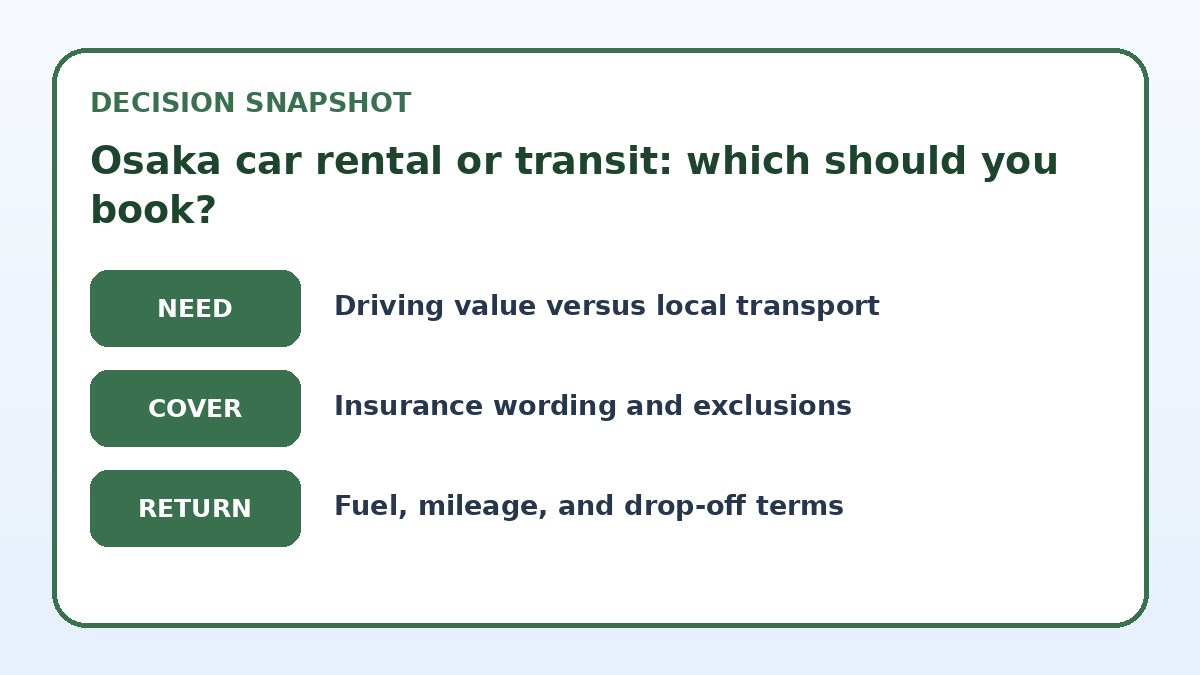
Next, research practical details: confirm whether your international driving permit is accepted, whether a credit card is needed for deposit, the rental company’s fuel policy, and any one-way drop fees. For trains and passes, check coverage area and transfer rules. When sensitive facts could change—insurance terms, cancellation policies, or toll collection options—verify them on the provider’s final booking page before you commit.
Frequently asked questions
Can a solo traveler drive in Osaka with an international driving permit?
Many visitors use an international driving permit (IDP) to drive in Japan, but acceptance and required documentation can vary by rental company and nationality. Before you book, check the rental company’s final booking page for the list of accepted permits, the exact IDP format required, and any additional identification they demand. Also verify whether the car provider requires a local translation of your license, what insurance options are available, and whether road assistance is included. Don’t assume every counter will accept the same documents—confirm in writing if possible.
Will a rental car save time compared with trains for common Osaka day trips?
It depends on your destinations and timing. For places well-served by JR or regional lines, trains may be faster and avoid traffic. For dispersed rural routes or multi-stop loops that would otherwise require several transfers, a car can save time. Estimate door-to-door travel times for typical days—include walking to stations, transfer waits, and parking search time versus driving and tolls. Use that comparison to decide whether the time savings justify rental complexity and costs for your itinerary.
How should I handle parking and tolls in my planning?
Treat parking and tolls as predictable travel costs rather than incidental extras. Before booking, research parking options at each overnight stop and at major attractions—note whether payment is by cash, card, or app and whether spaces are limited. For toll roads, ask the rental company about toll-payment systems (ETC cards or manual payment) and whether tolls are billed through the provider. These operational details can change, so confirm specific payment methods and any administrative fees on the rental company’s final booking page.
Final planning note
For most solo travelers whose itineraries keep them in central Osaka, public transport offers a lower-stress, more efficient way to get around. A rental car becomes worthwhile when your trip includes multiple rural excursions, late-night legs outside the rail timetable, or the need to carry significant equipment. Make a choice by mapping destinations, comparing door-to-door times, and checking the exact rental terms—insurance, permits, fuel rules, and parking—on the provider’s final booking page. If you want to view current availability or compare companies, Trip.com can be one place to look, but always verify critical details with the supplier before you finalize.
Continue planning
Check current options and final conditions
Use the provider page to confirm live availability, the final total, cancellation terms, and every condition that matters to your trip.
This evergreen planning guide was created with AI-assisted drafting and a structured quality review. It does not display live prices, schedules, availability, visa guidance, or provider rankings. Verify current details before booking. Some links are affiliate links; we may earn a commission at no additional cost to you.