If you’re traveling to Osaka and will be hauling extra luggage—large suitcases, skis, or photographed gear—deciding to rent a car changes more than convenience. The practical answer: driving can be worth it for flexible multi-destination plans (outer Osaka, Kansai coast, or rural Kansai day trips) but only if you confirm fuel rules, allowed mileage, and luggage-related charges before you book. Many rental providers vary on how they charge for fuel (full-to-full vs prepaid fuel) and how they calculate excess mileage; some size categories also carry per-bag fees or require larger-vehicle upgrades. Read the policy wording on the final booking page (fuel policy, daily or per-km mileage caps, trunk dimensions or stated luggage limits, and insurance liability language) and compare that with realistic daily kilometers you’ll drive. If anything on the provider page is unclear, ask the rental company in writing so pickup isn't a surprise.
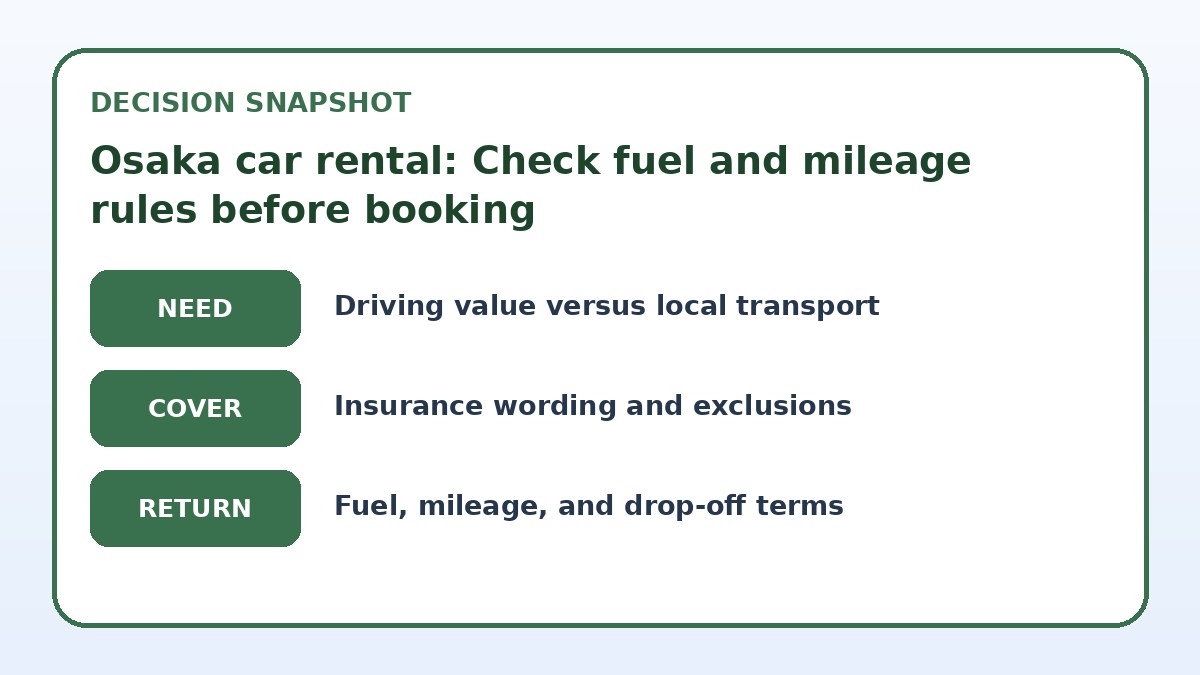
Decide whether driving improves your Osaka plan
Start by comparing what you would do with and without a car. If your plans are centered in central Osaka—Namba, Umeda, and Tennoji—public transit is faster, cheaper, and eliminates parking hassles. But if your trip includes suburban hotels, family-friendly attractions outside the city, or luggage that won’t fit comfortably on trains and through busy stations, driving can save time and stress. Map your days, estimate door-to-door times with luggage, and identify where public transit requires multiple changes or long walks.
Next, quantify benefits against costs tied specifically to fuel and mileage rules. If the rental has generous mileage or unlimited kilometers and a clear full-to-full fuel policy, you’re less likely to pay unexpected fees for a few long drives. If the provider uses prepaid fuel with no refund, short hops become less economical. Also consider parking: downtown parking charges and limited spaces may offset the convenience of a car, so include realistic parking expectations in the decision.
Decide whether driving earns its place
| Mobility strategy | Best for | Cost or friction to check |
|---|---|---|
| Rent a full-size car with unlimited mileage | Travelers with lots of luggage and long day trips from Osaka | Higher base rental and fuel costs; parking and city driving can be inconvenient |
| Compact rental with prepaid fuel and daily mileage cap | Short stays within Osaka avoiding long drives | Lower cost but risk of paying for extra kilometers or unused prepaid fuel |
| Public transit plus occasional taxi or paid luggage transfer | City-focused itineraries with bulky luggage that can be stored or transferred | Less flexible schedule; taxis add cost for repeated trips with heavy bags |
| Car-share or single-day rental for the heaviest-luggage day | Travelers who mostly use trains but need a car for one major excursion | Requires planning pickup/return windows and may lack roof/cargo options |
Check live rental choices only after the route test
Use the exact driver, dates, pickup point, and return plan to compare current conditions.
Understand fuel policies and how they affect luggage-driven decisions
Fuel policy language varies: full-to-full, same-to-same, or prepaid/energized fuel options. For travelers with extra luggage who plan many short journeys, full-to-full is usually best—return the car with the same fuel level and avoid paying for unused fuel. Prepaid fuel might be tempting at pickup for convenience, but with heavy luggage you may be using less driving time than expected and lose money on unused fuel. Always verify whether fuel receipts are required at return or whether the provider measures tank visually.
Check what the provider's final booking page says about refueling requirements and how they charge for missing fuel. Some companies impose a refueling penalty plus a per-liter rate; others charge a set fee regardless of the deficit. For luggage-heavy trips where you might make only a few runs, calculate whether the cost of prepaying is higher than refilling locally before return. If refueling near the drop-off is inconvenient, factor the convenience premium into your decision.
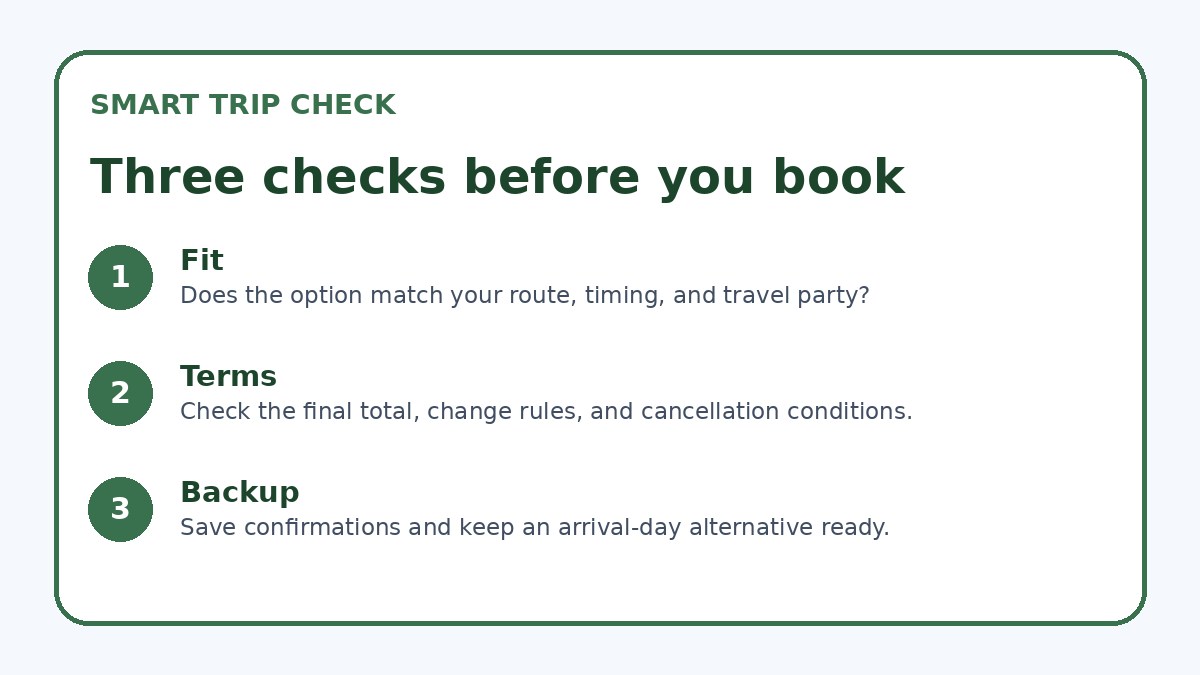
Compare the full rental conditions
Confirm insurance wording, exclusions, deposit, fuel, mileage, and return terms on the final page.
Mileage caps, insurance wording, and pickup/return friction
Mileage rules are often the unseen cost when you drive beyond city limits. Rentals may include a daily kilometer allowance or cap total mileage for the booking; other offers provide unlimited mileage but sometimes exclude certain regions. For a luggage-heavy traveler making day trips out of Osaka—coastal routes or mountains—estimate your total kilometers and ensure the allowance covers it or that the per-kilometer overage fee is acceptable. On the final booking page, confirm whether mileage is counted per calendar day, per 24-hour period, or per rental period.
Insurance and pickup/return friction also determine whether driving is worth it. Read the insurance wording carefully: liability limits, collision damage waivers, and whether damage to roof racks or cargo areas is excluded matter when you pack bulky items. Verify pickup logistics—whether airport pickups use remote desks or shuttles, whether after-hours returns need drop-box keys, and whether the provider inspects luggage-related damage at collection or return. If any policy text is unclear, ask the company to confirm in writing before you travel.
Car rental terms to verify
- Confirm the fuel policy on the final booking page—full-to-full, prepaid, or other—and how missing fuel is charged at return.
- Calculate expected total kilometers and verify the mileage allowance or per-km overage rate before completing the reservation.
- Check trunk dimensions or stated luggage limits on the provider page; if unclear, request confirmation of fit for your specific bags.
- Read insurance and damage-exclusion wording to see if roof racks, interior cargo areas, or oversized loads are covered or excluded.
- Verify pickup and return logistics: shuttle needs, after-hours procedures, and whether a fuel receipt must be shown at drop-off.
- Compare the total estimated cost (rental, fuel handling, mileage overage, parking, and optional extra-luggage fees) against non-driving alternatives.
Fallback plans if you decide not to drive
If the fuel and mileage rules make driving unattractive, plan a non-driving fallback that handles extra luggage sensibly. Many hotels offer luggage storage and transfers; some long-distance buses and limited express trains have designated luggage areas or luggage-service options that pick up bags from major hotels. When using trains, choose services that allow advance seat reservations and are known to have space for suitcases or bring padded luggage straps to facilitate carrying to and from stations.
Combine mobility methods: reserve taxis for first/last-mile transfers with luggage, use local car services for short suburban legs, and rely on regional trains for longer distances. If you need a vehicle occasionally but not all the time, consider hourly car-share options or single-day rentals for the heaviest-luggage day only. Whatever fallback you select, check the provider pages for baggage size limits, reservation rules, and any extra fees to avoid surprises when you arrive in Osaka.
Car Rental & Road Trip questions travelers ask
How do I decide between full-to-full and prepaid fuel when renting in Osaka?
Full-to-full is generally better if you can refill before returning—this avoids losing money on unused prepaid fuel. Prepaid fuel may be convenient if you can’t refuel near the drop-off or have limited time, but make a quick estimate: if you expect light driving, prepaid often costs more. On the provider’s booking page check whether fuel is measured by inspection or by meter, and whether the company charges a flat refuel penalty. When in doubt, ask the rental company how they calculate final fuel charges so you won’t be surprised at return.
What luggage size rules should I check for Osaka car rentals?
Rental providers sometimes state luggage limits by vehicle category rather than precise dimensions. Look for trunk volume, listed number of suitcases, or a spec sheet on the final booking page. If your luggage includes oversized items—golf bags, skis, or multiple large suitcases—contact the company with exact dimensions and ask if a larger vehicle or roof box is required. Also confirm whether roof racks or interior cargo modifications are permitted and whether that affects insurance coverage or incurs extra fees.
If mileage caps look tight, is upgrading the only option?
Not necessarily. You can plan routes more tightly, use the car for only the longest-luggage segment, or combine transit with taxi hops to reduce kilometers. Another approach is to choose a rental with a higher daily cap or unlimited mileage if available; on the final booking page confirm the overage fee and whether interstate or prefecture travel is restricted. If none of that is attractive, consider booking a single-day rental for the long drive and otherwise using trains or buses to limit total kilometers.
Final decision note
Driving in and around Osaka with extra luggage can be a practical choice, but it hinges on clear fuel, mileage, and insurance rules. Make the decision by mapping your itinerary and estimating realistic kilometers and luggage needs, then verify the provider’s fuel policy, mileage allowance, trunk or luggage specs, and insurance exclusions on the final booking page. If any terms are ambiguous, get written confirmation from the rental company before you arrive. If driving looks costly or fragile, use a hybrid approach—public transit for city days, car rental or car-share for heavy-luggage excursions—to keep flexibility without unexpected charges.
Continue planning
Check current options and final conditions
Use the provider page to confirm live availability, the final total, cancellation terms, and every condition that matters to your trip.
This evergreen planning guide was created with AI-assisted drafting and a structured quality review. It does not display live prices, schedules, availability, visa guidance, or provider rankings. Verify current details before booking. Some links are affiliate links; we may earn a commission at no additional cost to you.