If you’re traveling New York City to Washington, DC for business and carrying one or more pieces of luggage, the practical choice comes down to where you want to start and end your day, how much handling you’ll tolerate, and how tight your schedule is. For most business travelers a direct Amtrak-style train or a premium coach that boards from convenient terminals will offer the best balance of comfort and luggage ease. High-frequency rail or coach reduces transfer friction; airports add extra handling and security time. This guide walks you through terminal fit, luggage transfers, timing flexibility, and sensible backups so you can decide whether to prioritize door-to-door convenience, speed, or cost while keeping your bags and schedule under control.

Choosing the mode: rail, coach, air or mixed
Start by mapping door-to-door time rather than comparing only in-vehicle durations. Trains typically depart and arrive from central stations closer to business districts, which usually reduces taxi or rideshare time. Coaches often use terminals that are downtown or near major transit hubs, but they may require earlier arrival for loading. Flights offer faster airborne time but add airport transfers, security, and baggage reclaim, which can erase the airborne advantage for short intercity trips. If you have heavy or multiple suitcases, factor in baggage handling at each transfer point rather than just the ride time.
A mixed itinerary—rail one way and air the other, or coach to a nearby hub then train—can make sense when schedules or loyalty program benefits matter. When combining modes, plan where you’ll change and whether you’ll carry luggage through that connection or use checked baggage. Avoid routing that requires carrying bags across multiple stations or long walks between terminals during peak hours. For business travelers, the simplest single-transfer journey is usually the least friction: fewer handoffs mean fewer opportunities for delay or lost items.
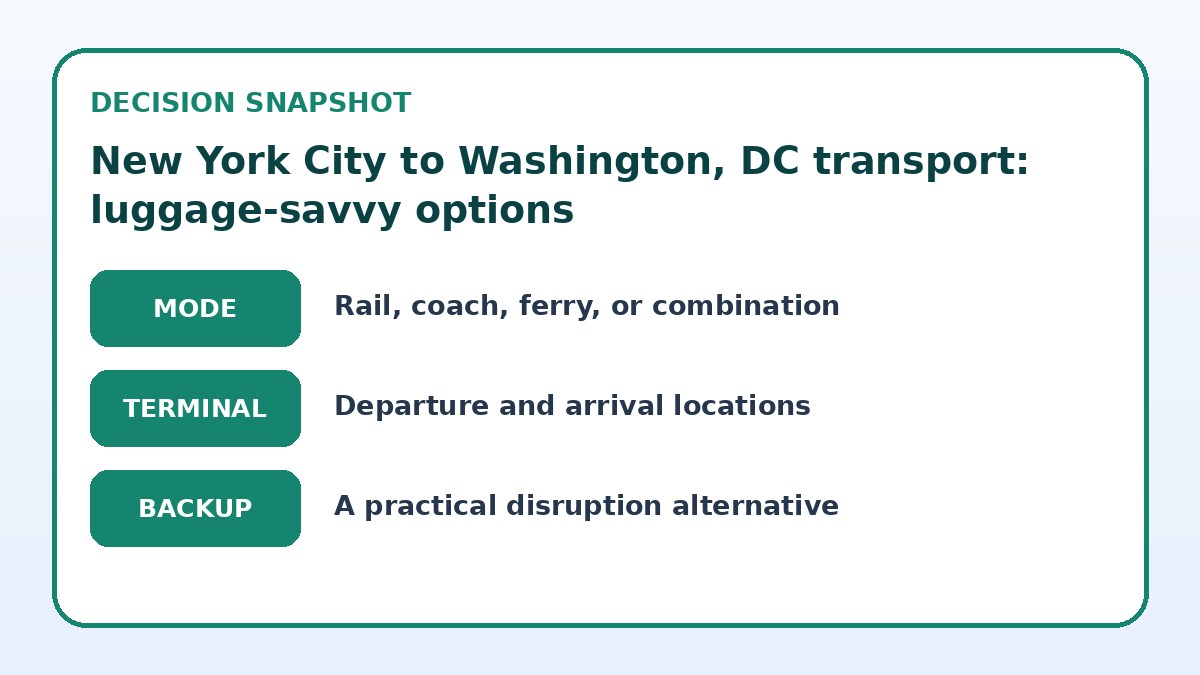
Choose the end-to-end journey plan
| Journey approach | Best for | Friction to check |
|---|---|---|
| Direct intercity train | Travelers who want minimal transfers, room for larger carry-ons, and central arrival points. | Schedules may be less frequent at off-peak times; verify platform access and luggage policies before booking. |
| Premium coach service | Cost-aware business travelers who accept under-bay loading or short terminal walks for lower fare and sensible comfort. | May require handling of bags during loading; terminal-to-office transfer times vary by operator and city location. |
| Air (flight) | Those prioritizing the shortest airborne time or connecting from farther-away airports. | Adds security lines, baggage reclaim time, and longer door-to-door durations when airports are out of town. |
| Mixed-mode (train one way, coach or air return) | Travelers optimizing schedule or loyalty perks while balancing luggage convenience. | Introduces an extra handoff and requires careful coordination of arrival terminals and luggage handling procedures. |
Check live intercity options
Look beyond the ride itself and compare terminals, transfers, luggage, and arrival fit.
Terminal fit and luggage friction
Examine the terminals for how luggage is moved and stored. Some rail stations have wide, step-free access from platform to concourse and elevators to street level, which is helpful with rollaboards and wheeled cases. Coach terminals may require loading into underfloor bays—check whether staff load for you or if you must manage bulky bags yourself. Airports add security checkpoints and longer walking distances; factor in the time to check, reclaim, and transfer checked baggage. If your departure or arrival includes multiple flights or trains, think through the physical path between platforms and the potential need to drag bags up stairs or across bridges.
Also consider first- and last-mile connections: will you walk a block with luggage, take a hotel shuttle, or book a rideshare that can handle multiple bags? If you’ll arrive at a central station but your client’s office is across town, a short cab might be preferable to a longer subway trip with a suitcase. For peace of mind, ask hotels and meeting venues in advance about luggage storage or porter services, and verify elevator access at stations and terminals on the provider’s final booking page rather than relying on secondary sources.
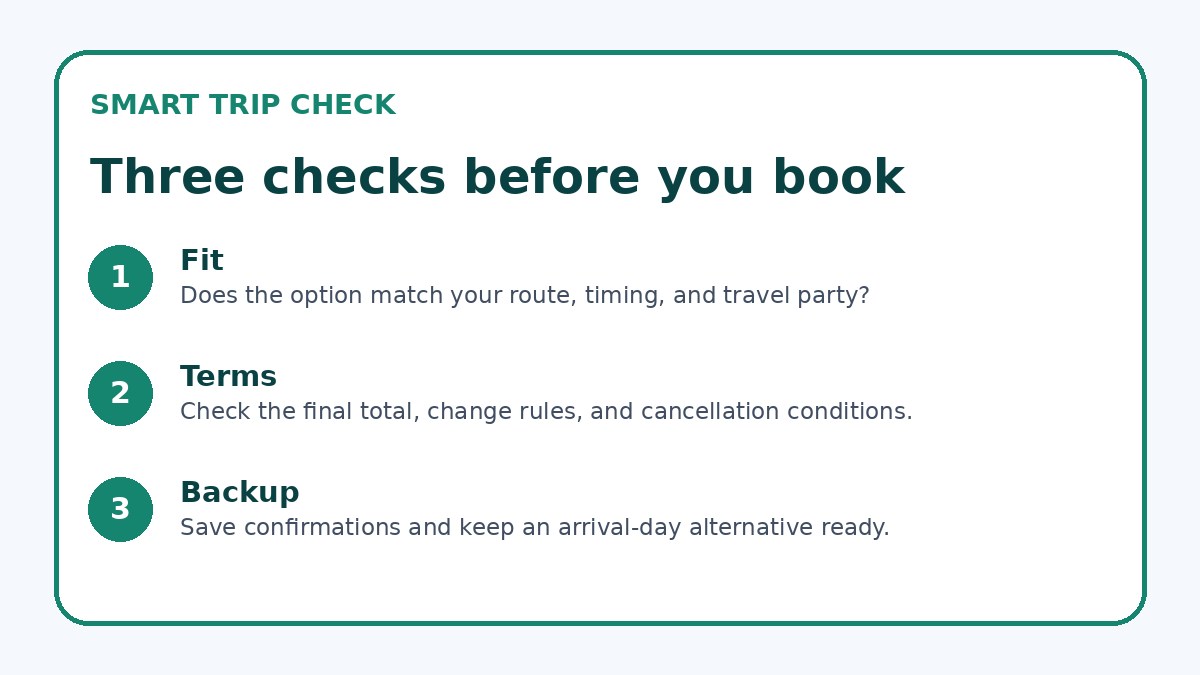
Timing flexibility and business schedules
Business trips often have tight windows. Choose services with reliable frequency and realistic buffer time for unexpected delays. Trains and frequent coaches give you flexible options to move to an earlier or later departure if meetings slide. If your schedule is non-negotiable, select a single-connection or direct service and build in extra time for luggage handling, especially if checking bags. Avoid itineraries that require tight transfers between different modes unless you have a substantial layover; carrying a briefcase and a single carry-on is far easier to move quickly than several checked pieces.
When booking, compare potential door-to-door windows rather than just scheduled departure times. Consider typical urban traffic at your pickup and drop-off times: morning and evening peaks can add substantial rideshare time. If you must arrive before a meeting, look for services that get you into the city with time to spare for unexpected delays. Confirm platform locations, terminal layout, and recommended arrival windows on the provider’s final booking page, and factor those into your travel schedule rather than assuming the vehicle time equals total travel time.
Compare the practical alternatives
Use the final page to confirm what is actually offered on your dates and save a workable fallback.
Intercity travel checklist
- Confirm on the provider’s booking page whether luggage is stored with you, in an undercarriage hold, or requires check-in and note any size or weight limits.
- Measure and weigh your largest suitcase to ensure it meets published carry-on or checked-baggage dimensions before booking any segment.
- Plan door-to-door logistics: estimate time from your office or hotel to the departure terminal and add buffer for traffic, security, and luggage handling.
- Arrange luggage assistance if needed—hotel porters, curbside check-in, or third-party transfer services—and confirm pickup/drop-off windows.
- Pack essential business items (documents, chargers, one outfit) in a carry-on you will keep with you in case checked bags are delayed.
- Save and screenshot terminal maps, platform locations, and the provider’s baggage rules from the final booking page for quick reference on travel day.
Disruption backup and luggage contingencies
Have a straightforward backup plan that minimizes bag transfers. If your primary option is a train, your backup might be a coastwise coach or a direct flight that reduces time on the ground. If flying, a later train could be a more predictable alternative when weather or security causes airborne delays. Carry important documents and one essential change of clothes in your carry-on so a delayed or missing checked bag won’t derail a meeting. Photograph contents or create a quick packing list in case you need to claim lost items.
Also pre-arrange contacts and services: save local taxi or rideshare numbers, know nearby luggage storage options, and confirm with your hotel whether early check-in or secure bag drop is available. For high-value items, consider a compact lockable carry-on and carry-on-only itineraries when possible. When provider-specific facts could change, verify baggage allowance, check-in arrival recommendations, and transfer rules on the provider’s final booking page—this is where up-to-date baggage size limits, check-in cutoffs, and terminal maps will appear.
Rail & Intercity Transport questions travelers ask
Is it faster to take a train or a flight between New York City and Washington, DC with luggage?
Flying can have a shorter airborne time, but door-to-door speed depends on airport distance from downtown, security, and baggage reclaim delays. Trains usually arrive in central stations closer to business districts, often reducing total transfer time and the need to check bags. For business travelers with carry-on luggage and meetings near the station, rail is frequently the more predictable door-to-door option. Always compare the total travel window—ride plus transfers—and confirm baggage handling rules on the provider’s final booking page before deciding.
What’s the best way to handle multiple suitcases during a one-day business trip?
If possible, move to a carry-on-only setup for single-day trips. If multiple suitcases are unavoidable, arrange a hotel or third-party luggage hold at your arrival point so you don’t drag bags into meetings. Alternatively, book a service that provides porter or curbside assistance to transfer bags between vehicle and terminal. Pre-planning where each bag will be stored and who is responsible for it reduces transfer friction and keeps you mobile between meetings.
How should I choose between terminals when my calendar is tight?
Prioritize minimizing transfers and walking with luggage. Pick a departure and arrival that place you closest to your first and last meeting locations, and choose routes with fewer changes. If options exist, prefer services with central-station arrival or coach terminals near business districts over distant airports. Check the final booking pages for terminal maps, recommended arrival times, and elevator access, and build a buffer into your schedule for security lines, baggage handling, and urban traffic to avoid last-minute stress.
Final decision note
For business travelers moving between New York City and Washington, DC with luggage, the practical choice balances door-to-door convenience, luggage handling, and schedule certainty. Trains and downtown coach services usually minimize transfers and last-mile friction, while flights may help when airborne time is critical but introduce extra baggage and security steps. Prepare by verifying luggage rules on the provider’s booking page, arranging assistance or storage if you’ll carry multiple bags, and keeping a simple disruption backup. With a clear door-to-door plan and basic contingencies, you can focus on meetings instead of your suitcases.
Continue planning
Check current options and final conditions
Use the provider page to confirm live availability, the final total, cancellation terms, and every condition that matters to your trip.
This evergreen planning guide was created with AI-assisted drafting and a structured quality review. It does not display live prices, schedules, availability, visa guidance, or provider rankings. Verify current details before booking. Some links are affiliate links; we may earn a commission at no additional cost to you.