
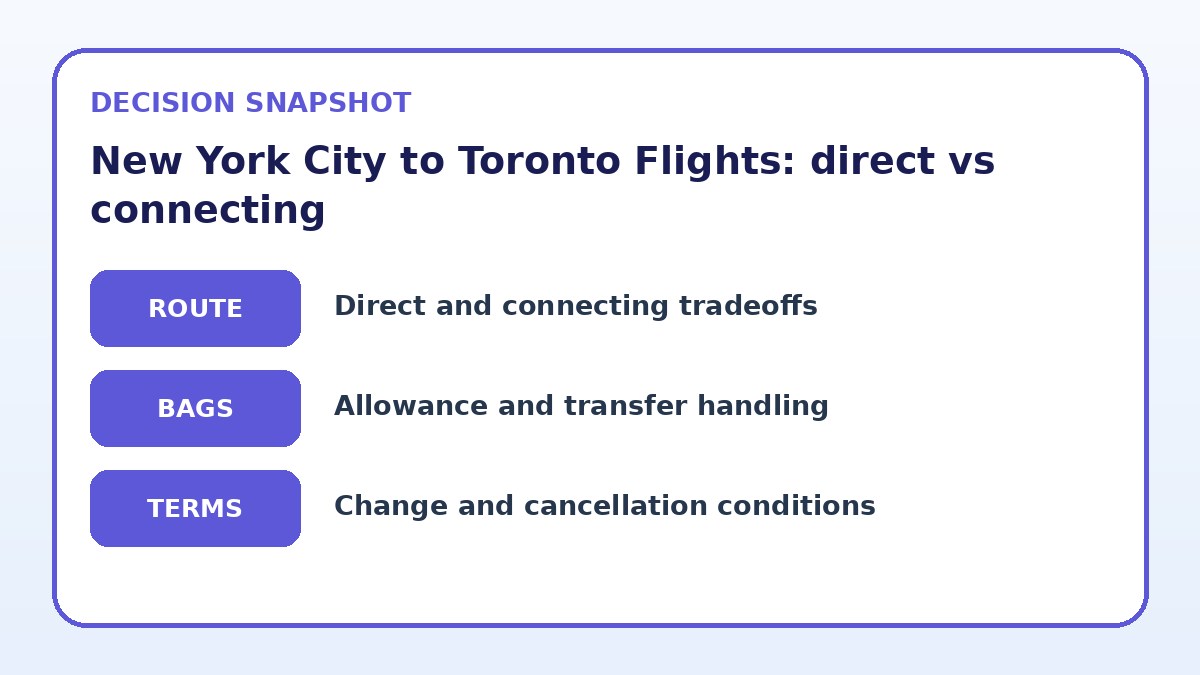
If you’re planning your first trip from New York City to Toronto, the core choice is simple in concept: book a direct flight for fewer hassles, or take a connecting itinerary that might be cheaper or open better schedules. Practically, start by checking whether nonstops are offered from your preferred NYC airport and compare total door-to-door time rather than just airborne minutes. Connections can save money or allow travel at times nonstops don’t exist, but they add steps and risk — missed connections, extra security or customs procedures, and baggage handling complexities. This guide gives a quick recommendation up front, then walks through the tradeoffs, decision criteria, and what to verify on airline booking pages so you can pick the option that matches your priorities and tolerance for complexity.
Why direct flights are appealing for first-time visitors
Direct flights keep your journey straightforward: one takeoff, one landing, one set of boarding procedures. For first-time visitors unfamiliar with Canadian entry formalities or Toronto’s airport layout, a nonstop removes the uncertainty of making a tight connection and reduces the number of times you need to navigate security or follow signage. Fewer airport changes also means lower chances of delayed or lost baggage, which is especially valuable if you’re traveling with important items, family, or limited time in Toronto.
That simplicity translates to predictable total travel time and less stress on arrival, important if you have a hotel check-in window, business meeting, or evening plans. Nonstops tend to depart from major NYC airports with frequent ground transport links, making the pre-flight leg easier to plan. However, nonstops may have fewer schedule options and sometimes higher fares; these tradeoffs matter when you need flexibility or are trying to manage a tight budget.
How connecting flights can help with schedules and budgets
Connecting options expand what’s possible: more departure times, alternative airlines, and routes that might fit awkward schedules. If nonstop flights are full, too expensive, or don’t match your preferred travel window, a connection can bridge the gap. Connecting itineraries sometimes let you fly from a different NYC airport that’s more convenient for your origin, or pair a low-cost carrier leg with a traditional airline for perceived savings. For travelers who value price or flexible routing over simplicity, connections can be sensible.
But that flexibility comes with operational differences to check. Connections increase total door-to-door time and require you to allow comfortable layovers for security, customs, and potential delays. If your itinerary includes tight minimum connection times or requires changing terminals, add buffer minutes to your plan. Also verify whether baggage transfers are included and whether you’ll need to claim and recheck bags, because international borders and interline agreements affect procedures.
| Approach | Best for | Tradeoff to check |
|---|---|---|
| Direct flight | Travelers prioritizing simplicity, speed, and lower risk of missed connections | Fewer schedule options and sometimes higher fares or less flexibility |
| Single-ticket connecting itinerary | Passengers wanting more scheduling choices with some operational protection | Longer travel time and more steps, but delay protections usually apply |
| Separate-ticket connecting itinerary | Budget-focused travelers who can tolerate added connection risk | You assume the risk for missed connections and baggage transfer problems |
| Mixed-carrier connections with longer layovers | Those balancing cost and safety by giving themselves buffer time | Longer overall travel time and possible airport wait discomfort |

Practical decision criteria: what to compare when booking
Make side-by-side comparisons of total travel time (including transfers), not just airborne duration. List the airport pairs, departure and arrival times, number and length of layovers, and whether the transfer requires changing terminals or going through additional security. For international travel to Canada, note whether your connection affects how and where you clear customs and immigration; some itineraries process pre-clearance in the U.S., while others have arrival procedures in Toronto.
Next, examine booking conditions: change and cancellation policies, baggage rules, and whether the flights are on a single ticket or separate tickets. A single-ticket itinerary generally protects you if the first leg is delayed, while separate tickets shift risk to you. Check minimum connection time published by the airline and, if available, look for guaranteed connection language. Finally, consider personal priorities — budget, travel companions, comfort, and how much buffer you want for the unexpected.
Before you book
- Confirm whether the itinerary is on a single ticket or separate tickets and note the protection each offers for missed connections.
- Compare total door-to-door time, including ground transfers, layovers, and anticipated customs or immigration steps.
- Verify baggage rules and whether checked baggage is automatically transferred on connecting legs.
- Check the airline’s published minimum connection time and any guaranteed-connection language on the booking page.
- Allow extra buffer time when scheduling tight connections or if you must change terminals or re-clear security.
- Save screenshots of booking pages and contact information for airlines covering each leg in case you need help during travel.
What to verify on the airline page before you click buy
When you find an attractive option, confirm the full itinerary details on the airline’s final booking page. Verify baggage allowances and any fees for checked or carry-on bags, because carriers differ widely and booking platforms don’t always show the fine print. Check whether both legs are on the same ticket and whether the airline explicitly describes baggage transfer and customs procedures for connections, especially if the route involves an intermediate stop in another country or a different carrier.
Also review change and refund policies, the listed minimum connection time, and whether seats are confirmed for all legs. If your itinerary includes different tickets, contact the airlines or travel agent to understand reroute and delay protections, or add extra layover time to reduce risk. Use Trip.com or the carrier’s site to compare options, but always rely on the airline’s final booking page for operational details and any conditions you must accept before purchase.
Frequently asked questions
How much layover time should I allow when connecting through another airport?
Aim for at least 90 minutes for domestic-to-international connections and longer if you must change terminals or re-clear security. Minimum times depend on the airports involved and whether baggage is checked through; some travelers choose two- to three-hour layovers to remove stress. If both flights are on the same ticket, carriers sometimes protect you against missed connections, but you still need time for potential delays and immigration. Check the airline’s recommended minimum connection time and factor in the time you want for restroom breaks, food, or unexpected queueing.
Do I have to go through customs and immigration on a connection to Toronto?
That depends on your routing and whether pre-clearance is available. Many U.S. airports offer U.S. pre-clearance for flights to Canada, while other itineraries require clearing Canadian customs on arrival in Toronto. If your itinerary routes through a third country, you may clear immigration there or in Toronto depending on the airport’s procedures and the carriers involved. Always verify customs and immigration steps on the airline’s booking page and ask the airline if you are unsure how a specific connection handles border formalities.
Are there advantages to flying from a particular New York airport for this route?
Each NYC airport offers tradeoffs in convenience, ground transport, and available flights. LaGuardia and JFK generally have more scheduled international and nonstop options, while Newark may offer different carriers and routing. Choose the airport that reduces total door-to-door time from your origin and offers reliable ground connections to your final arrival time. When comparing options, include the time and cost to reach each NYC airport and the transit time from Toronto’s airport to your accommodation.
Final planning note
For first-time visitors, a direct flight between New York City and Toronto is usually the simplest and least stressful option, especially when you want predictable travel and minimal airport juggling. Connecting itineraries make sense when nonstop schedules don’t fit your timing, when you’re targeting a lower fare, or when a different NYC airport is more convenient. Always compare total door-to-door time, confirm whether the itinerary is a single ticket, and check baggage and customs procedures on the airline’s final booking page before committing. Use the comparison points and checklist to match the choice to your priorities — time, budget, or peace of mind.
Continue planning
Check current options and final conditions
Use the provider page to confirm live availability, the final total, cancellation terms, and every condition that matters to your trip.
This evergreen planning guide was created with AI-assisted drafting and a structured quality review. It does not display live prices, schedules, availability, visa guidance, or provider rankings. Verify current details before booking. Some links are affiliate links; we may earn a commission at no additional cost to you.