If you are arriving in New York City with extra luggage, choose private transfer if you prioritize door-to-door convenience and minimizing time handling bags; choose public transit if you prefer lower out-of-vehicle cost and can manage carrying or storing bulky items. The tradeoff is simple: private transport reduces carrying and transfers but usually requires advance booking and space confirmation, while public options demand more physical effort, route planning and attention to luggage rules on subways, commuter rails, and buses. This guide helps you decide based on how much luggage you have, where you are going in the city, your budget flexibility, mobility needs, and willingness to transfer between modes. It then walks through practical steps to compare and verify services, what to pack for transfers, and red flags to check before booking.
See current options before you compare the details
Availability and final conditions change. Open Trip.com now or keep reading for the practical comparison.
Assess your luggage and mobility needs
Start by inventorying every bag: suitcases (size and number), wheeled duffels, instruments, extra boxes, and any items you cannot or prefer not to lift repeatedly. Note whether bags have wheels, whether you’ll need to stow them overhead, and if any pieces are oversized or fragile. Also consider who is traveling with you and whether anyone has mobility restrictions, young children, or prams. These details change the equation: three medium suitcases and a stroller make public transfers much less attractive than one or two checked suitcases.
Next, translate those needs into measurable criteria: how many door-to-door lifts you want to avoid, whether elevator access is required at arrival stations, and whether you need curbside assistance. If you rely on elevators or ramps, map the accessibility of your arrival terminal and nearby transit stations rather than assuming all are step-free. Finally, factor in time sensitivity: a short business schedule or late-night arrival often justifies the higher convenience of a private vehicle.
Comparing public transit options with extra luggage
Public transit in New York City includes subway lines, commuter rails, buses, and airport shuttles. For travelers with extra luggage, the subway can be the fastest, most direct option for many Manhattan destinations but requires lifting bags up and down stairs at older stations. Commuter rails such as those serving Long Island or suburbs often have level boarding and more space, but you must check schedules and transfer points. Buses and airport shuttles can carry luggage, yet they may make many stops and require loading and unloading at curbs.
When evaluating public transit, consider ease of last-mile travel: how far is the walk from the stop to your lodging, and are station elevators functioning? If your transfer involves multiple changes, each transfer is an opportunity for strain or delay. Practical steps include measuring realistic walking distances with luggage, confirming elevator availability on transit agency websites before travel, and comparing door-to-door travel time with private options. Remember that off-peak hours may offer less crowded trains and easier luggage handling.
| Approach | Best for | Tradeoff to check |
|---|---|---|
| Private door-to-door transfer | Travelers prioritizing minimal handling, direct routes, and accessibility with multiple large bags. | Higher cost and need to confirm vehicle size, pickup location, and baggage policy before booking. |
| Public transit (subway, commuter rail, bus) | Budget-minded travelers with manageable luggage who can lift bags and handle transfers or stairs. | May require multiple transfers, elevator checks, and more physical carrying of bags. |
| Shared shuttle or pooled ride | Those seeking a middle ground between cost and convenience and are flexible on stop sequences. | Extra stops increase travel time and repeated handling; space for oversized items can be limited. |
| Hybrid plan (mix private and public) | Travelers with variable schedules who want to avoid one long, expensive transfer but keep convenience where needed. | Requires extra coordination and possibly short-term luggage storage or rebooking logistics. |
Ready to check the option that fits your plan?
Use your exact dates and traveler details so the provider page can show the current total and conditions.
Private transfers: what to confirm before you book
Private cars, taxis, or rideshares offer curbside pickup, direct routing, and room for luggage—but not all vehicles are equally suitable. Before booking, confirm vehicle trunk and cabin capacity for your exact number of bags and any oversized items. Ask whether the driver will assist with loading, whether pickups are curbside at your terminal or require a short walk to an official rideshare area, and how late-night or early-morning arrivals are handled. If you need a larger vehicle, explicitly request a van or SUV rather than assuming a standard car will suffice.
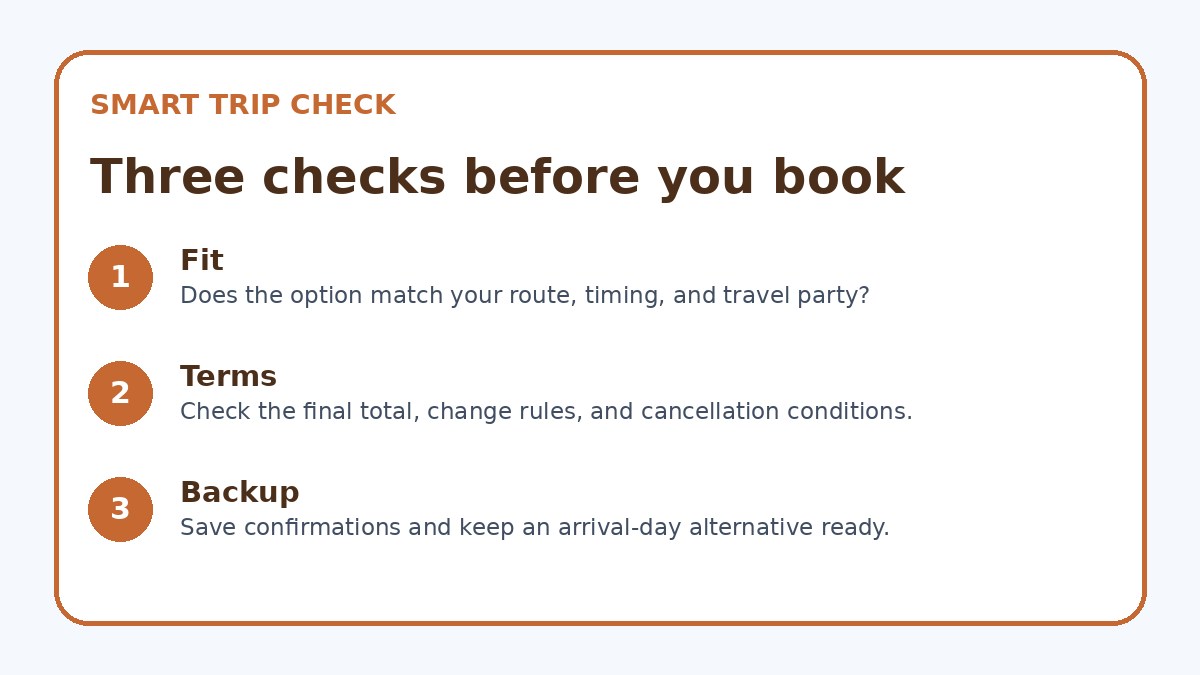
Also verify booking terms that can affect your arrival: cancellation and change rules, where drivers can legally meet passengers at the airport, and whether the price shown includes tolls or airport pickup fees. Because provider details change, always follow through to the provider’s final booking page to confirm those operational details. If you compare options on an aggregator like Trip.com, use the provider page to verify vehicle size, baggage capacity, pickup logistics, and any extra charges.
Before you book
- Count all bags and measure or note any oversized or fragile items before choosing your transfer.
- Check elevator and accessibility information for transit stations you’ll use on official transit websites.
- Confirm vehicle type and trunk capacity with private providers and ask about driver assistance for loading.
- Compare door-to-door travel time estimates for each option, including expected wait and potential multiple stops.
- Verify pickup and drop-off points at your arrival terminal on the provider’s final booking page.
- Plan a backup: identify a nearby luggage storage or second transfer option in case your first choice becomes impractical.
Handling shared shuttles and hybrid choices
Shared airport shuttles and pooled ride services blend lower cost with some door-to-door convenience, but they introduce tradeoffs. Shuttles usually pick up and drop off multiple passengers, which can mean extra stops and repeated bag handling; weigh how much extra time and handling you accept in exchange for savings. Pooled rides within app-based platforms can be quicker but sometimes place luggage in trunk space shared with other passengers, so confirm that there’s enough room and that drivers will not refuse oversized items.
If you are uncertain, consider a hybrid plan: book a private transfer for the airport arrival, then switch to public transit for travel around the city, or vice versa on departure. Also think about short-term luggage storage if you’ll be sightseeing before check-in—choosing a nearby storage or locker can make public transit feasible even with extra bags. Whatever you pick, align the decision with the number of bags, your arrival time, and tolerance for extra stops or handling.
Frequently asked questions
Is the subway practical for travelers with multiple large suitcases in New York City?
The subway can be practical if your bags are wheeled and you can lift them up stairs or use elevators at the stations you’ll use. Many stations, especially older ones, have limited elevator access which can make transfers difficult with heavy suitcases. If your journey requires several transfers or long stairs, the subway becomes less practical. Before relying on it, map the exact stations you’ll use, check elevator status on the transit agency page, and estimate walking distances from the station entrances to your accommodation.
How do I make sure a private car will fit my extra or oversized luggage?
Do not assume vehicle types fit all luggage: ask the provider for trunk dimensions or request a specific vehicle class such as a minivan or cargo-capable SUV. When booking, list the number and size of bags and ask whether a roof rack or trailer is necessary or available. Confirm whether the driver will assist with loading and unloading and where the curbside pickup location will be. Always verify these details on the provider’s final booking page before confirming to avoid being turned away at pickup.
What if my flight arrives late at night—should I use public transit or a private transfer?
Late-night arrivals change the balance toward private transfers because subways, buses, and some commuter trains run less frequently and stations may be emptier but with limited staff or closed elevators. If mobility or safety while handling heavy bags is a concern, a prearranged private transfer reduces waiting and walking. However, if you are on a tight budget and comfortable with self-transport, check late-night transit schedules and station accessibility in advance and have a backup taxi or rideshare option ready in case of delays.
Final planning note
Choosing between public or private transport for a New York City airport transfer when you have extra luggage comes down to three things: how many and what type of bags you have, how much handling and walking you are willing to do, and whether time or cost is more important. Private transfers simplify logistics but require careful confirmation of vehicle size and pickup details; public transit saves money but can force repeated lifts and transfers unless stations are accessible. Use the checklist to prepare, verify operational details on the provider’s booking page, and consider a hybrid approach if your trip includes both budget constraints and moments when convenience matters most.
Continue planning
Check current options and final conditions
Use the provider page to confirm live availability, the final total, cancellation terms, and every condition that matters to your trip.
This evergreen planning guide was created with AI-assisted drafting and a structured quality review. It does not display live prices, schedules, availability, visa guidance, or provider rankings. Verify current details before booking. Some links are affiliate links; we may earn a commission at no additional cost to you.