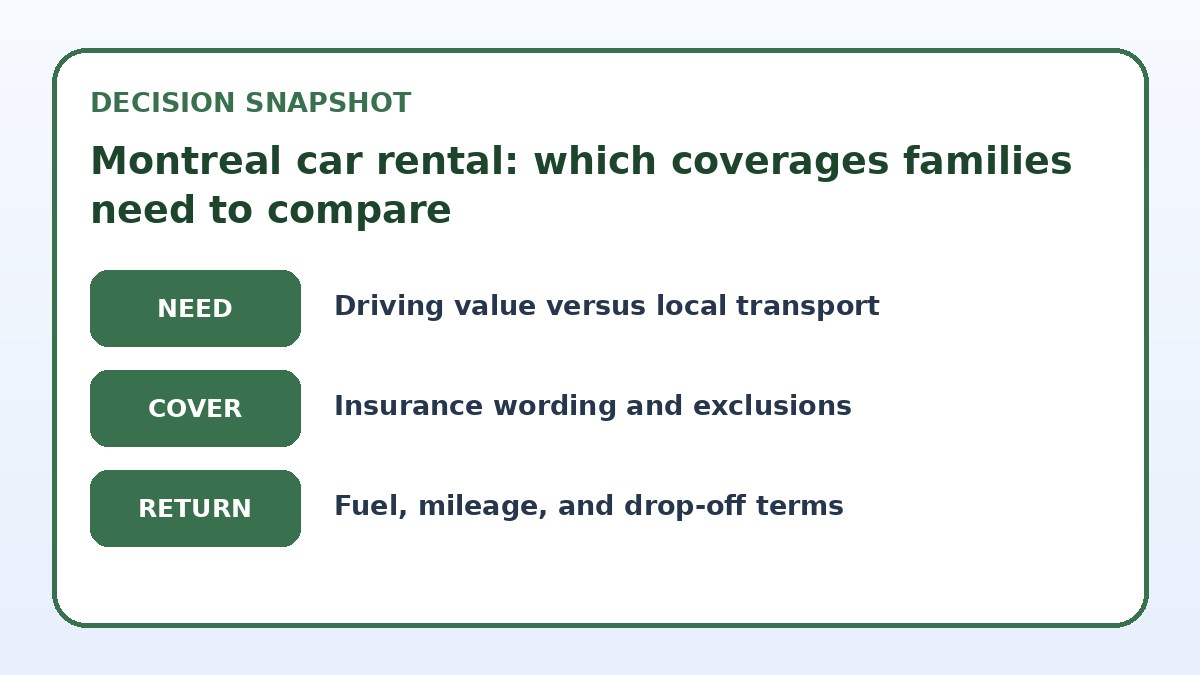
Practical answer first: for families renting a car in Montreal, verify three things before you complete any reservation — liability minimums, collision/damage coverage (CDW/LDW) limits and exclusions, and how a domestic or credit-card policy coordinates with the rental company’s wording. Ask the rental counter or booking page to explain definitions like 'loss/damage waiver' versus 'collision damage waiver' and whether fuel loss, towing, and administrative fees are excluded. Families should also check whether drivers under a specific age or additional household drivers are covered and whether child seats, winter tires, or road assistance are listed separately. These details determine whether you need supplemental coverage, can rely on home insurance or a credit card, or should buy the rental firm's product. Below I explain tradeoffs, what clauses trigger out-of-pocket bills, and exactly what to verify on the rental company’s final booking page.
See current options before you compare the details
Availability and final conditions change. Open Trip.com now or keep reading for the practical comparison.
Deciphering common insurance terms on rental pages
Rental companies use similar words for different things. Collision Damage Waiver (CDW) or Loss Damage Waiver (LDW) often means the company waives its right to charge you for certain damage, but waivers aren’t insurance and frequently exclude glass, tires, undercarriage, and roof damage. Liability coverage refers to third-party bodily injury and property damage; provincial minimums in Quebec may be part of the base rental, but limits and legal defense provisions vary. Read the contract text; do not rely on short summary lines or button labels. Families should specifically look for exclusions that could apply when child seats are installed or when driving on secondary roads.
Some pages use shorthand like 'full coverage' that can be misleading. A 'full' package may remove the rental company’s damage fines but still allow charges for administrative fees and loss-of-use (the income the agency claims while a vehicle is being repaired). Roadside assistance products vary: some include towing within a radius, others only cover jump-starts or keys. Make a checklist of words and phrases seen on the booking site, then compare those exactly with your personal policies. If the page references a legal code or provincial requirement, note it and verify with the insurer or rental counter.
How family-specific needs change what to prioritize
Families have different exposure than solo travelers. With children you’ll want minimal disruption and predictable bills: confirm whether child-seat damage, spilled food, or interior stains are covered or excluded. If you plan on trips outside Montreal — rural drives or provinces nearby — verify permitted territory and whether coverage changes across borders. Additional drivers matter: if both parents will swap driving, ensure both are listed as authorized drivers; otherwise damage claims may be denied. Young drivers attract extra fees and often different coverage limits, so check age cutoffs and whether a family member’s auto policy extends to rental vehicles for drivers under the household’s regular policy.
Think about scenarios rather than line items. If a tire blowout on a provincial route would leave you stranded, a roadside assistance add-on that guarantees towing and a replacement vehicle matters. If you plan to use the car for multiple short hops inside Montreal with child seats installed, double-check whether the waiver covers interior cleaning or replacement of baby equipment. Balancing risk tolerance with convenience, families often accept a modest standalone add-on for a deductible-first claim instead of facing complex reimbursement from home insurers after travel.
| Approach | Best for | Tradeoff to check |
|---|---|---|
| Buy the rental company’s CDW/LDW | Families wanting a simple, on-site solution with immediate coverage and fewer steps if damage occurs | Higher daily cost and possible exclusions like tires, glass, and loss-of-use that still require extra purchases |
| Use your personal auto insurance | Families whose home policy explicitly covers rentals in Quebec and includes reasonable deductibles | You may face a deductible and a potential premium increase after a claim; verify territory and authorized-driver rules first |
| Rely on credit-card rental coverage | Families who meet card terms (full rental paid on card, eligible vehicle class) and want secondary reimbursement | Coverage is often secondary and may exclude certain damage types, plus reimbursing you can be slower and more paperwork-heavy |
| Buy a third-party travel/insurance policy | Families seeking tailored coverage (zero deductible options, broader items) and documented policy limits for trips | Requires careful policy comparison and timely purchase; some policies still exclude specific scenarios like off-road use |
Ready to check the option that fits your plan?
Use your exact dates and traveler details so the provider page can show the current total and conditions.
How to compare rental wording with your existing policies
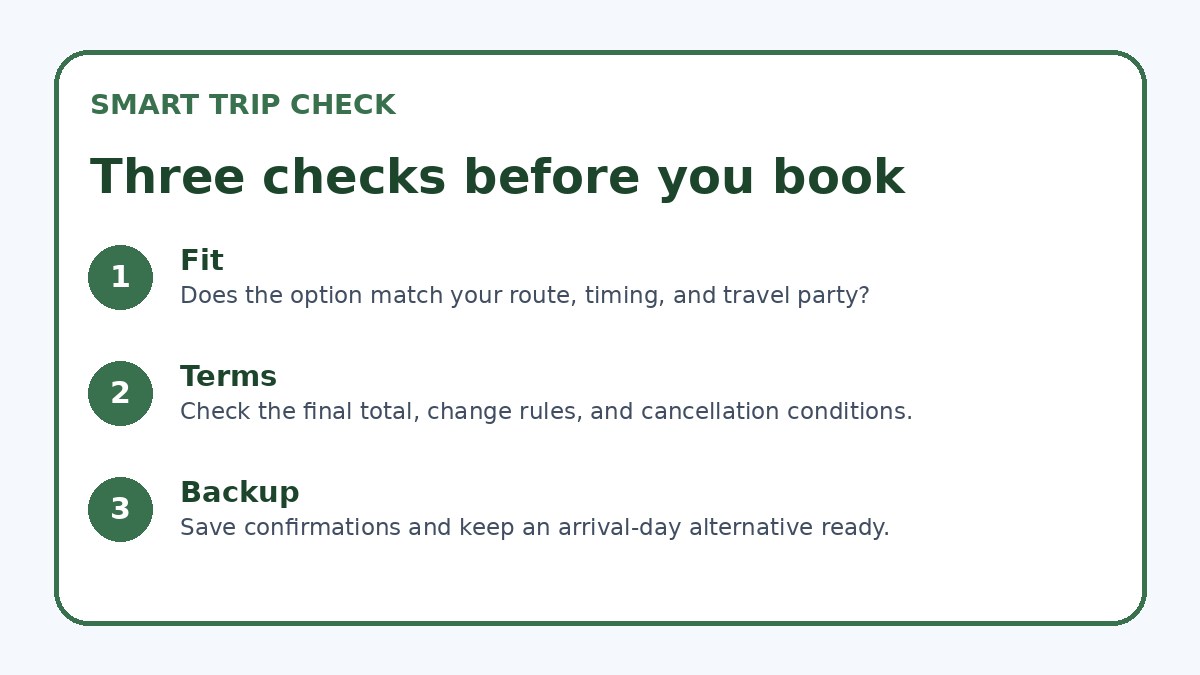
Before booking, gather the relevant pages or summary documents for your personal auto policy and any credit-card benefits that claim to cover rentals. Look for three specific things in each: exclusions (for example, drivers under a certain age or international use), claim procedure (whether you must pay up front and seek reimbursement), and covered costs (loss of use, towing, administrative fees, and legal defense). If your household policy lists geographic limits, make sure Quebec and intra-Canada rentals are permitted. Credit-card coverage often applies only when you use the card to pay the full rental cost, and many cards exclude certain vehicle classes or long-term rentals.
When the rental company’s booking page lists coverage, match the wording line by line to your documents. If the rental agreement requires you to file the claim with the rental firm first, or to obtain a police report for certain incidents, that process needs to be feasible while traveling with children. If you find gaps or conflicting instructions, contact both your insurer and the credit-card benefits administrator and ask them: do you cover this specific rental type in Quebec, and how will reimbursement work? Ask for clear written confirmation if the answer affects your purchase decision.
Before you book
- Save or print the rental company’s full insurance wording and confirmation PDF before leaving home.
- Confirm every intended driver’s name and age appear on the reservation as 'authorized drivers'.
- Compare the rental wording to your home auto policy and credit-card benefits, focusing on exclusions, deductibles, and territory.
- Ask the rental company in writing whether loss-of-use, towing, and administrative fees are included in any waiver.
- Verify the claimed claim procedure (police report, timeframes, and local phone numbers) will be practical during family travel.
- Take photos of the vehicle at pickup and drop-off and keep dated records to support any future dispute.
What to verify on the rental company’s final booking page
When you reach the final booking page or the email confirmation, verify the exact wording of coverages and the prices for optional products. Confirm driver names and ages, listed extras like child seats or GPS, and the specific product names for waivers and assistance. Note any references to provincial rules or insurers; if the company lists a third-party insurer, ask for that insurer’s policy number or a downloadable policy. Take screenshots or save the confirmation PDF. If the page mentions exclusions (for example, 'not covered: windscreen and tires'), treat that as binding unless changed at pickup in writing.
Also verify the damage reporting and claim process stated on the confirmation: who to call, whether a police report is required for certain claims, and whether the rental company will charge a hold on your card for the deductible amount. If the confirmation lists a damage deposit or pre-authorization amount, calculate whether your card limit can accommodate it alongside other holds. Finally, check cancellation and amendment terms; if plans change with children, a flexible booking and clear refund or modification rules reduce stress.
Frequently asked questions
Does provincial law in Quebec require rental companies to include liability coverage?
Provincial rules affect how liability is presented, but rental wording varies by company. Many rentals include a minimum liability component to meet local rules, yet limits differ and additional coverage can be offered for higher limits or legal defense. Do not assume the included amount will cover serious third-party claims; check the confirmation for explicit monetary limits and whether the rental firm names the insurer. If you’re unsure, ask the rental company to spell out the liability limit in writing and verify whether your personal umbrella policy or credit card would step in.
Can a family rely entirely on a credit card’s rental coverage in Montreal?
Possibly, but only if the card’s terms match your situation: you must usually pay the rental with that card and accept any listed vehicle-class or territorial restrictions. Many cards provide secondary coverage, requiring you to file with your personal insurer first; some premium cards offer primary coverage. Check the cardholder agreement for exclusions like van or large-SUV rentals, drivers under a certain age, or long-term rentals. Request a benefits summary from your card issuer, and confirm whether the coverage applies specifically to rentals in Quebec.
What should families do at the rental counter to avoid disputes later?
At pickup, inspect the car thoroughly with a staff member and point out any scratches, dents, or interior marks; get the agent to initial or note them on the rental agreement and take timestamped photos. Confirm which products were added and the exact names used on the contract for CDW/LDW, liability, and roadside assistance. Ask what to do and whom to call in the event of an incident, whether a police or incident report is required, and whether any immediate holds will be placed on your card. Keep all receipts and the rental agreement until any deposit holds are cleared.
Final planning note
Families renting a car in Montreal benefit most from reading insurance wording with scenarios in mind: who will drive, where you’ll go, and what interruptions would cost you. Start by checking liability limits, the precise scope of any CDW/LDW, and how extras like roadside assistance and loss-of-use are handled. Match those clauses against your home auto policy and any credit-card benefits, and get written confirmation of anything that affects coverage. At pickup, document the vehicle and confirm authorized drivers; when in doubt, a modest additional waiver or third-party policy can simplify claims and reduce stress during family travel. Before you click 'confirm', save the booking wording and ensure your payment card can handle any holds.
Continue planning
Check current options and final conditions
Use the provider page to confirm live availability, the final total, cancellation terms, and every condition that matters to your trip.
This evergreen planning guide was created with AI-assisted drafting and a structured quality review. It does not display live prices, schedules, availability, visa guidance, or provider rankings. Verify current details before booking. Some links are affiliate links; we may earn a commission at no additional cost to you.