Practical answer up front: set targeted price alerts only for flights and hotels that match your baggage needs, then freeze spending decisions with a short checklist before booking. For travelers carrying extra luggage—sports gear, musical instruments, or oversized bags—alerts can save money but also tempt quick bookings that ignore baggage fees, connection times, and airport transfers. Start by identifying two or three flights or accommodations that meet your luggage constraints (carry-on limits, checked-bag size and weight, ground transport accessibility). Create alerts limited to those exact itineraries or room types, and set a secondary alarm for baggage policy review. Use a short waiting period—24 to 72 hours—before you finalize to compare total out-the-door costs, not just headline fares.
See current options before you compare the details
Availability and final conditions change. Open Trip.com now or keep reading for the practical comparison.
Set alerts that reflect your true baggage costs
Price alerts are only useful if they track the fares you can actually use with your luggage. Rather than monitoring broad routes or generic hotel deals, filter alerts for the fare class or room type that includes the baggage allowance you need, or that allows you to add the specific checked items you’ll carry. For flights, that means selecting an economy fare that either includes at least one checked bag or allows you to purchase a predictable baggage add-on. For hotels, choose room types that have clear luggage handling or elevator access notes if you’re hauling large cases or equipment.
Avoid registering for generic route alerts that show the lowest base fares; those often omit baggage and ancillaries and create misleading comparisons. Use alert fields to capture departure/arrival airports, minimum baggage allowance, and desired connection characteristics (for example, single-connection itineraries to protect checked items from tight layovers). Where tools don’t allow baggage filters, create alerts only for airlines you’ve pre-checked for baggage policy clarity and reputational reliability handling oversized luggage.
Evaluate total out-the-door cost before any impulse booking
When an alert pings, pause to calculate the true total price: base fare or room rate plus baggage fees, seat selection, carry-on rules, ground transfers, and any special handling for oversized items. For Los Angeles, factor in airport transfers (LAX is large and spread out, and transfer options vary by terminal), parking if you’re driving, and whether your hotel or rental requires extra fees for oversized luggage storage. For rentals and long stays, luggage transport and storage during activities can add unexpected costs—budget for those likewise.
Tradeoffs matter: a slightly higher fare that includes a checked bag and a convenient arrival terminal might save money and stress compared with a low headline fare that adds fees and forces awkward transfers. Compare direct flights versus one-stop options if both are available—directs reduce the risk of delayed connections and the hassle of moving oversized bags between terminals. Always verify the provider’s baggage rules and any ancillary charges on the final booking page before clicking confirm; policies and fees can change between alert creation and purchase.
| Approach | Best for | Tradeoff to check |
|---|---|---|
| Aggressive alerting (monitor many routes/fares) | Travelers flexible with luggage and schedules who prioritize lowest fare opportunities. | High chance of impulse booking and hidden baggage or transfer costs that erode savings. |
| Targeted alerting (filtered by baggage-friendly fares) | Travelers with extra luggage who want relevant bargains without surprise fees. | Fewer alerts and possibly fewer headline bargains, but clearer total cost comparisons. |
| Single-option lock (one itinerary/hotel watched closely) | Travelers with fixed luggage needs or tight transfer preferences seeking clarity. | Misses broader market movement; may pay slightly more but reduces booking stress. |
| No-alert manual watch | Travelers who prefer deliberate comparison and phone confirmations before booking. | Requires more time and effort; risks missing short sales unless you check frequently. |
Ready to check the option that fits your plan?
Use your exact dates and traveler details so the provider page can show the current total and conditions.
Decision triggers and a short cooling-off routine
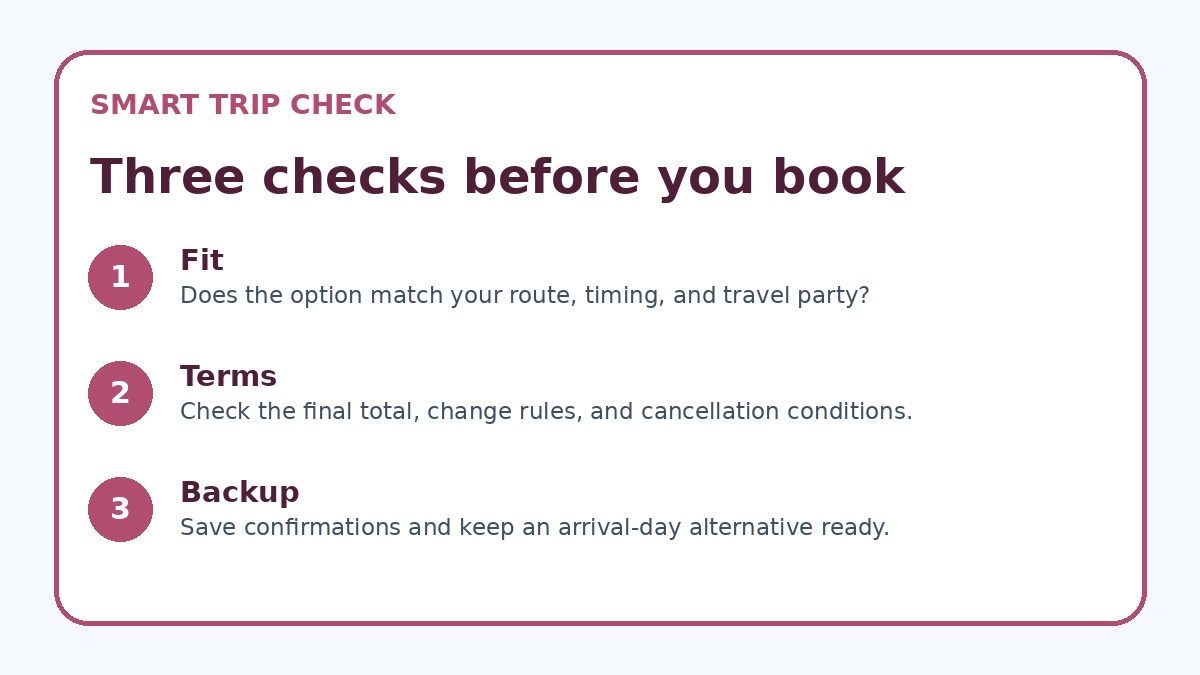
Set simple decision triggers that determine whether an alerted deal is bookable for you. Example triggers: the total price with one checked bag is within your target budget; the itinerary has at least 60–90 minutes for domestic connections and 120+ minutes for international ones; the arrival terminal has easy ground transport options to your neighborhood. If an alert meets all your triggers, proceed; if not, add the alert to a secondary watch list for reevaluation. This keeps you from snapping up deals that look good at first glance but cost more in time, hassle, or last-minute fees.
Institute a mandatory cooling-off period after an alert fires—24 to 72 hours depending on how soon you need to travel. Use that time to call the airline or hotel to confirm baggage handling and storage details on the provider’s official booking page, check recent traveler reports for transfer times at your arrival airport, and compare one or two vetted alternatives. If the deal remains the best match after this routine, book it. If not, let the alert expire and repeat the process with fresh criteria.
Before you book
- Create alerts only for flights and rooms that explicitly meet your luggage allowance or handling needs.
- When an alert triggers, calculate the total cost including all baggage and transfer fees before considering booking.
- Call the airline or property if baggage policy language is unclear, and confirm details on the final booking page.
- Use a 24–72 hour cooling-off period after an alert to compare alternatives and verify logistics.
- Check arrival terminal and ground transfer options for Los Angeles to ensure smooth handling of oversized luggage.
- If booking car rental, verify trunk capacity and any extra equipment needs on the rental company’s booking page.
Protect yourself: what to verify on booking pages
Before you commit, verify the exact baggage allowances, weights, dimensions, and fees on the carrier or property’s final booking page—do not rely on summary text from an alert. Confirm the fare class and whether that fare permits refunds, free changes, or only travel credits; understand the timing and cost to add another checked bag if your pack ends up heavier. If you have unusual items (sports equipment, musical instruments, fragile gear), check special handling rules and whether advance notice or booking of space is required.
For ground logistics, confirm where you’ll arrive at Los Angeles (which terminal) and how you’ll reach your accommodation with bulky luggage. Verify whether the hotel offers luggage drop or elevator access and whether local rideshare or shuttle vehicles can accommodate oversized items. If you plan to rent a car, check trunk capacity expectations on the rental page and whether additional drivers, insurance, or equipment (roof racks, bike mounts) will be needed and how that affects total cost.
Frequently asked questions
How do I pick which alerts to set when traveling to Los Angeles with oversized bags?
Start by listing non-negotiables: minimum checked-bag weight allowance, acceptable number of connections, and preferred arrival airports or terminals in Los Angeles. Set alerts only for itineraries and airlines that meet these criteria or that allow a simple paid upgrade to the necessary baggage allowance. For hotels, pick properties with clear luggage handling, elevator access, and close transport links. Limiting alerts to these matching parameters reduces noise and prevents impulse purchases that won’t accommodate your luggage.
If an alert price looks great but baggage rules are unclear, what should I do?
Don’t book immediately. Use the cooling-off period to open the provider’s final booking page and read the full baggage policy there. If still unclear, call the airline or hotel and ask for written confirmation of baggage allowances and any special handling rules for oversized items. Include time to check transfer logistics and vehicle space for rideshares or shuttles. If confirmation is not possible or satisfactory, treat the alert as informational rather than actionable.
Should I prefer direct flights to Los Angeles when carrying extra luggage?
Direct flights reduce the number of times baggage is transferred, lowering the risk of delays or damage—this can be worth a higher fare for large or fragile items. However, some connecting itineraries include better baggage allowances or significantly lower total costs even after fees. Compare the full trip cost, connection times, and how terminals handle checked items. If a connecting option leaves minimal layover time or requires moving between distant terminals, a direct flight is usually the more reliable choice.
Final planning note
Price alerts can be powerful helpers for Los Angeles travel deals, but only when they are disciplined and built around your luggage realities. Treat alerts as signals to run a rapid but thorough check of total out-the-door costs—baggage fees, transfer logistics, and any special handling needs—rather than as triggers to buy immediately. Use targeted alerts, a short cooling-off routine, and verification on the provider’s booking page to avoid impulse choices that cost more in time or hassle. With a few simple rules and a focus on total cost and logistics, you can capture good deals for Los Angeles without compromising your extra-luggage needs.
Continue planning
Check current options and final conditions
Use the provider page to confirm live availability, the final total, cancellation terms, and every condition that matters to your trip.
This evergreen planning guide was created with AI-assisted drafting and a structured quality review. It does not display live prices, schedules, availability, visa guidance, or provider rankings. Verify current details before booking. Some links are affiliate links; we may earn a commission at no additional cost to you.