Practical answer first: for most couples wanting a relaxed, romantic, flexible trip, drive if you want privacy, scenic stops and full control; take a daytime intercity train if you prefer to sit together, read, and enjoy coastal views without driving; fly if your priority is shaving travel time and you accept airport transfers and less together-time. Los Angeles to San Francisco transport decisions hinge on priorities: intimacy and flexibility, ease and comfort, or speed. Think about how you like to spend travel hours together — talking, stopping for views, or maximizing destination time. Later sections compare tradeoffs (cost vs convenience, scenic value vs speed), outline booking checks, and give a short checklist so you can pick the option that fits your relationship’s travel style and practical constraints.
See current options before you compare the details
Availability and final conditions change. Open Trip.com now or keep reading for the practical comparison.
How to weigh privacy, time, and shared experience
Couples often make tradeoffs among privacy (being alone together), total door-to-door time, and the quality of time spent traveling. Driving puts you in a private bubble where conversation, playlists, and detours are entirely yours, but it also means one partner will drive while the other supervises navigation or relaxes. Trains and flights let both partners be present without one person driving; trains especially keep you together in a shared cabin environment where you can move around, stretch, and sit facing one another if seats permit.
When comparing options, focus on door-to-door time rather than just in-vehicle time. Flying may be the fastest in the air, but add the time for airport transfers, check-in, security, and possible waits for luggage. Trains often deliver city-center to city-center service, which can be more convenient for walking into neighborhoods and hotels. Driving gives total control over schedule but includes highway time and parking search at both ends—factor those into your planning so you’re choosing based on real usable time together.
Scenery, stops, and the romantic route choices
If scenery and spontaneous stops are big for you as a couple, choose the route and mode that maximize views and pull-over options. Driving the coast or scenic highways lets you plan side trips to overlooks, small towns, and beaches; you can build a route that becomes part of the trip itself. Trains may follow routes with coastal or countryside views, offering photographable moments and the comfort of moving between viewpoints without the stress of driving. Think about whether you prefer to experience views together while moving or to stop and explore on foot.
For a romantic trip, consider where you want to spend most of the couple-time: in transit, walking a beach, or in cafes. If stops matter, map key pullovers or towns you both want to visit and see which mode supports them. When comparing options, list the must-see stops and ask whether they lie on the driving route, along a rail line, or require a detour from airports. That inventory will quickly show which transport option supports the kind of shared memories you’re aiming to create.
| Approach | Best for | Tradeoff to check |
|---|---|---|
| Drive together in a rented or personal car | Couples valuing privacy, flexible stops, and carrying extra luggage | One driver handles navigation and fatigue; parking and city driving add complexity |
| Daytime intercity train | Couples wanting low-effort shared travel and scenic views | Less control over schedule and stops; verify connections and baggage limits |
| Flight between cities | Couples with limited vacation time prioritizing speed | Airport procedures and transfers reduce usable together-time |
| Mixed approach (fly one way, drive or train the other) | Couples balancing speed with scenic exploration | Higher coordination and potentially higher combined costs |
Ready to check the option that fits your plan?
Use your exact dates and traveler details so the provider page can show the current total and conditions.
Practical costs, luggage, and comfort considerations
Evaluate true costs beyond headline fares: fuel, tolls, parking, and possible one-way rental fees for cars; checked-bag charges, transfers, and parking for flights; and seat selection or sleeper options for trains. For couples traveling with more luggage, a car can simplify handling and let you carry bikes or bulky items without extra fees. Trains and planes have baggage rules that vary; always confirm allowances, restrictions, and any additional fees on the provider’s booking page before committing.
Comfort matters: if either partner gets motion sickness, long drives might be less comfortable than a train where walking is possible. If you value private space and uninterrupted conversation, a car or private rides may be preferable. Trains often have cafés, restrooms, and the chance to move around; flights are shorter but more confined. Before booking, verify seat types, legroom, and onboard amenities directly with the operator so you know whether seating configurations match how you like to travel together.
Before you book
- Decide top priority: privacy/flexibility, scenic shared time, or fastest travel; write it in one line to guide choices.
- Estimate door-to-door time for each option including transfers, check-in, and parking to compare real usable time together.
- List must-see stops or activities; map them against each transport option to ensure route compatibility.
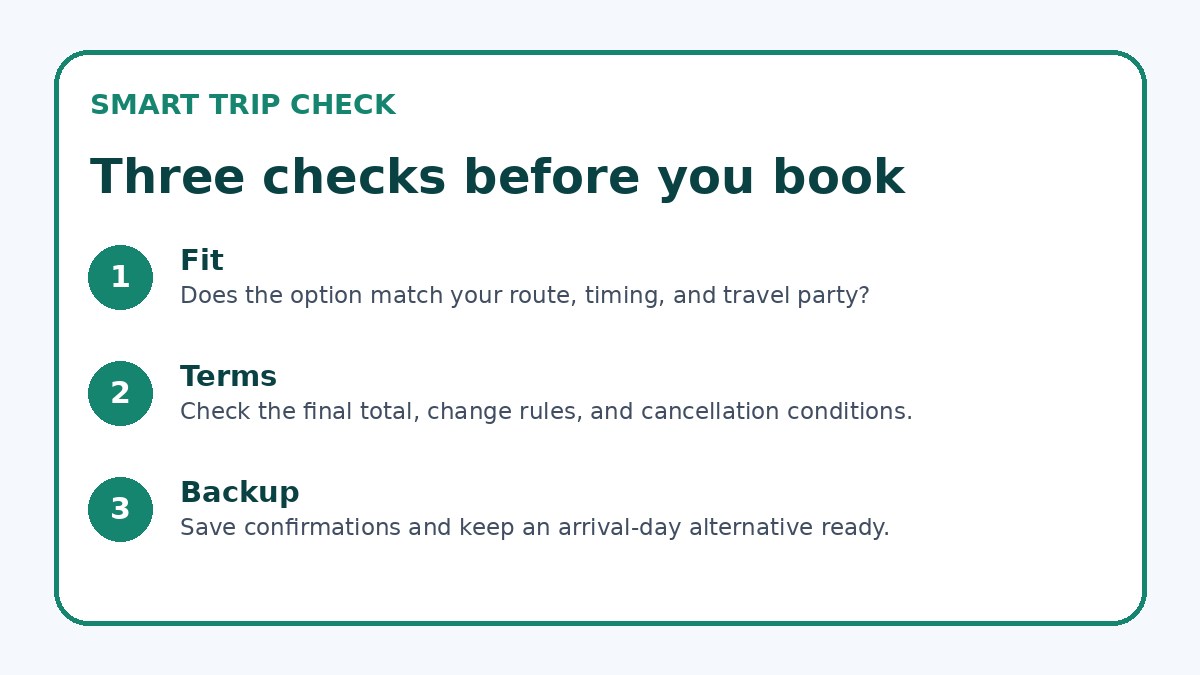
- Check baggage rules, seat selection, and change/cancellation terms on the operator’s booking page before purchasing.
- If driving, confirm rental company one-way policies, insurance options, and parking availability at your destination.
- If choosing train or flight, verify whether services are direct or require connections and plan buffer time for transfers.
Booking strategy and what to verify before you commit
Once you narrow to a mode, compare real-world door-to-door times, luggage rules, cancellations, and change policies. For trains and flights check whether schedules are direct or require connections; for drives check road and parking conditions at both endpoints. Provider policies and schedules can change—always verify exact departure and arrival locations, baggage allowances, seat selection options, and cancellation/change terms on the provider’s final booking page. Trip.com can be used once to compare availability or pricing but verify the operator’s page before finalizing.
Also confirm where you’ll start and end the journey in each option: which airport terminals or rail stations, and whether that requires extra transfers. For car travel, decide whether you want a one-way rental or a round-trip plan and check pick-up/drop-off policies. Build a simple time-and-cost spreadsheet for each option showing transfer times, probable parking or transfer fees, and how many hours you’ll actually spend together — that practical comparison often makes the best choice obvious.
Frequently asked questions
Is it better for couples to drive or take the train between Los Angeles and San Francisco?
It depends on what you want from the trip. Driving offers privacy and full control over stops and schedule, ideal if you want roadside detours and tailored pacing. Trains let both partners relax, move around, and share scenic views without one person driving, making them a low-effort romantic choice. Compare door-to-door time, parking or transfer logistics, and whether your must-see stops require a car. Use those factors to pick the mode that matches how you want to spend time together.
How should couples factor luggage and comfort into their transport choice?
Luggage and comfort can tilt the decision quickly. A car handles bulky items and multiple bags without extra fees, while trains and flights enforce baggage limits and sometimes charge for checked items. Comfort issues like motion sickness, need to move around, or desire for onboard amenities favor trains. Before booking, check the operator’s baggage policies, seat comfort options, and restroom/food availability so you’re confident both partners will be comfortable for the full journey.
Can couples mix modes to get the best of both speed and scenic travel?
Yes—mixing modes is a practical strategy: fly one way to save time and drive or take a train the other way to enjoy scenery and stops. This requires more coordination, such as arranging one-way car rentals or ensuring train schedules align with your return. Account for extra coordination time and potentially higher combined costs. Verify all pick-up, drop-off, and transfer details on provider pages to avoid surprises and to confirm connections between different transport legs.
Final planning note
Choosing the best Los Angeles to San Francisco transport for couples comes down to how you prioritize privacy, shared experience, and time. If you want control and scenic detours, driving together wins; if you prefer low-effort shared time with room to relax and enjoy views, consider a daytime train; if time is the scarcest resource, evaluate flights while factoring in airport transfers. Make a simple comparison of door-to-door time, luggage rules, and must-see stops, and verify schedules and policies on providers’ booking pages before you buy. With that checklist in hand, you’ll pick the option that fits both your travel style and practical constraints.
Continue planning
Check current options and final conditions
Use the provider page to confirm live availability, the final total, cancellation terms, and every condition that matters to your trip.
This evergreen planning guide was created with AI-assisted drafting and a structured quality review. It does not display live prices, schedules, availability, visa guidance, or provider rankings. Verify current details before booking. Some links are affiliate links; we may earn a commission at no additional cost to you.